
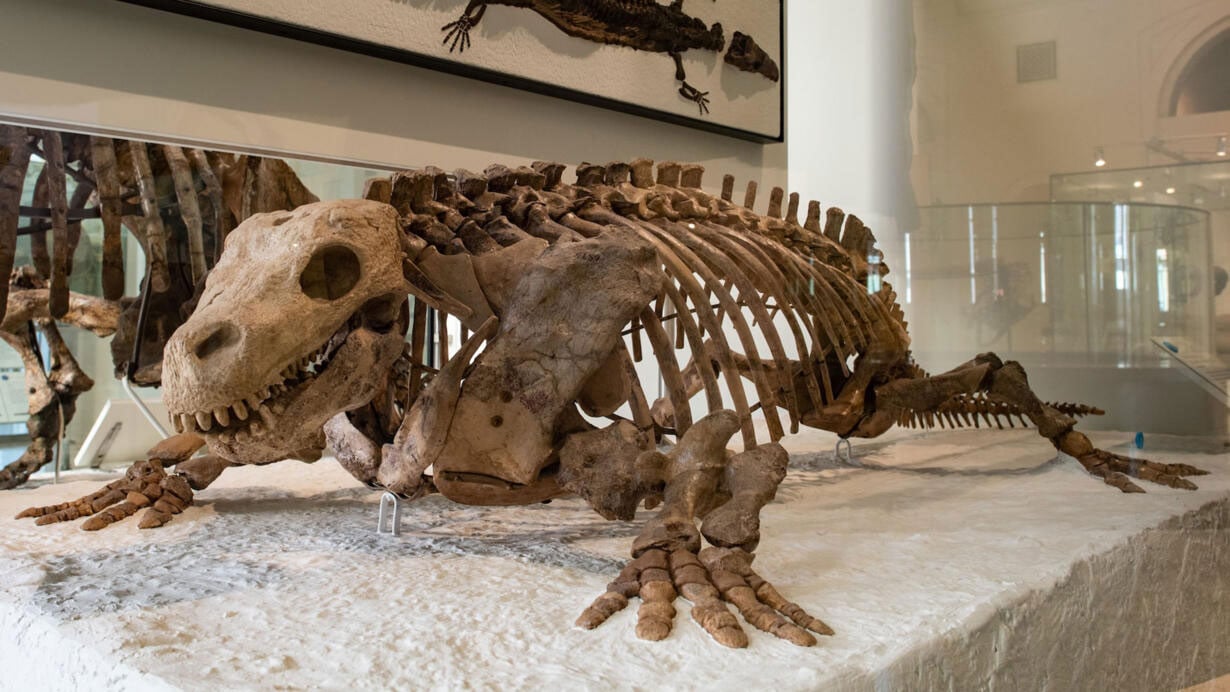
A famous Scottish fossil is forcing scientists to rethink what claw-like feet really reveal about the move onto land.
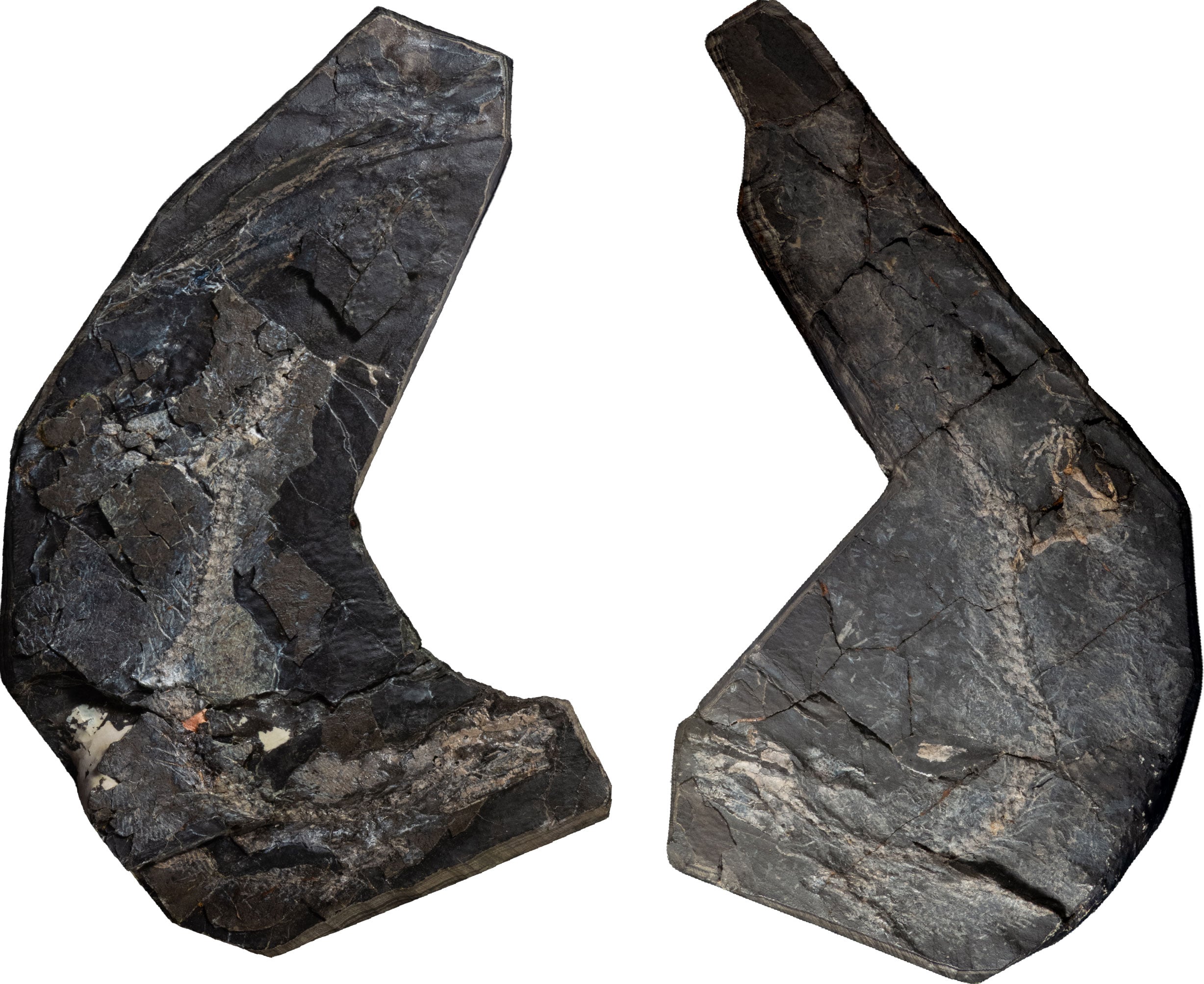
Pressed flat inside two slabs of Scottish rock, a 345-million-year-old skeleton seemed to carry some unmistakable signs of life on land. Its four limbs ended in five-digit feet, and the tips of its fingers and toes looked strikingly like claws. For decades, those features helped make Westlothiana lizziae, better known as “Lizzie,” a landmark in the story of how vertebrates moved away from water and gave rise to reptiles, birds, and mammals. Yet the fossil had been crushed so badly that much of its anatomy remained hidden inside the stone.
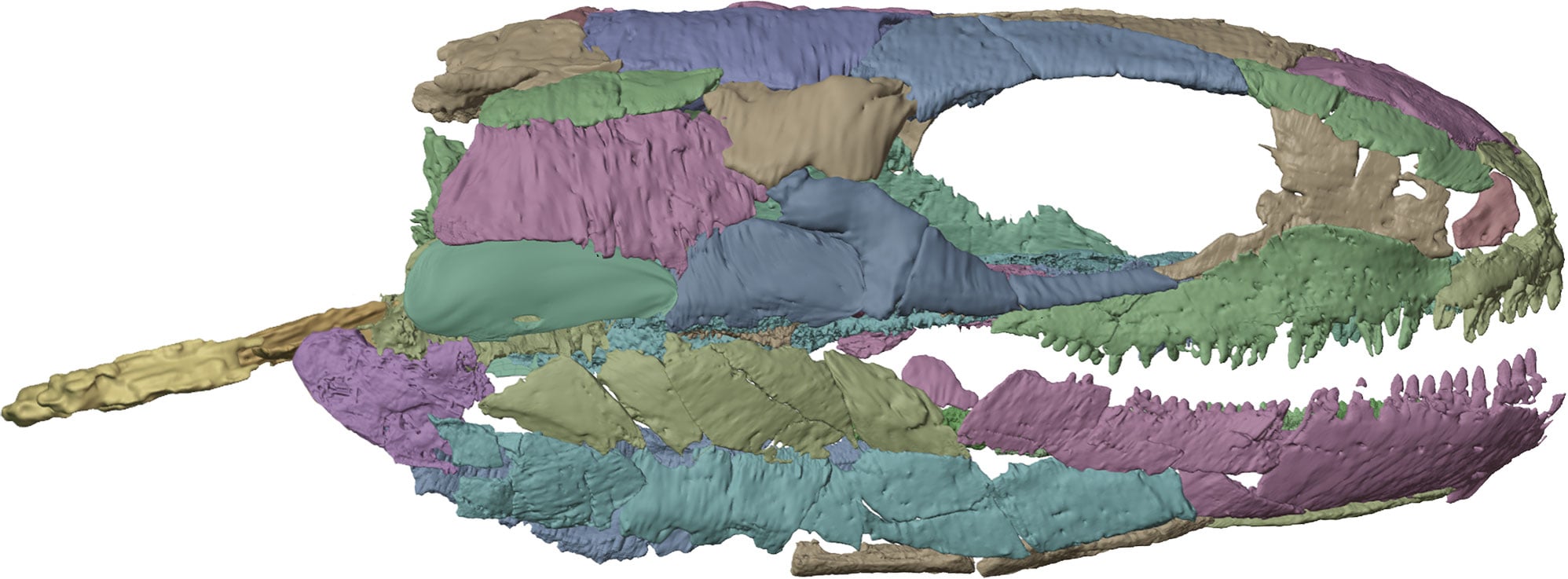
Peering through that rock with X-rays has now exposed a very different animal. Researchers from the American Museum of Natural History and the University of Oxford, working with the European Synchrotron Radiation Facility in Grenoble, France, reconstructed structures that could not be seen from the fossil’s surface. Their results, published in Nature, revealed a primitive skull, ossified internal gills, and a fish-like mouth packed with thousands of tiny teeth.
“Lizzie has been an icon for the early evolution of amniotes for decades,” said Xavier Jenkins, a postdoctoral fellow in the Museum’s Division of Paleontology and co-lead author of the study. “But when we were finally able to see inside the fossil, we found an animal that looked very different from what we expected.”
Reptile-like feet built Lizzie’s reputation
Discovered in Scotland in 1984 and formally described in 1990, Westlothiana had initially been interpreted largely from the anatomy exposed on the surfaces of its two slabs. Its nearly complete skeleton stood apart from many animals living around the same time because its limbs looked more suited to supporting a body than the more fin-like appendages seen in some early tetrapod relatives.
Those visible feet helped secure Lizzie’s reputation as an early amniote, the branch of vertebrates that eventually produced reptiles, birds, and mammals. Researchers repeatedly used the fossil as an important reference point when estimating when animals with fully land-adapted lifestyles began appearing.
Hidden gills overturn the reptile label
Inside Lizzie’s skull, however, the synchrotron scans uncovered features that do not fit that interpretation. The internal gills and tooth-filled, fish-like mouth instead place the animal on a much older branch of the tetrapod family tree and indicate that it was aquatic or amphibious rather than a fully terrestrial reptile ancestor.
“The surprisingly primitive features of the skull show us that Lizzie was not only not a reptile but belonged to a much more ancient lineage. It turns out looks can be deceiving, and Lizzie lived a completely different lifestyle than we previously thought,” said Ben Igielman, co-lead author of the study, who started this research during his graduate work at the University of Oxford.
Keeping those reptile-like feet creates another surprise. Five toes, claw-like tips, and limb structures once treated as hallmarks of land-adapted amniotes were apparently already present in more ancient members of the stem lineage leading toward tetrapods. In other words, some pieces of the body plan associated with later land animals evolved before the animals carrying them had fully left the water behind.
“This is a big surprise,” said study co-author Roger Benson, the Museum’s Macaulay Curator of Paleontology. “It shows that, although we think of amphibians as being more ‘primitive’ than reptiles today, some of the traits of reptiles were already there in the ancestor of both amphibians and reptiles.”
Clawed tracks no longer identify amniotes
Claw-shaped impressions preserved in still older fossil trackways may now need the same kind of caution. Some tracks dating to the Devonian Period, more than 359 million years ago, have been interpreted as evidence that amniotes had already evolved because they record four-limbed animals walking on claw-like digits.
If creatures as primitive as Westlothiana could also possess claw-like structures, those tracks no longer provide a simple fingerprint of an amniote. Some may instead have been left by amphibious tetrapod relatives that carried land-like anatomical features while still dividing their lives between water and shore.
“The broader lesson is that terrestrial-looking traits, such as a reptile-like foot, a weight-bearing forelimb, and claw-like phalanges were not unique features of tetrapods, but rather accumulated piecemeal in their close relatives, in animals that were still living in and out of the water,” Jenkins said.
Reference: “Evolution of terrestrial anatomy revealed by a derived stem tetrapod” by Ben Igielman, Xavier Jenkins, Jason Head, Vincent Fernandez, Lucy Roberts, Timothy Smithson and Roger Benson, 30 September 2026, Nature.
DOI: 10.1038/s41586-026-11090-6
Support for this study was provided by the National Science Foundation (grant number EAR-PF 2518154), the National Environment Research Council (grant numbers NE/S000739/1, NE/W007576/1, and NE/L002507/1), and the Biotechnology and Biological Sciences Research Council (grant number BB/X014819/1).
Never miss a breakthrough: Join the SciTechDaily newsletter.
Follow us on Google and Google News.