
New study suggests that hard eggshells evolved at least three times in dinosaur family tree.
New research suggests that the first dinosaurs laid soft-shelled eggs — a finding that contradicts established thought. The study, led by the American Museum of Natural History and Yale University and published on June 17, 2020, in the journal Nature, applied a suite of sophisticated geochemical methods to analyze the eggs of two vastly different non-avian dinosaurs and found that they resembled those of turtles in their microstructure, composition, and mechanical properties. The research also suggests that hard-shelled eggs evolved at least three times independently in the dinosaur family tree.
“The assumption has always been that the ancestral dinosaur egg was hard-shelled,” said lead author Mark Norell, chair and Macaulay Curator in the Museum’s Division of Paleontology. “Over the last 20 years, we’ve found dinosaur eggs around the world. But for the most part, they only represent three groups — theropod dinosaurs, which include modern birds, advanced hadrosaurs like the duck-bill dinosaurs, and advanced sauropods, the long-necked dinosaurs. At the same time, we’ve found thousands of skeletal remains of ceratopsian dinosaurs, but almost none of their eggs. So why weren’t their eggs preserved? My guess — and what we ended up proving through this study — is that they were soft-shelled.”
Amniotes — the group that includes birds, mammals, and reptiles — produce eggs with an inner membrane or “amnion” that helps to prevent the embryo from drying out. Some amniotes, such as many turtles, lizards, and snakes, lay soft-shelled eggs, whereas others, such as birds, lay eggs with hard, heavily calcified shells. The evolution of these calcified eggs, which offer increased protection against environmental stress, represents a milestone in the history of the amniotes, as it likely contributed to reproductive success and so the spread and diversification of this group. Soft-shelled eggs rarely preserve in the fossil record, which makes it difficult to study the transition from soft to hard shells. Because modern crocodilians and birds, which are living dinosaur, lay hard-shelled eggs, this eggshell type has been inferred for all non-avian dinosaurs.
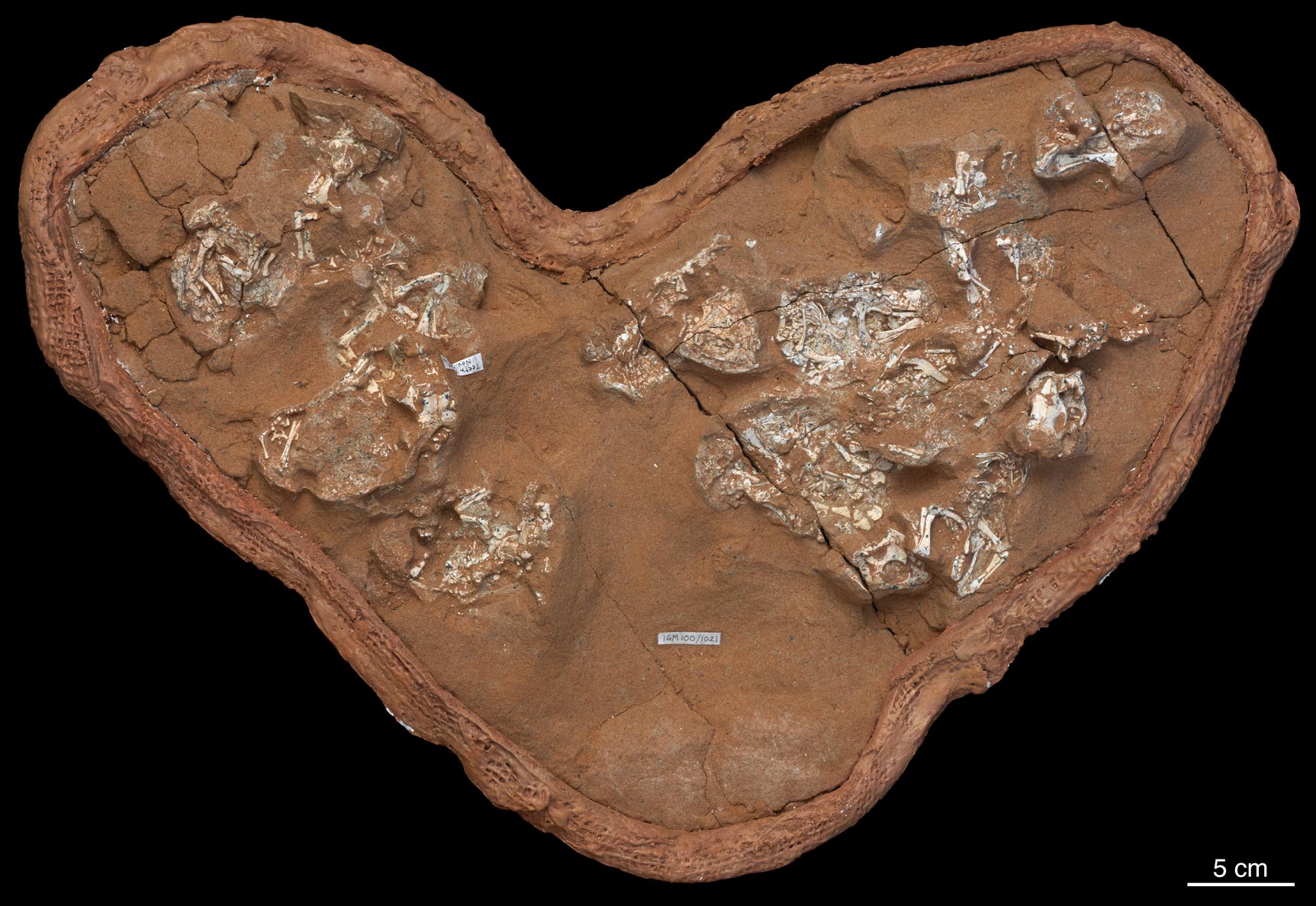
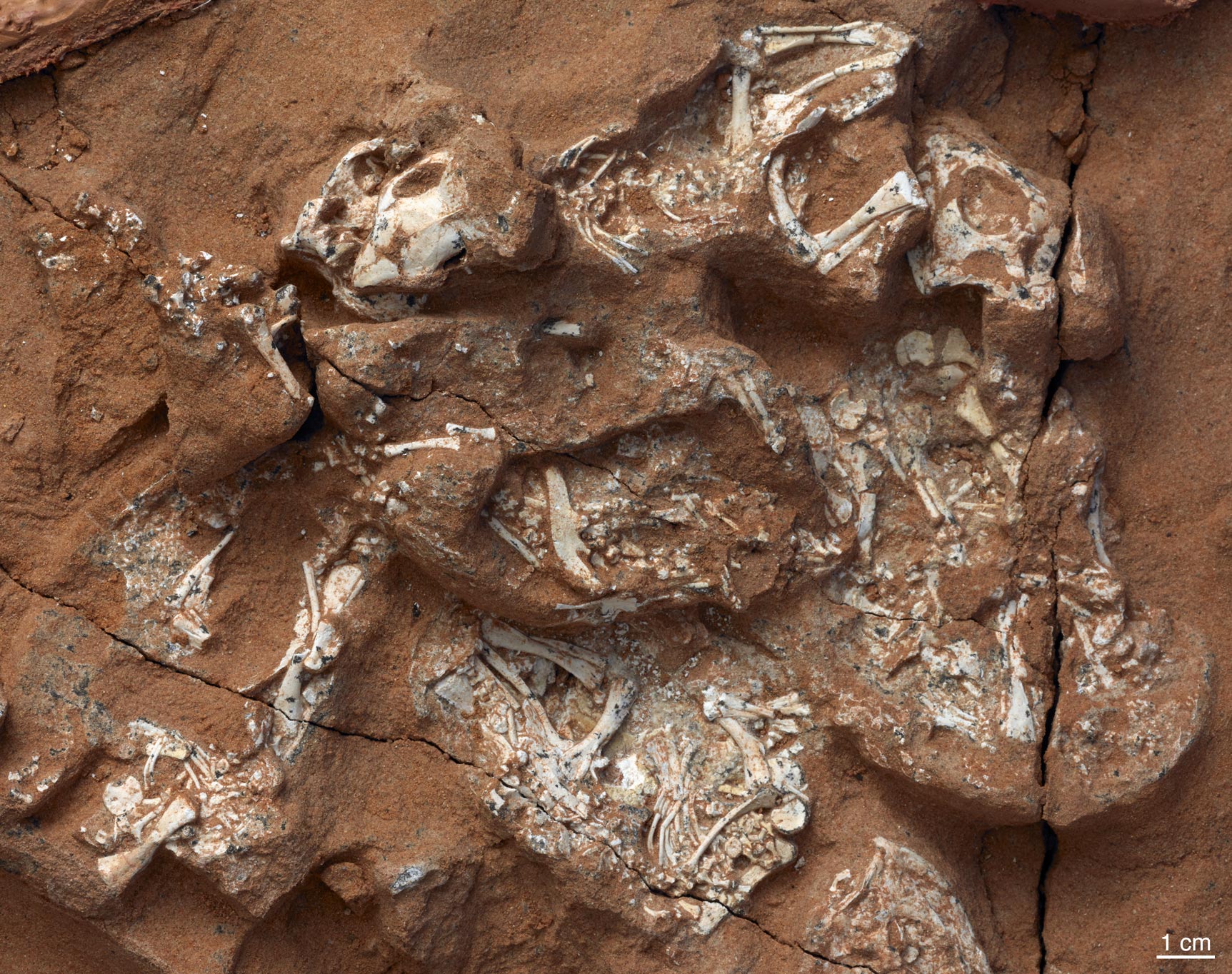
The researchers studied embryo-containing fossil eggs belonging to two species of dinosaur: Protoceratops, a sheep-sized plant-eating dinosaur that lived in what is now Mongolia between about 75 and 71 million years ago, and Mussaurus, a long-necked, plant-eating dinosaur that grew to 20 feet in length and lived between 227 and 208.5 million years ago in what is now Argentina. The exceptionally preserved Protoceratops specimen includes a clutch of at least 12 eggs and embryos, six of which preserve nearly complete skeletons. Associated with most of these embryos — which have their backbones and limbs flexed — consistent with the position the animals would assume while growing inside of the egg — is a diffuse black-and-white egg-shaped halo that obscures some of the skeleton.
In contrast, two potentially hatched Protoceratops newborns in the specimen are largely free of the mineral halos. When they took a closer look at these halos with a petrographic microscope and chemically characterized the egg samples with high-resolution in situ Raman microspectroscopy, the researchers found chemically altered residues of the proteinaceous eggshell membrane that makes up the innermost eggshell layer of all modern archosaur eggshells. The same was true for the Mussaurus specimen. And when they compared the molecular biomineralization signature of the dinosaur eggs with eggshell data from other animals, including lizards, crocodiles, birds, and turtles, they determined that the Protoceratops and Mussaurus eggs were indeed non-biomineralized — and, therefore, leathery and soft.

“It’s an exceptional claim, so we need exceptional data,” said study author and Yale graduate student Jasmina Wiemann. “We had to come up with a brand-new proxy to be sure that what we were seeing was how the eggs were in life, and not just a result of some strange fossilization effect. We now have a new method that can be applied to all other sorts of questions, as well as unambiguous evidence that complements the morphological and histological case for soft-shelled eggs in these animals.”
With data on the chemical composition and mechanical properties of eggshells from 112 other extinct and living relatives, the researchers then constructed a “supertree” to track the evolution of the eggshell structure and properties through time, finding that hard-shelled, calcified eggs evolved independently at least three times in dinosaurs, and probably developed from an ancestrally soft-shelled type.
“From an evolutionary perspective, this makes much more sense than previous hypotheses, since we’ve known for a while that the ancestral egg of all amniotes was soft,” said study author and Yale graduate student Matteo Fabbri. “From our study, we can also now say that the earliest archosaurs — the group that includes dinosaurs, crocodiles, and pterosaurs — had soft eggs. Up to this point, people just got stuck using the extant archosaurs — crocodiles and birds — to understand dinosaurs.”
Because soft eggshells are more sensitive to water loss and offer little protection against mechanical stressors, such as a brooding parent, the researchers propose that they were probably buried in moist soil or sand and then incubated with heat from decomposing plant matter, similar to some reptile eggs today.
Reference: “The first dinosaur egg was soft” by Mark A. Norell, Jasmina Wiemann, Matteo Fabbri, Congyu Yu, Claudia A. Marsicano, Anita Moore-Nall, David J. Varricchio, Diego Pol and Darla K. Zelenitsky, 17 June 2020, Nature.
DOI: 10.1038/s41586-020-2412-8
Other authors on this paper include Congyu Yu from the American Museum of Natural History; Claudia Marsicano from the University of Buenos Aires; Anita Moore-Nall and David Varricchio from Montana State University; Diego Pol from the Museum of Paleontology Egidio Feruglio, Argentina; and Darla K. Zelenitsky from the University of Calgary.
Never miss a breakthrough: Join the SciTechDaily newsletter.
Follow us on Google and Google News.
1 Comment
I have a soft tissue baby Triceratops could really use some help to get someone to study it before it dries out