
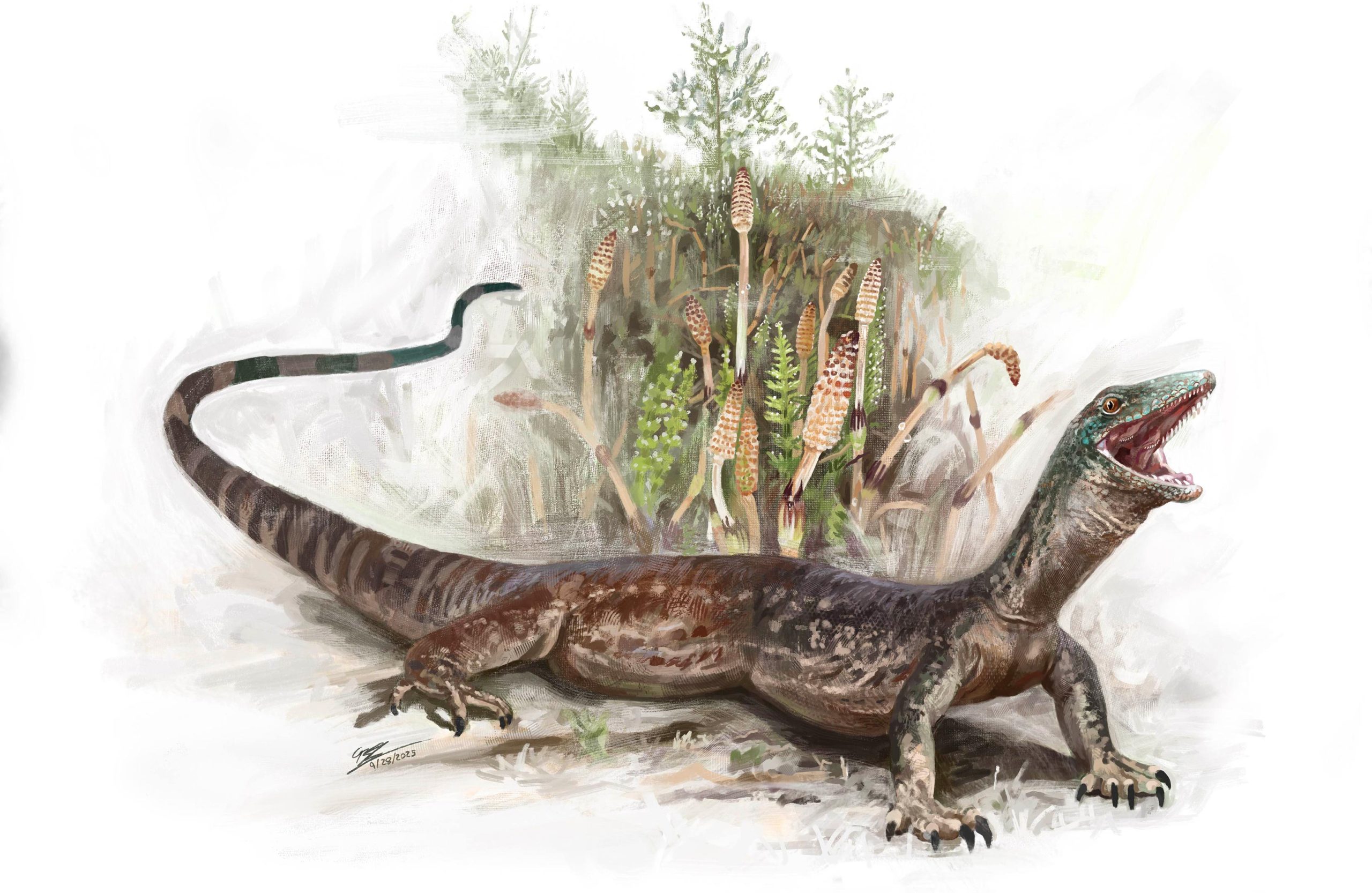
Scientists have discovered a strange Jurassic lizard on Scotland’s Isle of Skye that’s blurring the boundaries between snakes and lizards.
The 167-million-year-old species, Breugnathair elgolensis, Gaelic for “false snake of Elgol,” had snake-like jaws and curved teeth but a lizard’s body and limbs.
Ancient Lizard Discovery Blurs Evolutionary Lines
New research has uncovered a species of hook-toothed lizard that lived about 167 million years ago and has a confusing set of features seen in snakes and geckos—two very distant relatives. One of the oldest relatively complete fossil lizards yet discovered, the Jurassic specimen is described in a study, published on October 1 in the journal Nature, from a multinational collaboration between the American Museum of Natural History and scientists in the United Kingdom, including University College London and the National Museums Scotland, France, and South Africa.
The species was given the Gaelic name Breugnathair elgolensis meaning “false snake of Elgol,” referencing the area in Scotland’s Isle of Skye where it was discovered. Breugnathair had snake-like jaws and hook-like, curved teeth similar to those of modern-day pythons, paired with the short body and fully-formed limbs of a lizard.
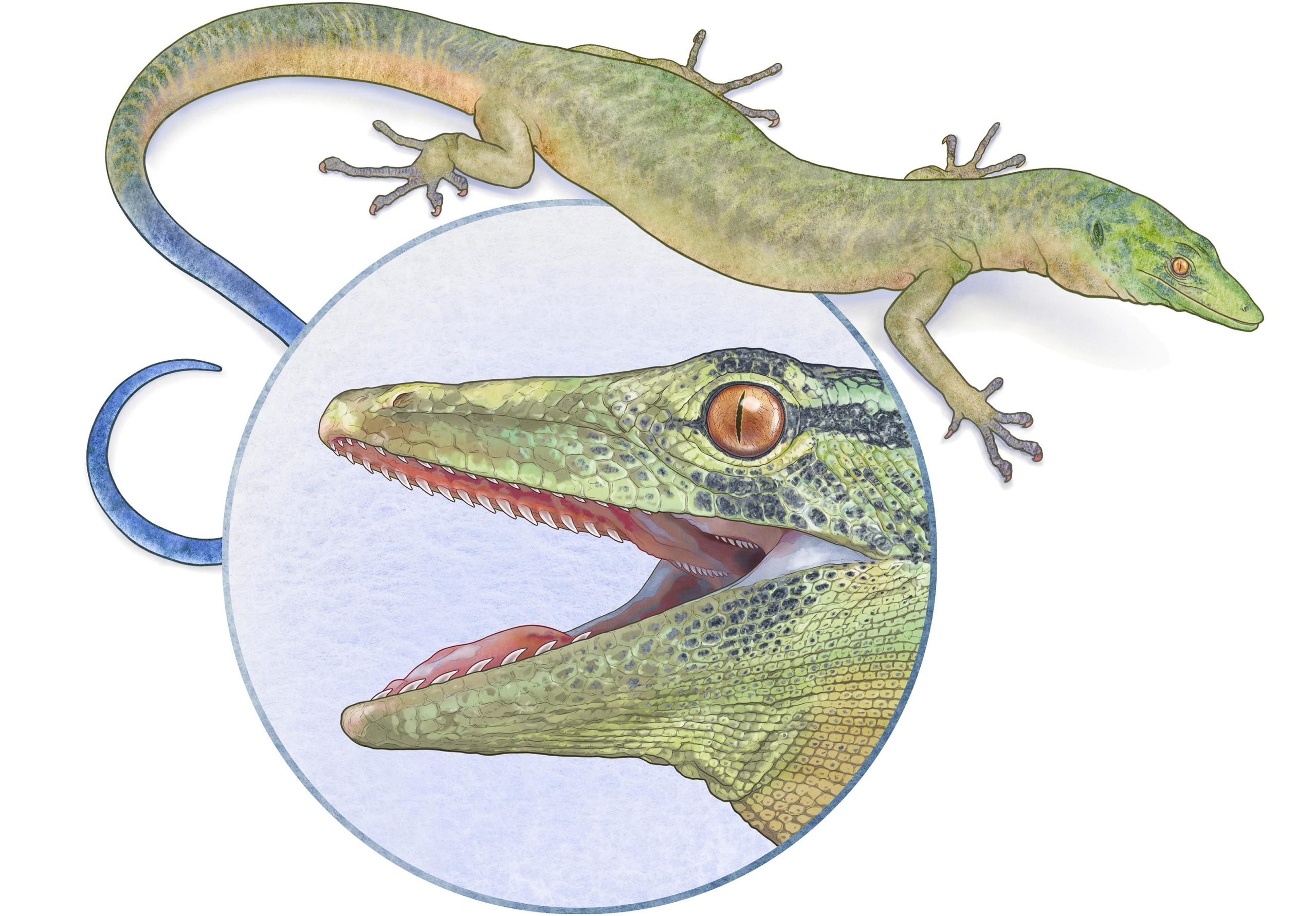
Snake-Like Jaws, Lizard-Like Body
“Snakes are remarkable animals that evolved long, limbless bodies from lizard-like ancestors,” said the study’s lead author Roger Benson, Macaulay Curator in the American Museum of Natural History’s Division of Paleontology. “Breugnathair has snake-like features of the teeth and jaws, but in other ways, it is surprisingly primitive. This might be telling us that snake ancestors were very different to what we expected, or it could instead be evidence that snake-like predatory habits evolved separately in a primitive, extinct group.”
Lizards and snakes together form a group called squamates. Breugnathair has been placed in a new group of extinct, predatory squamates called Parviraptoridae, which was previously known only from more fragmentary fossils. Earlier studies reported snake-like tooth-bearing bones that were found in close proximity with bones that had gecko-like features. But because these seemed so drastically different, some researchers believed they belonged to two different animals. The new work on Breugnathair rejects those earlier findings, showing that both snake-like and gecko-like features exist together in a single animal.
A Fossil Decade in the Making
Breugnathair was discovered in 2016 by Stig Walsh from the National Museums Scotland while on an expedition with Benson and others on the Isle of Skye. The researchers have spent almost 10 years since then preparing the specimen, imaging it with computed tomography as well as with high-powered x-rays at the European Synchrotron Radiation Facility in Grenoble, France, and analyzing the results.
“The Jurassic fossil deposits on the Isle of Skye are of world importance for our understanding of the early evolution of many living groups, including lizards, which were beginning their diversification at around this time,” said Susan Evans from University College London, who co-led the study. “I first described parviraptorids some 30 years ago based on more fragmentary material, so it’s a bit like finding the top of the jigsaw box many years after you puzzled out the original picture from a handful of pieces. The mosaic of primitive and specialized features we find in parviraptorids, as demonstrated by this new specimen, is an important reminder that evolutionary paths can be unpredictable.”
Predator of the Jurassic Ecosystem
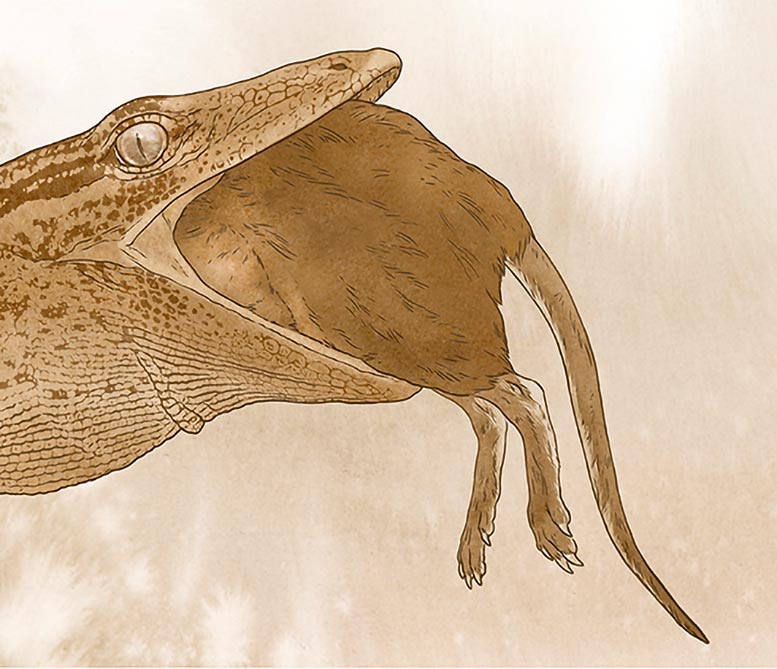
Nearly 16 inches long from head to tail, Breugnathair was one of the largest lizards in its ecosystem, where it likely preyed on smaller lizards, early mammals, and other vertebrates, like young dinosaurs. But is it a lizard-like ancestor of snakes? Because it has such an unusual mixture of features, and because other fossils that shed light on early squamate evolution are rare, the researchers did not arrive at a conclusive answer. Another possibility is that Breugnathair could be a stem-squamate, a predecessor of all lizards and snakes, that independently evolved snake-like teeth and jaws.
“This fossil gets us quite far, but it doesn’t get us all of the way,” Benson said. “However, it makes us even more excited about the possibility of figuring out where snakes come from.”
Reference: “Mosaic anatomy in an early fossil squamate” by Roger B. J. Benson, Stig A. Walsh, Elizabeth F. Griffiths, Zoe T. Kulik, Jennifer Botha, Vincent Fernandez, Jason J. Head and Susan E. Evans, 1 October 2025, Nature.
DOI: 10.1038/s41586-025-09566-y
Other study authors include Zoe Kulik from the American Museum of Natural History, Elizabeth Griffiths Jason Head from the University of Cambridge, Jennifer Botha from the University of the Witwatersrand, South Africa, and Vincent Fernandez from the European Synchrotron Radiation Facility.
Funding was provided, in part, by the National Research Foundation, Genus: DSTI-NRF Centre of Excellence in Palaeosciences, and the Palaeontological Scientific Trust.
Never miss a breakthrough: Join the SciTechDaily newsletter.
Follow us on Google and Google News.