
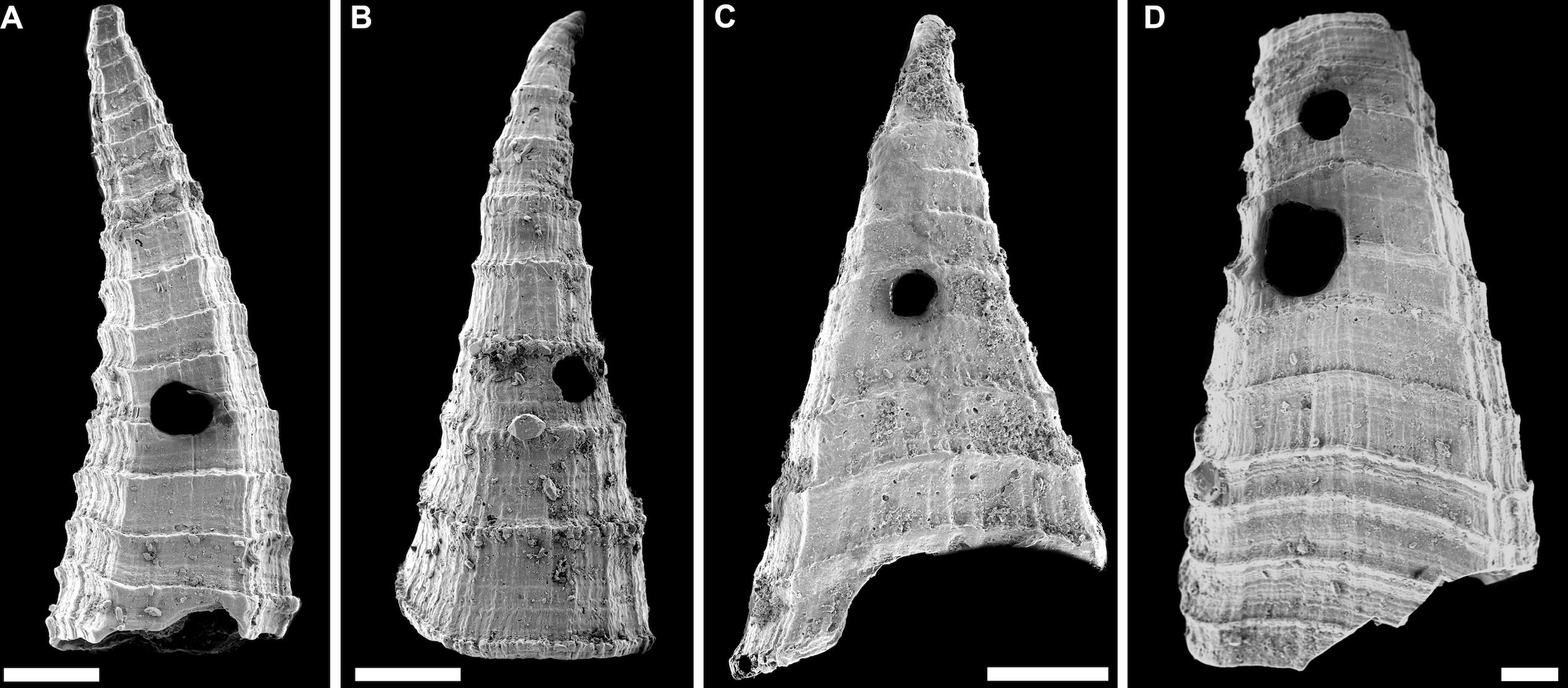
Hundreds of perforated Cambrian shells reveal distinctive predator-prey dynamics in the ocean 517 million years ago.
Researchers from the American Museum of Natural History have uncovered the earliest known evidence of an evolutionary arms race in the fossil record. The 517-million-year-old predator-prey interactions took place in an ancient ocean that once covered present-day South Australia. These interactions involved a small, shelled organism distantly related to modern brachiopods and an unidentified marine predator capable of puncturing its shell.
Published in Current Biology, the study marks the first confirmed instance of an evolutionary arms race from the Cambrian period.
“Predator-prey interactions are often touted as a major driver of the Cambrian explosion, especially with regard to the rapid increase in diversity and abundance of biomineralizing organisms at this time. Yet, there has been a paucity of empirical evidence showing that prey directly responded to predation, and vice versa,” said Russell Bicknell, a postdoctoral researcher in the Museum’s Division of Paleontology and lead author of the study.
An evolutionary arms race is a process where predators and prey continuously adapt and evolve in response to each other. This dynamic is often described as an arms race because one species’ improved abilities lead to the other species improving its abilities in response.
Analyzing 517-Million-Year-Old Shells
Bicknell and colleagues from the University of New England and Macquarie University—both in Australia—studied a large sample of fossilized shells of an early Cambrian tommotiid species, Lapworthella fasciculata, from South Australia. More than 200 of these extremely small specimens, ranging in size from slightly larger than a grain of sand to just smaller than an apple seed, have holes that were likely made by a hole-punching predator—most likely a kind of soft-bodied mollusk or worm.
The researchers analyzed these specimens in relation to their geologic ages, finding an increase in shell wall thickness that coincides with an increase in the number of perforated shells in a short amount of time. This suggests that a microevolutionary arms race was in place, with L. fasciculata finding a way to fortify its shell against predation and the predator, in turn, investing in the ability to puncture its prey despite its ever-bulkier armor.
“This critically important evolutionary record demonstrates, for the first time, that predation played a pivotal role in the proliferation of early animal ecosystems and shows the rapid speed at which such phenotypic modifications arose during the Cambrian Explosion event,” Bicknell says.
Reference: “Adaptive responses in Cambrian predator and prey highlight the arms race during the rise of animals” by Russell D.C. Bicknell, Nicolás E. Campione, Glenn A. Brock and John R. Paterson, 3 January 2025, Current Biology.
DOI: 10.1016/j.cub.2024.12.007
This research was funded in part by the University of New England, the American Museum of Natural History, and the Australian Research Council (grant #s DP200102005 and DE190101423).
Never miss a breakthrough: Join the SciTechDaily newsletter.
Follow us on Google and Google News.
3 Comments
I’ve scooped thousands of those from Mississippi sediments.
It’s nothing new.
The evoutionary process has been completely debunked. No transitional fossils have been discovered. This is a fact.
No it hasnt