

Scientists have made the first experimental observation of matter wave diffraction in a short-lived electron-positron atom.
A defining insight that sets quantum physics apart from classical physics is that matter behaves in unexpected ways at very small scales. One of the most important ideas to emerge was wave-particle duality, which shows that particles can also act like waves.
This behavior was first clearly demonstrated in the double-slit experiment. When electrons passed through two narrow openings, they formed a pattern of alternating light and dark bands on a detector. This pattern revealed that each electron acted like a wave, with its quantum wave function passing through both slits and interfering with itself.
Similar results were later observed with neutrons, helium atoms, and even large molecules, establishing matter-wave diffraction as a fundamental principle of quantum mechanics. However, this effect had not been directly observed in positronium, a short-lived system made of an electron and a positron bound together and orbiting a shared center.
Because both particles have equal mass, scientists have long aimed to understand how such a system would behave when diffracted.
Physicists observe wave behavior in antimatter atom
Building on this challenge, researchers from Tokyo University of Science in Japan, led by Professor Yasuyuki Nagashima, along with Associate Professor Yugo Nagata and Dr. Riki Mikami, have now demonstrated matter-wave diffraction in positronium. The beam used in their experiment had the necessary coherence and energy variation to reveal interference effects. The results, published in Nature Communications, provide a new confirmation of wave-particle duality.
“Positronium is the simplest atom composed of equal-mass constituents, and until it self-annihilates, it behaves as a neutral atom in a vacuum. Now, for the first time, we have observed quantum interference of a positronium beam, which can pave the way for new research in fundamental physics using positronium,” says Prof. Nagashima.
New beam makes experiment possible
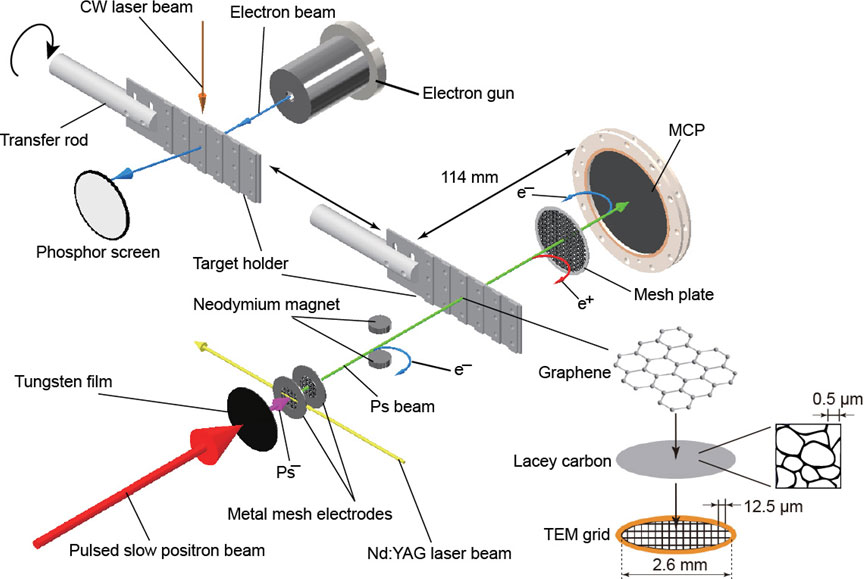
This advance depended on the creation of a highly controlled positronium beam. The team first produced negatively charged positronium ions and then used a precisely timed laser pulse to remove an extra electron. This process generated a fast, neutral, and well-defined beam of positronium atoms.
The beam was directed toward a graphene target whose atomic spacing closely matches the de Broglie wavelength of positronium at the energies used. As the atoms passed through a thin sheet of two to three layers of graphene, some were transmitted and detected with a position-sensitive detector. The resulting signal revealed a clear diffraction pattern.
Compared with earlier techniques, this method produces beams with higher energies, reaching up to 3.3 keV, along with a narrower spread in energy and a more focused trajectory. The experiment was also carried out in ultra-high vacuum conditions, which helped maintain a clean graphene surface and made the diffraction pattern easier to observe. The findings show that even though positronium consists of two particles, it behaves as a single quantum entity, with the electron and positron not acting independently during diffraction.
“This groundbreaking experimental milestone marks a major advance in fundamental physics. It not only demonstrates positronium’s wave nature as a bound lepton–antilepton system (a system that behaves like a tiny atom) but also opens pathways for precision measurements involving positronium,” says Dr. Nagata.
Unusual atom behaves like a single particle
The researchers also examined whether positronium produces interference in the same way as a single particle such as an electron. Their results confirm that it does, representing a key step forward in understanding this system.
In addition to confirming its quantum behavior, positronium diffraction could lead to practical applications. Because positronium carries no electric charge, it may be useful for non-destructive and surface-sensitive analysis of materials, including insulators and magnetic surfaces that are difficult to study with charged particle beams.
Looking further ahead, experiments involving positronium interference could make it possible to test how antimatter responds to gravity. This remains an open question, as no direct measurements have yet been made, even for electrons.
Reference: “Observation of positronium diffraction” by Yugo Nagata, Riki Mikami, Nazrene Zafar and Yasuyuki Nagashima, 23 December 2025, Nature Communications.
DOI: 10.1038/s41467-025-67920-0
This work was supported by JSPS KAKENHI Grants No. JP25H00620, No. JP21H04457, No. JP17H01074.
Never miss a breakthrough: Join the SciTechDaily newsletter.
Follow us on Google and Google News.
2 Comments
Because positronium has some mass like photons (e.g., gravity lensing) it stands to reason that it too will be affected by the field of radiant pulsing angular lines of gravity force it resides in which, despite more than a decade of comments and four cheaply and easily replicated video demonstrations, only I seem to understand and believe in. Therefore, as with the original Thomas Young misinterpretation of photons being both particles and waves in 1801, to make the same mistake with positronium in 2026 might delay the progress of physics for another 225 years. My proof, 4th of 4: https://odysee.com/@charlesgshaver:d/5Gravity:c
There are no particles – which shows that “science” wishes to allow peers their illusions. Plus, particles allows people to count readily – particles, amounts of particles – and feels good as everything we deal with are items, coins, potatoes, etc. If someone told them to drop particles they’d all flip – careers and prizes would flounder. What would become of them. – But you have to have math – They like to count.
If there’s no p[articles, everything is different – the whole brain twister of science is new – new brain twisting.
But that what builds your mind. And lets face it, there’s whole lotta brains out there that need some building, yes?