
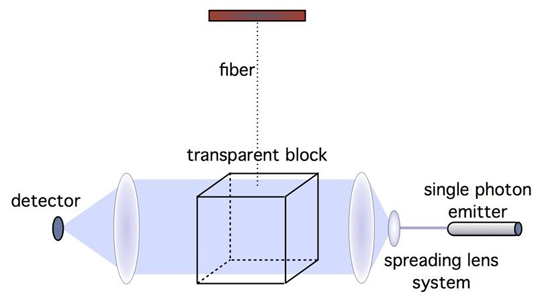
A new tabletop experiment using a single photon was proposed to show whether space-time is made up of indivisible units. Space isn’t smooth, and physicists think that on the quantum scale, it is composed of indivisible subunits, like the dots of a pointillist drawing. This pixelated landscape is thought to be populated by black holes, smaller than one trillionth of one trillionth of the diameter of a hydrogen atom, which continuously pop in and out of existence.
The study will be published in the journal Physical Review D. This hypothesis was proposed decades ago in order to unify quantum theory with Einstein’s theory of gravity, which is the only one of nature’s four fundamental forces not to have been incorporated into the Standard Model of Particle Physics.
Physicists have tried to use the Large Hadron Collider, gravitational wave detectors, and observations of distant cosmic explosions in order to determine whether space is grainy, but so far the results have proven to be inconclusive.
This new tabletop experiment was proposed by Jacob Bekenstein, a theoretical physicist at the Hebrew University of Jerusalem, and it uses readily available equipment.
The experiment was designed to examine on the scale of 1.6 × 10⁻³⁵ (1.6E-35) meters. This Planck length is the theoretical limit at which the macroscopic concept of distance ceases to have any meaning and quantum fluctuations begin to make space-time resemble a foamy sea.
Instead of using instruments, Bekentstein proposes to fire a single photon through a transparent block, and indirectly measure the minuscule distance that the block moves as a result of the photon’s imparted momentum.
The photon’s wavelength and the mass as well as the size of the block are carefully chosen so that the momentum is just large enough to move the block’s center of mass by one Planck length. If space-time is grainy on this scale, then the photon is less likely to make it through the block. If quantum fluctuations in length are important on Planck scale, a sea of black holes, each with a Planck-scale radius, will readily form. Anything that falls inside of these black holes will be unable to escape until the hole dissipates. If the center of mass of the moving block falls into one of these holes, the block’s movement will be impeded. Photons are much larger than the Planck length, and as such aren’t bothered by these quantum black holes.
The conservation of momentum in this experiment requires that the photon can’t make it through the block if it fails to move by a Planck length. So if fewer photons than expected are seen by the detector, this would mean that the block’s movement has been impeded by black holes, and that space-time exhibits quantum features at the Planck scale.
Distinguishing between possible quantum gravitational effects from others will be challenging, states Igor Pikovski, a quantum physicist at the Vienna Center for Quantum Science and Technology. It is unknown at what exact scale quantum gravity plays a significant role. There is plenty of room for granularity at much larger lengths, but there is no theory that could provide this answer, he continues.
Reference: “Is a tabletop search for Planck scale signals feasible?” by Jacob D. Bekenstein, 20 December 2012, Physical Review D.
DOI: 10.1103/PhysRevD.86.124040
Never miss a breakthrough: Join the SciTechDaily newsletter.
Follow us on Google and Google News.