
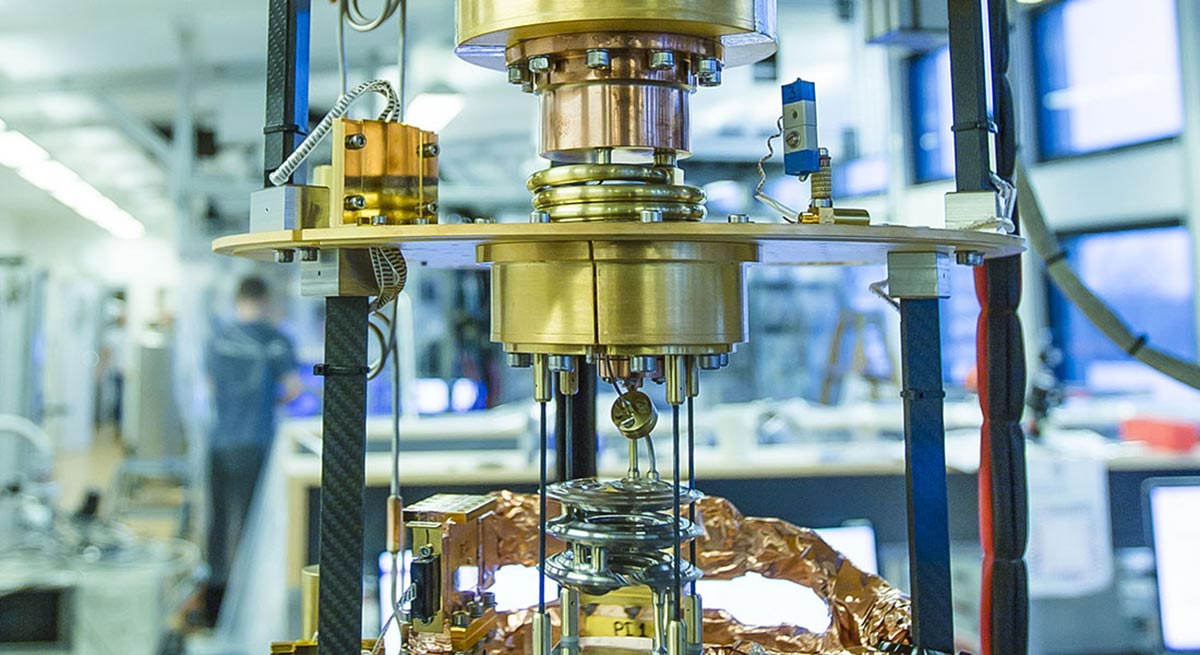
Scientists around the world work hard to rinse quantum systems for noise, which may disturb the function of tomorrow’s powerful quantum computers. Researchers from the Niels Bohr Institute (NBI) have found a way to use noise to process quantum information. This raises the performance of the quantum computing unit, the qubit.
An international collaboration led by scientists at the Niels Bohr Institute (NBI), University of Copenhagen, has demonstrated an alternative approach. Their method allows to use noise to process quantum information. As a result, the performance of the fundamental quantum computing unit of information, the qubit, is increased by 700 percent.
The results were published recently in the journal Nature Communications.
“Avoiding noise in quantum systems has proven difficult, since almost any change in the environment can spoil things. For instance, your system may be operating at a given magnetic or electric field, and if that field changes just slightly the quantum effects fall apart. We suggest a completely different approach. Instead of getting rid of noise, we use continuous real-time noise surveillance and adapt the system as changes in the environment happen,” says Ph.D. Researcher at NBI Fabrizio Berritta, lead author on the study.
The new approach is possible thanks to recent developments in several high-tech fields.
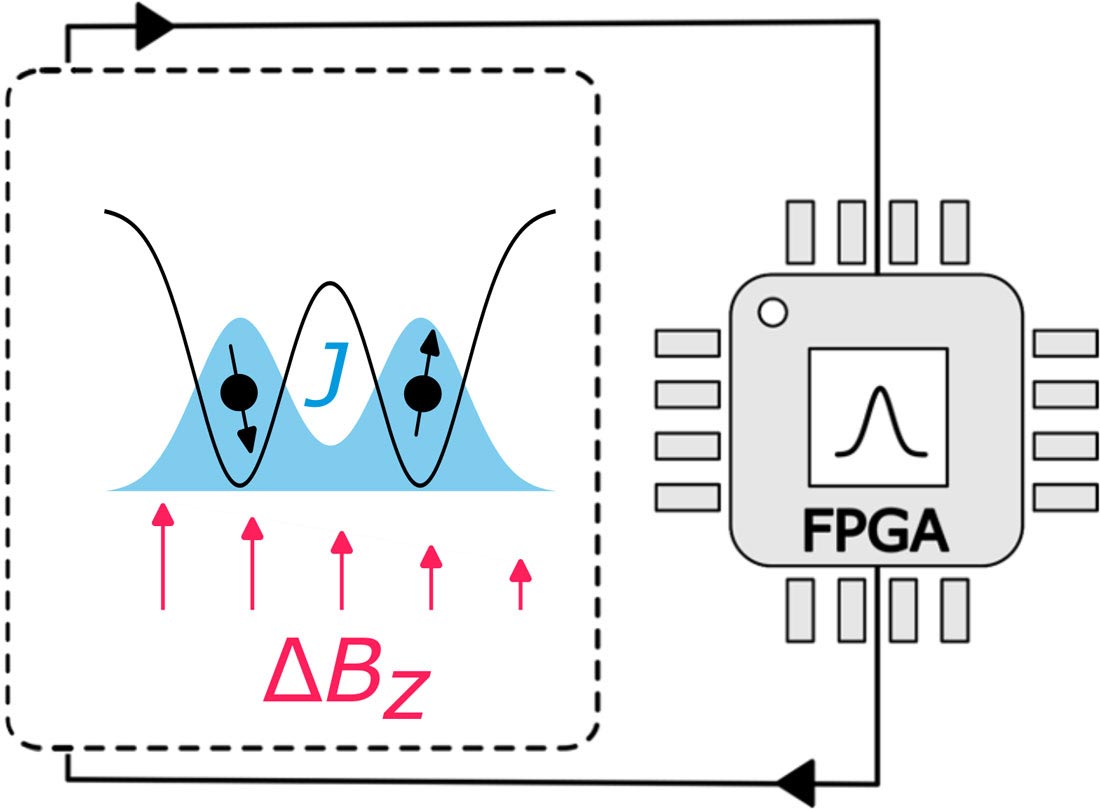
“Previously, say twenty years ago, it would have been possible to visualize the fluctuations after the experiment, but it would have been too slow to utilize this information during the actual experiment. We use FPGA (field-programmable-gate-array, ed.) technology to get the measurements in real-time. And further, we use machine learning to speed up the analysis,” explains Fabrizio Berritta, continuing:
“The whole idea is to get the measurements and do the analysis in the same microprocessor that adjusts the system in real-time. Else, the scheme would not be fast enough for quantum computing applications.”
Quantum Properties Add Value
In present computing, the basic unit of transferable information, known as the bit, is tied to the charge of electrons. It can have only one of two values, one or zero – either there are electrons or there are not. The corresponding quantum computing unit – known as the qubit – will be able to assume more than two values. The amount of information contained per qubit will increase exponentially with the number of quantum properties one is able to control, perhaps resulting in computers that are mind-blowingly more powerful than conventional computers one day.
One cornerstone of quantum mechanics is for the elementary particles to not just have a mass and a charge but also a spin. Another key term is entanglement. Here, two or more particles interact in such a way that the quantum state of a single particle cannot be described independently of the state of the other(s).
The protocol behind the new findings integrates a singlet-triplet spin qubit implemented in a gallium arsenide double quantum dot with FPGA-powered qubit controllers. The qubit involves two electrons, with the states of both electrons entangled.
Interdisciplinary Team Effort
Just like other spin qubits, the singlet-triplet qubit is vulnerable to even small disturbances in their environment. The physicists use the term “noise”, which should not be taken literally as acoustic noise. In relation to quantum systems, disturbances like electric or magnetic field fluctuations can spoil the quantum state(s) of interest.
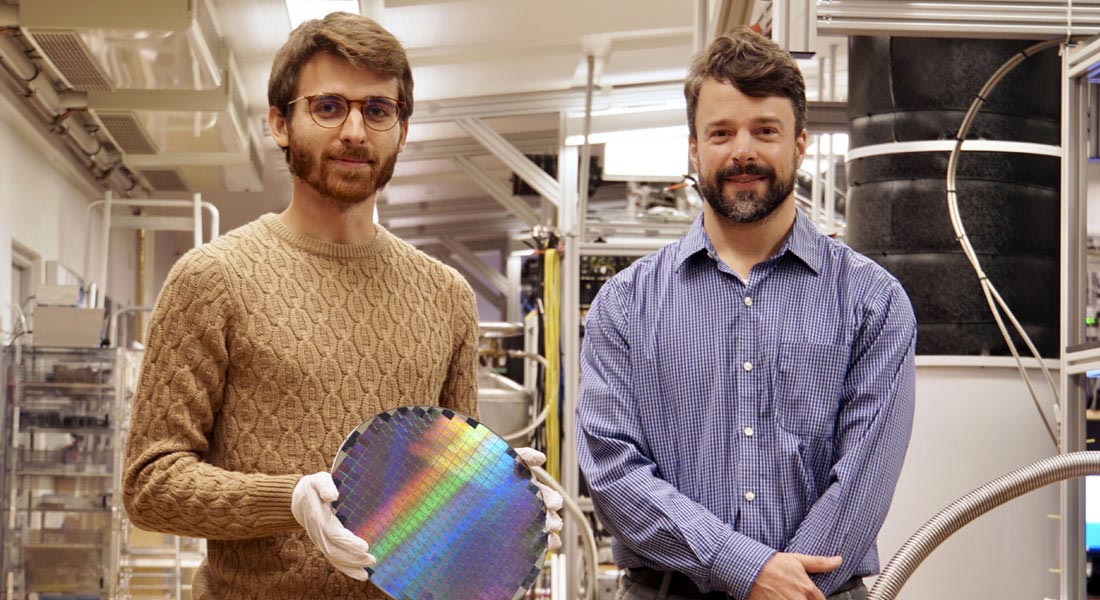
To demonstrate the beneficial use of environmental fluctuations, the researchers chose this qubit because its coupling to both magnetic noise and electric noise is well understood from a series of earlier studies at NBI, led by Professor Ferdinand Kuemmeth, heading a research group on semiconducting and superconducting quantum devices at NBI.
Funded by the EU, the new study brought together research groups at NBI, Purdue University, Norwegian University of Science and Technology, companies QDevil (Copenhagen), and Quantum Machines (Tel Aviv) across a range of fields such as qubit materials, qubit fabrication, qubit control hardware, quantum information theory, and machine learning.
“This collaboration illustrates that the development of quantum computers is no longer an activity that can be driven by individual physics groups. Take away any one of our partners, and this work would not have been possible,” says Ferdinand Kuemmeth.
A Better Approach to Noise
The researchers see the new protocol as a milestone towards the development of quantum computers, but also realize that many other milestones must be achieved.
“The next step for us will be to apply our protocol to systems of different materials and with more than one qubit,” says Fabrizio Berritta, concluding:
“I cannot say when we will see the first truly useful quantum computer. Maybe ten years from now. In any case, we believe to have come up with a promising approach. Many colleagues focus on getting rid of noise to develop better qubits, for instance by improving the quality of the materials used to fabricate the qubits. We have demonstrated that under certain conditions one can actively adjust for some of the noise. This could be relevant for other types of qubits besides the type in our study.”
Reference: “Real-time two-axis control of a spin qubit” by Fabrizio Berritta, Torbjørn Rasmussen, Jan A. Krzywda, Joost van der Heijden, Federico Fedele, Saeed Fallahi, Geoffrey C. Gardner, Michael J. Manfra, Evert van Nieuwenburg, Jeroen Danon, Anasua Chatterjee and Ferdinand Kuemmeth, 23 February 2024, Nature Communications.
DOI: 10.1038/s41467-024-45857-0
Never miss a breakthrough: Join the SciTechDaily newsletter.
Follow us on Google and Google News.