

Close Menu
    Facebook X (Twitter) Instagram
    SciTechDaily
    • Biology
    • Chemistry
    • Earth
    • Health
    • Physics
    • Science
    • Space
    • Technology
    Facebook X (Twitter) Pinterest YouTube RSS
    SciTechDaily
    Home»Physics»Quantum Interference Shown Experimentally in Larger Molecules
    Physics

    Quantum Interference Shown Experimentally in Larger Molecules

    By SciTechDailyMarch 28, 2012No Comments2 Mins Read
    Facebook Twitter Pinterest Telegram LinkedIn WhatsApp Email Reddit
    Share
    Facebook Twitter LinkedIn Pinterest Telegram Email Reddit
    quantum-interference-pattern
    The interference pattern of a double-slit experiment.

    Particle-wave duality is one of the most mysterious facets of quantum physics. It states that every quantum object has properties of both a wave and a particle. This can be easily demonstrated using the double-slit experiment. Streams of particles directed at a barrier, facing the two narrow openings, create an interference pattern, as though they are waves. Neither a pure wave nor particle description has been able to successfully explain these experiments.

    Researchers have now performed a quantum interference experiment with magnitudes larger and much more massive molecules than used before. The findings were published in the journal Nature Nanotechnology.
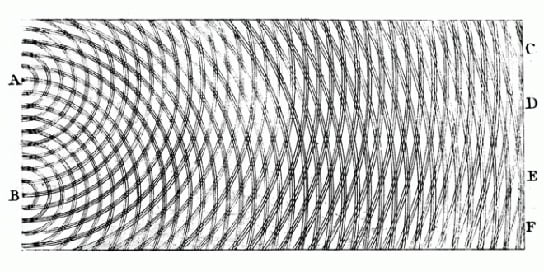
    double-slit-diffraction
    Thomas Young’s sketch of two-slit diffraction of light presented to the Royal Society in 1803

    The experiment, where 100 atoms were launched at a barrier that was designed to minimize molecular interactions, approaches the macroscopic scale, delving into an area where macroscopic and quantum physics overlap. This offers scientists a way to study the transition that has been frustrating to explain.

    In quantum physics, the wavelength of a massive particle is inversely proportional to its momentum since the mass is multiplied by the particle’s speed. The heavier an object, the shorter its wavelength at a given speed.

    Longer wavelengths make it easier to generate interference patterns. The large phthalocyanine (C32H18N8) molecule and its derivatives (C48H26F24N8O8) have more mass than any others that have produced observable patterns of quantum interference. The molecules needed to move slowly to produce interference. This was accomplished by directing a blue diode laser onto a thin film of molecules in a vacuum chamber, boiling off individual molecules directly under the beam, leaving the rest undisturbed.

    When they started the experiment, individual light spots started appearing in the fluorescent detector. Over time, these spots formed an interference pattern due to the wavelike character of the molecules.

    Future experiments with even larger molecules might be able to examine the exact transition between macroscopic physics and quantum physics, providing insight into a grand unified theory of physics.

    Reference: “Real-time single-molecule imaging of quantum interference” by Thomas Juffmann, Adriana Milic, Michael Müllneritsch, Peter Asenbaum, Alexander Tsukernik, Jens Tüxen, Marcel Mayor, Ori Cheshnovsky and Markus Arndt, 25 March 2012, Nature Nanotechnology.
    DOI: 10.1038/nnano.2012.34

    Never miss a breakthrough: Join the SciTechDaily newsletter.
    Follow us on Google and Google News.

    Molecules Particle Physics Popular Quantum Interference Quantum Physics Wave Particle Duality
    Share. Facebook Twitter Pinterest LinkedIn Email Reddit

    Related Articles

    Quantum Paradox Experiment Puts Einstein to the Test – May Lead to More Accurate Clocks and Sensors

    Physicists Chart the ‘Secret’ Movement of Quantum Particles

    Physicists Make First Ever Measurement of Antiproton Interactions

    New CERN Study Suggests Subatomic Particles Could Defy the Standard Model

    Experiment Using Photons Could Detect Quantum-Scale Black Holes

    Photons Traverse Optical Obstacles as Both a Wave and Particle Simultaneously

    Physicists Use Cheap Colliders to Probe for Heavy Photons

    Evidence of Elusive Majorana Fermions Raises Possibilities for Quantum Computing

    Higgs Boson Signals Gain Strength at Large Hadron Collider

    Leave A Reply Cancel Reply

    • Facebook
    • Twitter
    • Pinterest
    • YouTube

    Don't Miss a Discovery

    Subscribe for the Latest in Science & Tech!

    Trending News

    Millions Take These IBS Drugs, But a New Study Finds Serious Risks

    Scientists Unlock Hidden Secrets of 2,300-Year-Old Mummies Using Cutting-Edge CT Scanner

    Bread Might Be Making You Gain Weight Even Without Eating More Calories

    Scientists Discover Massive Magma Reservoir Beneath Tuscany

    Europe’s Most Active Volcano Just Got Stranger – Here’s Why Scientists Are Rethinking It

    Alzheimer’s Symptoms May Start Outside the Brain, Study Finds

    Millions Take This Popular Supplement – Scientists Discover a Concerning Link to Heart Failure

    The Universe Is Expanding Too Fast and Scientists Can’t Explain Why

    Follow SciTechDaily
    • Facebook
    • Twitter
    • YouTube
    • Pinterest
    • Newsletter
    • RSS
    SciTech News
    • Biology News
    • Chemistry News
    • Earth News
    • Health News
    • Physics News
    • Science News
    • Space News
    • Technology News
    Recent Posts
    • Simple Blood Test May Predict Alzheimer’s Years Before Brain Scans Show Signs
    • Scientists Say Adding This Unusual Seafood to Your Diet Could Reverse Signs of Aging
    • U.S. Waste Holds $5.7 Billion Worth of Crop Nutrients
    • Scientists Say a Hidden Structure May Exist Inside Earth’s Core
    • Doctors Surprised by the Power of a Simple Drug Against Colon Cancer
    Copyright © 1998 - 2026 SciTechDaily. All Rights Reserved.
    • Science News
    • About
    • Contact
    • Editorial Board
    • Privacy Policy
    • Terms of Use

    Type above and press Enter to search. Press Esc to cancel.