
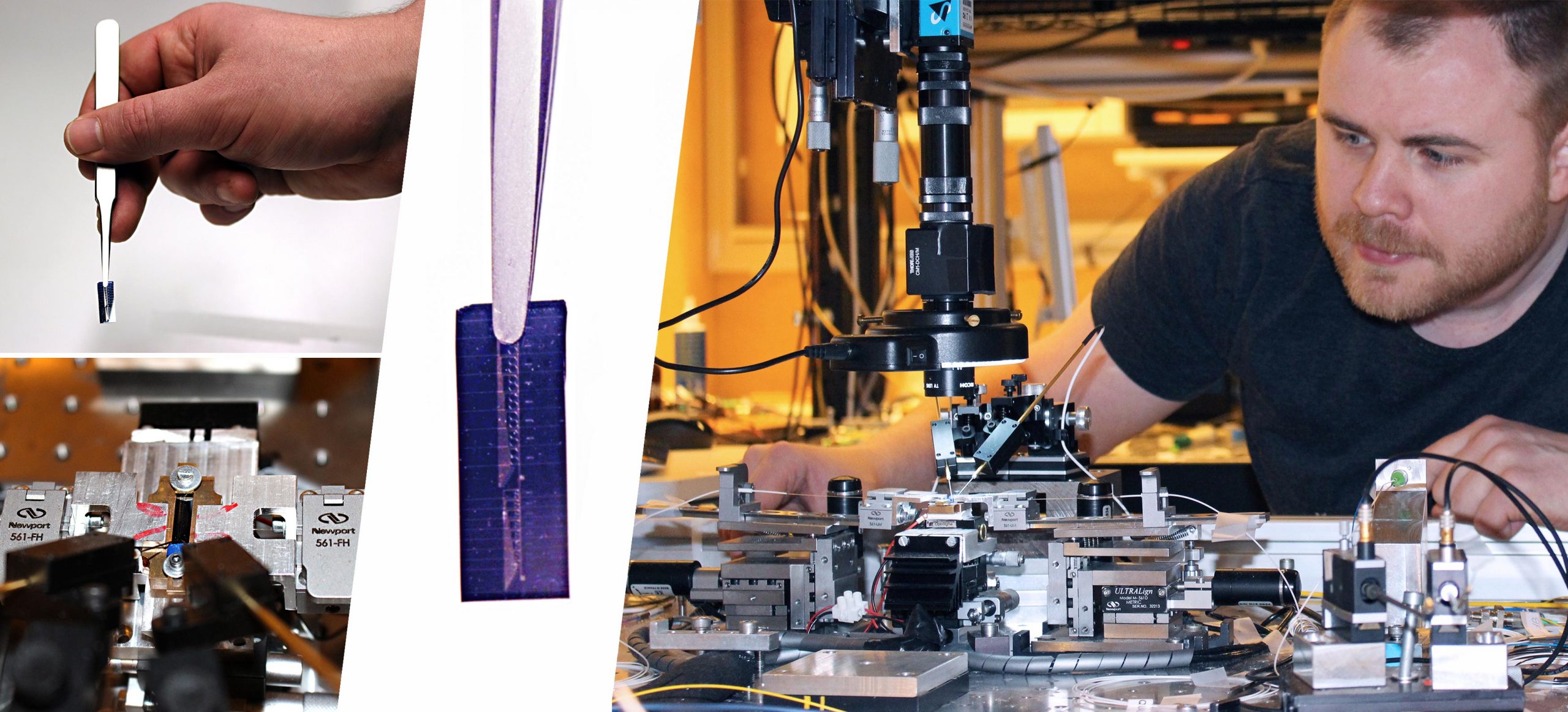
Tiny photonic devices could be used to find new exoplanets, monitor our health, and make the internet more energy efficient. Researchers from Chalmers University of Technology, Sweden, now present a game-changing microcomb that could bring advanced applications closer to reality.
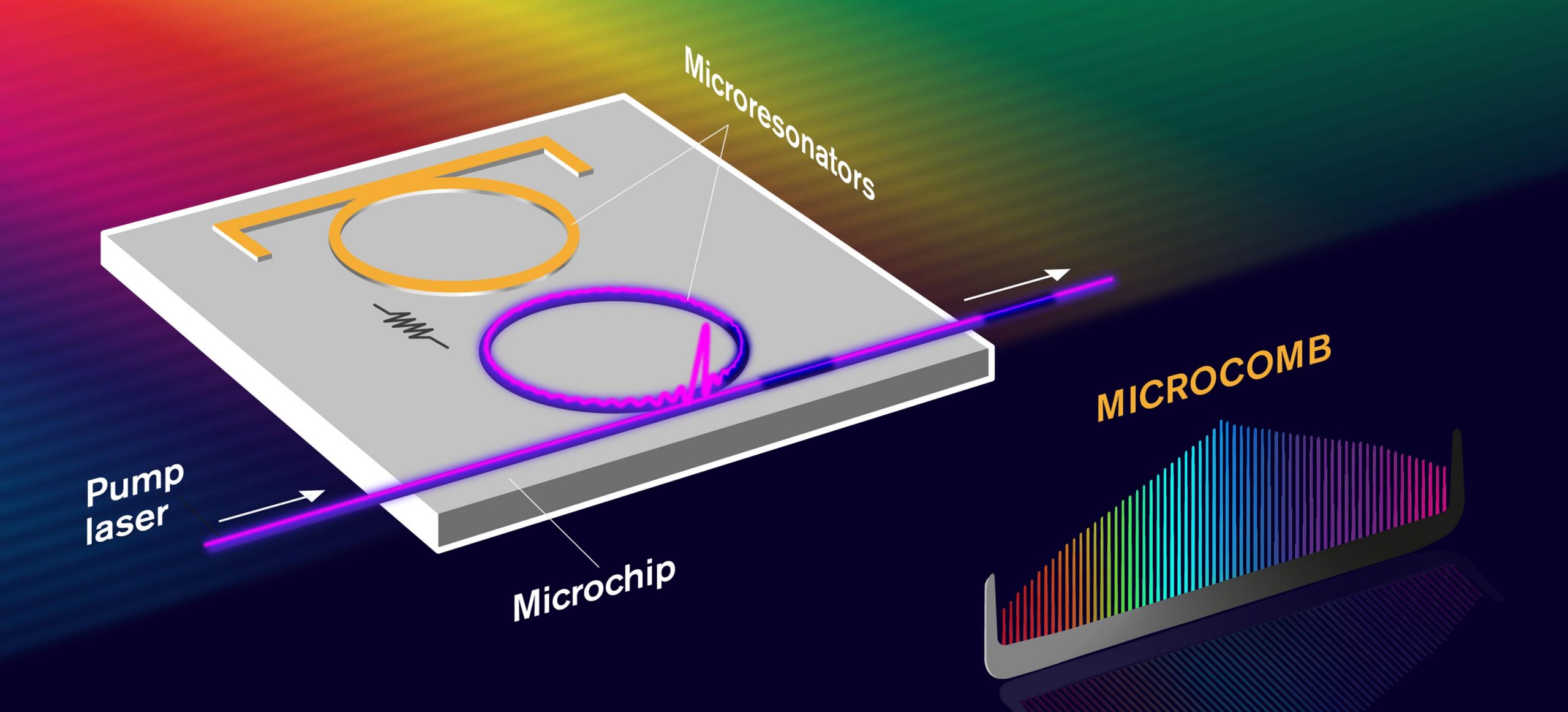
A microcomb is a photonic device capable of generating a myriad of optical frequencies — colors — on a tiny cavity known as microresonator. These colors are uniformly distributed so the microcomb behaves like a ‘ruler made of light’. The device can be used to measure or generate frequencies with extreme precision.
In a recent article in the journal Nature Photonics, eight Chalmers researchers describe a new kind of microcomb on a chip, based on two microresonators. The new microcomb is a coherent, tunable, and reproducible device with up to ten times higher net conversion efficiency than the current state of the art.
“The reason why the results are important is that they represent a unique combination of characteristics, in terms of efficiency, low-power operation, and control, that are unprecedented in the field,” says Óskar Bjarki Helgason, a PhD student at the Department of Microtechnology and Nanoscience at Chalmers, and first author of the new article.
The Chalmers researchers are not the first to demonstrate a microcomb on a chip, but they have developed a method that overcomes several well-known limitations in the field. The key factor is the use of two optical cavities — microresonators — instead of one. This arrangement results in the unique physical characteristics.

Placed on a chip, the newly developed microcomb is so small that it would fit on the end of a human hair. The gaps between the teeth of the comb are very wide, which opens great opportunities for both researchers and engineers.
A Wide Range of Potential Applications
Since almost any measurement can be linked to frequency, the microcombs offer a wide range of potential applications. They could, for example, radically decrease the power consumption in optical communication systems, with tens of lasers being replaced by a single chip-scale microcomb in data center interconnects. They could also be used in lidar for autonomous driving vehicles, for measuring distances.
Another exciting area where microcombs could be utilized is for the calibration of the spectrographs used in astronomical observatories devoted to the discovery of Earth-like exoplanets.
Extremely accurate optical clocks and health-monitoring apps for our mobile phones are further possibilities. By analyzing the composition of our exhaled air, one could potentially diagnose diseases at earlier stages.

Providing Answers to Questions Not Yet Asked
“For the technology to be practical and find its use outside the lab, we need to co-integrate additional elements with the microresonators, such as lasers, modulators, and control electronics. This is a huge challenge, that requires maybe 5-10 years and an investment in engineering research. But I am convinced that it will happen,” says Victor Torres Company, who leads the research project at Chalmers. He continues:
“The most interesting advances and applications are the ones that we have not even conceived of yet. This will likely be enabled by the possibility of having multiple microcombs on the same chip. What could we achieve with tens of microcombs that we cannot do with one?”
Reference: “Dissipative solitons in photonic molecules” by Óskar B. Helgason, Francisco R. Arteaga-Sierra, Zhichao Ye, Krishna Twayana, Peter A. Andrekson, Magnus Karlsson, Jochen Schröder and Victor Torres-Company, 25 January 2021, Nature Photonics.
DOI: 10.1038/s41566-020-00757-9
The paper is written by Óskar B. Helgason, Francisco R. Arteaga-Sierra, Zhichao Ye, Krishna Twayana, Peter A. Andrekson, Magnus Karlsson, Jochen Schröder and Victor Torres Company at the Department of Microtechnology and Nanoscience at Chalmers.
All the research, including modeling, theoretical and experimental work, and nanofabrication, has been carried out at Chalmers University of Technology. The research has been funded by the European Research Council, through Victor Torres Company’s ERC Consolidator Grant, and by the Swedish Research Council.
More about: Frequency combs and microcombs
A frequency comb is a special laser where the emission frequencies are evenly spaced. It functions as a ruler made of light, where the markers set the frequency scale across a portion of the electromagnetic spectrum, from the ultraviolet to the mid infrared. The location of the markers can be linked to a known reference. This was achieved in the late 90s, and it signified a revolution in precision metrology — an achievement recognized by the Nobel Prize in Physics in 2005.
A microcomb is a modern technology, alternative to mode-locked lasers, that can generate repetitive pulses of light at astonishing rates. They are generated by sending laser light to a tiny optical cavity called a microresonator. Thus, microcombs have two important attributes that make them extremely attractive for practical purposes: the frequency spacing between markers is very large (typically between 10 – 1,000 GHz), that is much higher than the spacing in mode-locked laser frequency combs, and they can be implemented with photonic integration technology. The compatibility with photonic integration brings benefits in terms of reduction of size, power consumption and the possibility to reach mass-market applications. The large spacing between teeth means that microcombs can be used for novel applications, such as light sources for fiber-optic communication systems or for the synthesis of pure microwave electromagnetic radiation.
The key to the new enhanced microcomb from Chalmers is that the researchers have used two microresonators instead of one. The microresonators interact with each other, similar to how atoms bind together when forming a diatomic molecule. This arrangement is known as a photonic molecule and has unique physical characteristics.
Never miss a breakthrough: Join the SciTechDaily newsletter.
Follow us on Google and Google News.