
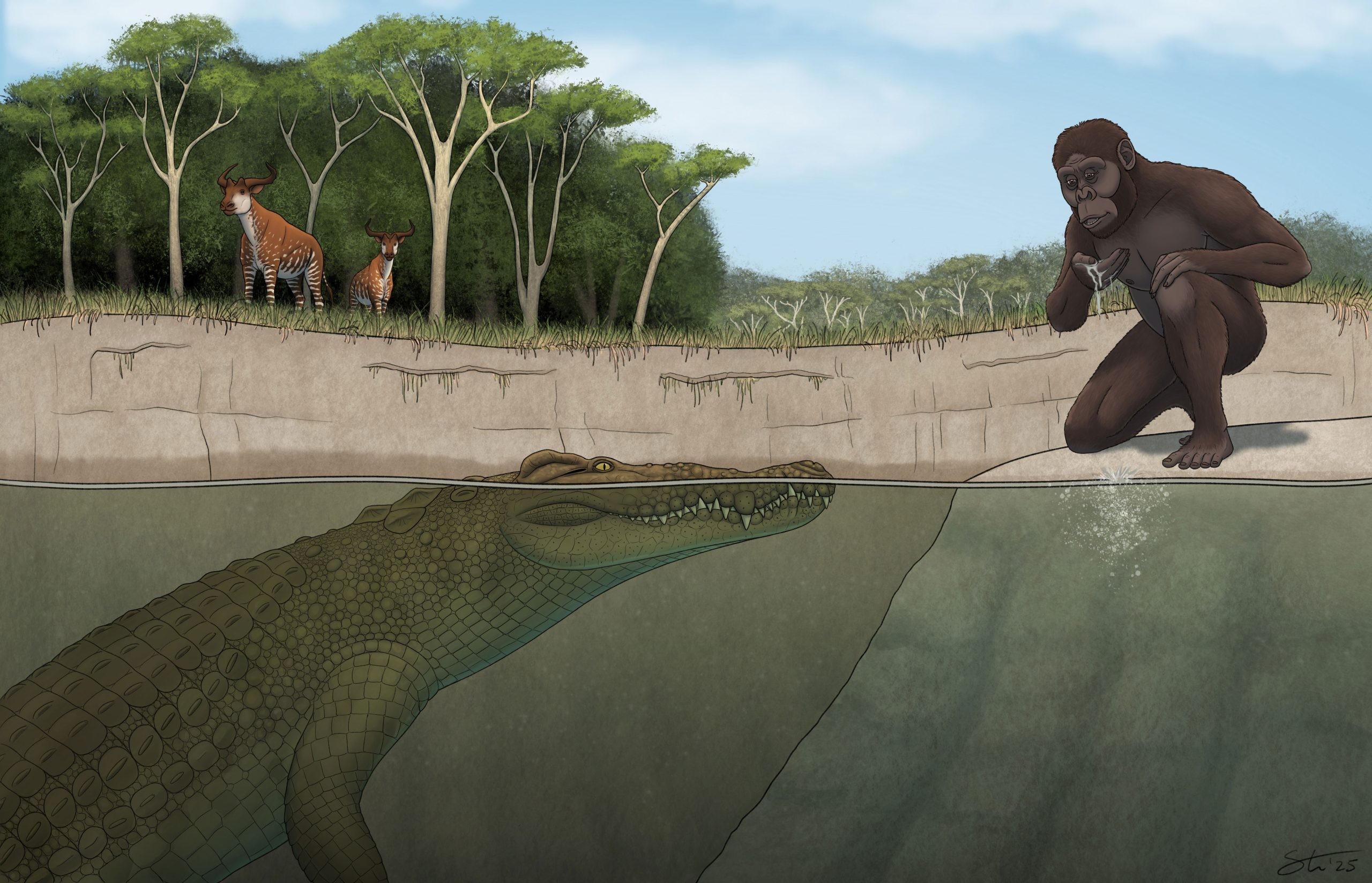
A newly named crocodile species from Ethiopia likely lived alongside Lucy’s species and dominated the wetlands of Hadar more than 3 million years ago.
More than 3 million years ago, when early human relatives such as the famous Lucy moved across the African landscape, they likely shared their world with a formidable crocodile that had a prominent bump on its snout and waited in rivers and lakes for animals that came too close.
A University of Iowa-led research team has identified that crocodile as a new species. In a study published in the Journal of Systematic Paleontology, the researchers named it Crocodylus lucivenator, meaning Lucy’s hunter.
The name fits the animal’s setting. This ancient reptile lived from about 3.4 million to 3 million years ago in Ethiopia, at the same time and in the same region as Lucy and her hominin species, Australopithecus afarensis. Lucy’s skeleton, found in 1974, was important because it was then the oldest and most complete early human ancestor or relative ever discovered. It also strengthened evidence that walking on two legs, or bipedalism, came before larger brain size in human evolution.
Lucy shared its landscape
The newly described crocodile measured about 12 to 15 feet long, with adults weighing between 600 and 1,300 pounds. It was a dominant predator and the only crocodile known from that landscape, a mix of shrubland and wetlands crossed by tree-lined rivers. The researchers describe it as an ambush predator that would have stayed hidden under the water, ready to strike animals that approached for a drink.
“It was the largest predator in that ecosystem, more so than lions and hyenas, and the biggest threat to our ancestors who lived there during that time,” says Christopher Brochu, professor in the Department of Earth and Environmental Sciences at Iowa and the study’s corresponding author. “It’s a near certainty this crocodile would have hunted Lucy’s species. Whether a particular crocodile tried to grab Lucy, we’ll never know, but it would have seen Lucy’s kind and thought, ‘Dinner.’
A snout revealed its identity
Brochu has studied ancient crocodiles for 35 years. He first examined the Crocodylus lucivenator specimens in 2016 while visiting a museum in Addis Ababa, Ethiopia’s capital.
“I was just blown away because it had this really weird combination of character states,” Brochu recalls.
One of the animal’s most distinctive features was a large hump at the center of its snout. A similar structure appears in the American crocodile, but not in Africa’s Nile crocodile. The researchers think male crocodiles may have used the hump to attract mates.
“You see this in some modern crocodiles,” Brochu says. “The male will lower his head down a little bit to a female to show it off.”
The researchers also report that Lucy’s hunter had a snout that stretched farther beyond its nostrils than those of other crocodiles from the same period, making it more similar to the elongated snouts of modern crocodiles.
Fossils preserve ancient conflict
The researchers studied 121 cataloged fossils, mostly skulls, teeth, and jaw fragments, representing dozens of individuals. The remains came from the Hadar site in Ethiopia’s Afar region, an area long known for discoveries tied to early human history, including Lucy and her relatives. Hadar was named a UNESCO World Heritage site in 1980.
Most of the fossils were fragmentary, requiring the team to reconstruct the broader anatomy from incomplete pieces. One specimen, however, preserved several partly healed jaw injuries, suggesting that the crocodile had fought with another member of its species, according to Stephanie Drumheller, teaching associate professor at the University of Tennessee, who earned her doctorate at Iowa.
“The fossil record preserves similar injuries in extinct groups as well, so this kind of face-biting behavior can be found throughout the crocodile family tree,” says Drumheller, a study co-author. “We can’t know which combatant came out on top of that fight, but the healing tells us that, winner or loser, this animal survived the encounter.”
At least three other crocodile species lived farther south in the Eastern Rift Valley, but Lucy’s hunter appears to have had the Hadar area to itself.
“During the Pliocene, Hadar was composed of a variety of habitats alongside its lake and river systems over space and time, including open and closed woodlands, gallery forests, wet grasslands, and shrublands,” says Christopher Campisano, associate professor in the School of Human Evolution and Social Change at Arizona State University and a study co-author. “Interestingly, this crocodile was one of only a few species that was able to persist throughout.”
Reference: “Lucy’s peril: A Pliocene crocodile from the Hadar Formation, north-eastern Ethiopia” by Christopher A. Brochu, Stephanie K. Drumheller, Christopher Campisano, Getahun Tekle, Tomas Getachew, Jason J. Head, Nathan C. Platt and Daniel Leaphart, 11 March 2026, Journal of Systematic Palaeontology.
DOI: 10.1080/14772019.2026.2614954
The U.S. National Science Foundation, the Leakey Foundation, the University of Iowa Office of International Programs, and the College of Liberal Arts and Sciences at Iowa funded the research.
Never miss a breakthrough: Join the SciTechDaily newsletter.
Follow us on Google and Google News.