
Close Menu
    Facebook X (Twitter) Instagram
    SciTechDaily
    • Biology
    • Chemistry
    • Earth
    • Health
    • Physics
    • Science
    • Space
    • Technology
    Facebook X (Twitter) Pinterest YouTube RSS
    SciTechDaily
    Home»Science»Turtles Share a Recent Common Ancestor with Birds and Crocodiles
    Science

    Turtles Share a Recent Common Ancestor with Birds and Crocodiles

    By Jim Shelton, Yale UniversitySeptember 3, 20153 Comments2 Mins Read
    Facebook Twitter Pinterest Telegram LinkedIn WhatsApp Email Reddit
    Share
    Facebook Twitter LinkedIn Pinterest Telegram Email Reddit
    New Research Shows Turtles Share a Recent Common Ancestor with Birds and Crocodiles
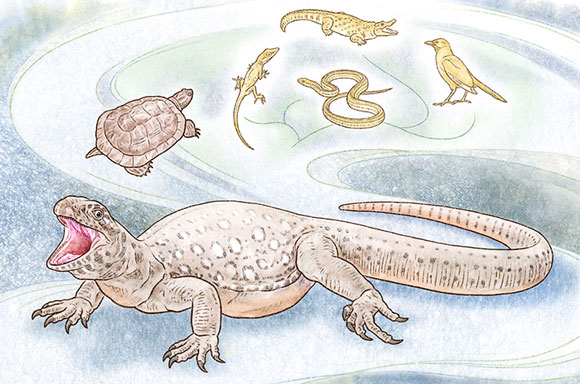
    New fossil evidence reveals that turtles share a recent common ancestor with birds and crocodiles. Credit: Illustration by Mick Ellison

    New fossil evidence reveals that turtles share a recent common ancestor with birds and crocodiles.

    There’s a twist in the turtle timeline.

    Thanks to new fossil evidence, paleontologists are able to prove that turtles share a recent common ancestor with birds and crocodiles. The discovery may settle a longstanding argument among scientists about the origins of turtles.

    At issue is the evolution of the turtle’s skull. Genetic analysis of molecular sequence data consistently places turtles in a group with birds and crocodilians. This would mean that early turtles had a diapsid skull, with a pair of openings behind each eye that allowed jaw muscles to tighten and flex during chewing. Yet there was no fossil evidence to confirm that position, until recently.

    A group of researchers from Yale, the New York Institute of Technology (NYIT), and the Denver Museum of Nature and Science found the telltale skull openings in a juvenile example of Eunotosaurus africanus, a 260-million-year-old reptile.

    “Eunotosaurus is a ‘cryptic’ diapsid because it closes the skull openings later in life,” said Bhart-Anjan Bhullar, a Yale assistant professor in the Department of Geology and Geophysics and co-author of a paper in Nature describing the finding. “Only the fortuitous discovery of these openings in a very young juvenile allowed us to realize this.”

    Gaberiel Bever of NYIT is the first author of the paper. The other co-authors are Daniel Field, a doctoral candidate in the Department of Geology and Geophysics at Yale; and Tyler Lyson of the Denver Museum of Nature and Science.

    “This process of apparent conflict between DNA and fossils, and eventual reconciliation through new discoveries is a great example of scientific progress, and how our knowledge of vertebrate evolution is itself continually evolving,” Field said.

    Reference: “Evolutionary origin of the turtle skull” by G. S. Bever, Tyler R. Lyson, Daniel J. Field and Bhart-Anjan S. Bhullar, 2 September 2015, Nature.
    DOI: 10.1038/nature14900


    Never miss a breakthrough: Join the SciTechDaily newsletter.
    Follow us on Google and Google News.

    Crocodiles Evolutionary Biology Fossils Geology Geophysics New York Institute of Technology Paleontology Turtle Yale University
    Share. Facebook Twitter Pinterest LinkedIn Email Reddit

    Related Articles

    These Alien-Looking Fossils May Explain the Origins of Complex Life

    50-Million-Year-Old Sea Turtle Unearthed in Syria Stuns Paleontologists

    Prehistoric Extinctions Offer Insights for Today’s Endangered Species

    Asteroid Collision Led to the Mass Extinction of Lizards and Snakes

    Coniophis Precedens, The Most Primitive Known Snake

    Experimental Evidence Verifies High-Pressure Structure for Cold-Compressed Graphite

    27-Foot Long Crocodylus Thorbjarnarsoni Roamed Kenya

    Carbonemys Was a Giant Turtle From Late Paleocene

    Mysterious “Godzillus” Fossil Discovered by Amateur Paleontologist

    3 Comments

    1. dythrame on September 3, 2015 10:18 pm

      recent??260million yrs recent?? 260 MILLION YEARS.. RECENT . SO WHAT WOULD BE OLD 360 MILLION YEARS?

      Reply
      • Karen, turtle reader on February 23, 2025 8:43 pm

        Thank you for the report on turtles. I will follow reading on how the turtle timeline is changed… It sounds as if anapsid turtles are just older diapsid turtles, and the original animals all had potentially powerful jaw mechanics, and that in general, turtles grew slowly and might have been very long-lived…

        Reply
    2. kamir bouchareb st on May 9, 2025 11:26 am

      thank uou for this

      Reply
    Leave A Reply Cancel Reply

    • Facebook
    • Twitter
    • Pinterest
    • YouTube

    Don't Miss a Discovery

    Subscribe for the Latest in Science & Tech!

    Trending News

    Researchers Have Found a Dietary Compound That Increases Longevity

    Scientists Baffled by Bizarre “Living Fossil” From 275 Million Years Ago

    Your IQ at 23 Could Predict Your Wealth at 27, Study Finds

    320 Light-Years Away, a Planet Confirms a Fundamental Cosmic Assumption

    The Crown Jewel of Dentistry? Breakthrough Tech Could Transform Tooth Repair

    Python Blood Could Hold the Secret to Weight Loss Without Side Effects

    Naturally Occurring Bacteria Completely Eradicate Tumors in Mice With a Single Dose

    New “Nanozyme Hypothesis” Could Rewrite the Story of Life’s Origins

    Follow SciTechDaily
    • Facebook
    • Twitter
    • YouTube
    • Pinterest
    • Newsletter
    • RSS
    SciTech News
    • Biology News
    • Chemistry News
    • Earth News
    • Health News
    • Physics News
    • Science News
    • Space News
    • Technology News
    Recent Posts
    • Scientists Discover Bizarre Crocodile Relative That Walked on Two Legs
    • How Quantum Mechanics Went From Baffling Theory to Revolutionizing Modern Technology
    • Scientists May Have Found the Key to Jupiter and Saturn’s Moon Mystery
    • Scientists Uncover Hidden Clues to the Origin of the Genetic Code
    • Scientists Discover Unexpected Role of Alzheimer’s Protein in Cell Division
    Copyright © 1998 - 2026 SciTechDaily. All Rights Reserved.
    • Science News
    • About
    • Contact
    • Editorial Board
    • Privacy Policy
    • Terms of Use

    Type above and press Enter to search. Press Esc to cancel.