

An amateur paleontologist found a mysterious fossilized specimen that may have once lived near the shallow seas that covered what is now the Cincinnati area. Believed to have been similar to a shrub, the fossil measures nearly seven feet long and over three feet wide and may be named “Godzillus.”
For 70 years, academic paleontologists have been assisted by a dedicated corps of amateurs known as the Dry Dredgers. Recently, one amateur found a very large and very mysterious fossil that has the professionals puzzled.
Around 450 million years ago, shallow seas covered the Cincinnati region and harbored one very large and now very mysterious organism. Despite its size, no one has ever found a fossil of this “monster” until its discovery by an amateur paleontologist last year.
The fossilized specimen, a roughly elliptical shape with multiple lobes, totaling almost seven feet in length, will be unveiled at the North-Central Section 46th Annual Meeting of the Geological Society of America, April 24, in Dayton, Ohio. Participating in the presentation will be amateur paleontologist Ron Fine of Dayton, who originally found the specimen, Carlton E. Brett and David L. Meyer of the University of Cincinnati geology department, and Benjamin Dattilo of the Indiana University Purdue University Fort Wayne geosciences faculty.
Fine is a member of the Dry Dredgers, an association of amateur paleontologists based at the University of Cincinnati. The club, celebrating its 70th anniversary this month, has a long history of collaborating with academic paleontologists.
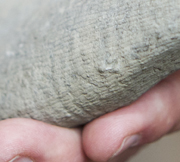
“I knew right away that I had found an unusual fossil,” Fine said. “Imagine a saguaro cactus with flattened branches and horizontal stripes in place of the usual vertical stripes. That’s the best description I can give.”
The layer of rock in which he found the specimen near Covington, Kentucky, is known to produce a lot of nodules or concretions in a soft, clay-rich rock known as shale.
“While those nodules can take on some fascinating, sculpted forms, I could tell instantly that this was not one of them,” Fine said. “There was an ‘organic’ form to these shapes. They were streamlined.”
Fine was reminded of streamlined shapes of coral, sponges, and seaweed as a result of growing in the presence of water currents.
“And then there was that surface texture,” Fine said. “Nodules do not have surface texture. They’re smooth. This fossil had an unusual texture on the entire surface.”
For more than 200 years, the rocks of the Cincinnati region have been among the most studied in all of paleontology, and the discovery of an unknown, and large, fossil has professional paleontologists scratching their heads.
“It’s definitely a new discovery,” Meyer said. “And we’re sure it’s biological. We just don’t know yet exactly what it is.”
To answer that key question, Meyer said that he, Brett, and Dattilo were working with Fine to reconstruct a timeline working backward from the fossil, through its preservation, burial, and death to its possible mode of life.
“What things had to happen in what order?” Meyer asked. “Something caused a directional pattern. How did that work? Was it there originally or is it post-mortem? What was the burial event? How did the sediment get inside? Those are the kinds of questions we have.”
It has helped, Meyer said, that Fine has painstakingly reassembled the entire fossil. This is a daunting task, since the large specimen is in hundreds of pieces.
“I’ve been fossil collecting for 39 years and never had a need to excavate. But this fossil just kept going, and going, and going,” Fine said. “I had to make 12 trips, over the course of the summer, to excavate more material before I finally found the end of it.”
Even then he still had to guess as to the full size, because it required countless hours of cleaning and reconstruction to put it all back together.
“When I finally finished it was three-and-a-half feet (1.1 meters) wide and six-and-a-half feet (2 meters) long,” Fine said. “In a world of thumb-sized fossils that’s gigantic!”
Meyer, co-author of A Sea without Fish: Life in the Ordovician Sea of the Cincinnati Region, agreed that it might be the largest fossil recovered from the Cincinnati area.
“My personal theory is that it stood upright, with branches reaching out in all directions similar to a shrub,” Fine said. “If I am right, then the upper-most branch would have towered nine feet high. “
As Meyer, Brett and Dattilo assist Fine in studying the specimen, they have found a clue to its life position in another fossil. The mystery fossil has several small, segmented animals known as primaspid trilobites attached to its lower surface. These small trilobites are sometimes found on the underside of other fossilized animals, where they were probably seeking shelter.
“A better understanding of that trilobite’s behavior will likely help us better understand this new fossil,” Fine said.
Although the team has reached out to other specialists, no one has been able to find any evidence of anything similar having been found. The mystery monster seems to defy all known groups of organisms, Fine said, and descriptions, even pictures, leave people with more questions than answers.
The presentation April 24 is a “trial balloon,” Meyer said, an opportunity for the team to show a wide array of paleontologists what the specimen looks like and to collect more hypotheses to explore.
“We hope to get a lot of people stopping by to offer suggestions,” he said.
In the meantime, the team is playing around with potential names. They are leaning toward “Godzillus.”
Never miss a breakthrough: Join the SciTechDaily newsletter.
Follow us on Google and Google News.
2 Comments
Check the Museum in Big Stone Gap, Wise County, Virginia. If they have not been filed into infinity, there are many specimens like this one at the institute. Various fossils have been found in the shale areas of near-by coal mines and on private land for over at least 60 years. The Museum was, at my last visit decades ago, very small without much of a staff.
.
My father, with others of the community, personally found several fossils and donated them to the museum in the 1950s and 1960s. The fossils, after so many decades, may have been stored or donated to other museums, but there still should be records.
I have seen small versions of this textured fossil in our creek near Shepherdsville, KY. Not as flattened. I assumed it to be a plant or plant part like the crinoid fowering body we find as well.