
Temperature records show past volcanic activity, current climate warming trends.
Scientists used a 600-year-old marine sponge to reconstruct a record of ocean temperature in the North Atlantic revealing past volcanic activity as well as the current global warming trend from the release of carbon dioxide and other heat trapping gasses into Earth’s atmosphere and absorbed by the oceans.
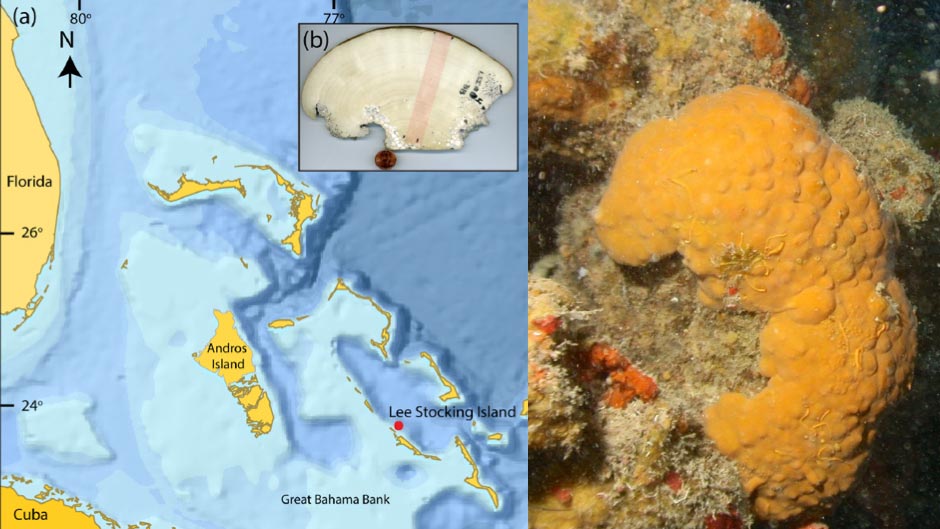
The University of Miami (UM) Rosenstiel School of Marine and Atmospheric Science-led research team used geochemical proxies to reconstruct a 600-year-long record of Atlantic Ocean temperatures from the skeleton of a sclerosponge (Ceratoporella nicholsoni).
The basketball-sized sclerosponge was collected via submersible more than 430 feet (133 meters) below the surface in Exuma Sound, The Bahamas by the study’s senior author Peter Swart, a professor of marine geosciences at the UM Rosenstiel School. Sclerosponges are slow-growing marine organisms with a soft outer body and hard limestone skeleton that record upper ocean temperature and climate conditions. Although individuals could be as old as 1000-2000 years, their distribution is poorly documented because of the difficulty and expense of collection.
Long-Term Climate Clues Hidden in the Skeleton
“Atlantic Ocean temperatures fluctuate on various timescales, including multi-decadal, and this influences the weather and climate in North America, Europe, and Africa,” said Swart. “This 600-year-long temperature reconstruction can help us understand how the climate has changed in the past so that scientists can better project how conditions may change in the future. “
To understand environmental changes beyond what modern instruments can provide, scientists turn to long-lived marine organisms like Sclerosponges that record ambient environmental conditions in their skeletons.
Implications for Hurricanes and Rainfall Forecasts
“Predicting and projecting future temperatures in the Atlantic can help us better prepare for hurricanes, as well as fluctuations in summertime precipitation rates in Florida,” said the study’s lead author Amanda J. Waite, a UM Rosenstiel School alumna.
“This record highlights both the important role volcanic eruptions had on North Atlantic temperature both before and after industrialization and the increasing contribution of manmade factors, such as greenhouse gases and air pollution, to the temperature record over the twentieth century,” said Lisa Murphy, a co-author of the study and a lecturer at the Rosenstiel School’s department of atmospheric sciences.
The samples were dated using uranium-thorium by scientists at GEOMAR Helmholtz‐Zentrum für Ozeanforschung Kiel in Germany.
The study, titled “Observational and model evidence for an important role for volcanic forcing driving Atlantic Multidecadal Variability over the last 600 years,” was published in the American Geophysical Union’s journal Geophysical Research Letters. The study’s authors include: Peter K. Swart, Amanda J. Waite, Jeremy M. Klavans, Amy C. Clement and Lisa N. Murphy from the UM Rosenstiel School and Volker Liebetrau, and Anton Eisenhauer from GEOMAR Helmholtz‐Zentrum für Ozeanforschung Kiel in Germany.
Reference: “Observational and Model Evidence for an Important Role for Volcanic Forcing Driving Atlantic Multidecadal Variability Over the Last 600 Years” by Amanda J. Waite, Jeremy M. Klavans, Amy C. Clement, Lisa N. Murphy, Volker Liebetrau, Anton Eisenhauer, Ralf J. Weger and Peter K. Swart, 16 November 2020, Geophysical Research Letters.
DOI: 10.1029/2020GL089428
Funding for the research is a follows: The sclerosponge was collected under NOAA/NURP award 95‐340044 to D. McNeill, M. Grammer, and P. K. Swart.
This work was supported by the NSF (OCE 9819147 and OCE 0823636) awards to P. K. Swart.
A. Clement, J. Klavans, and L. Murphy were supported by grants from the NSF Climate and Large Scale Dynamics and Paleo Perspectives on Climate Change programs (AGS 1703076 and AGS 1735245).
Never miss a breakthrough: Join the SciTechDaily newsletter.
Follow us on Google and Google News.
2 Comments
Wow! One sponge! You got all of that from one sponge? All you did was show that the water around that item was a certain composition. Not the whole effing planet. Dumbass losers. just sayin’…..
The article says, “… a record of ocean temperature in the North Atlantic revealing past volcanic activity as well as the current global warming trend from the release of carbon dioxide and other heat trapping gasses into Earth’s atmosphere and absorbed by the oceans.” The abstract makes no such claim, despite political pressures to do so. Indeed, what the abstract says is, “There are, however, multidecadal periods not connected to current estimates of external forcing over the last millennium allowing for alternative explanations, such as internally driven changes in ocean and atmospheric circulation.” Actually, what the co-author is quoted as saying is, “This record highlights both the important role volcanic eruptions had on North Atlantic temperature both before and after industrialization and the increasing CONTRIBUTION of manmade factors, such as greenhouse gases AND air pollution, …”
The editor’s claim is disputed by some scientists. It is not universally accepted, and to make such a claim is disingenuous! What the editor should have written is, “… the current global warming trend, claimed by some, to be exclusively from the release …”
If there is a problem with the acceptance of science in this country, then some of the blame falls on the shoulders of scientists and journalists who report findings as though they were handed down from on high, when a reasonably bright and well-educated person can see contradictions and unwarranted authoritarian claims. Just the facts, ma’am, please!