
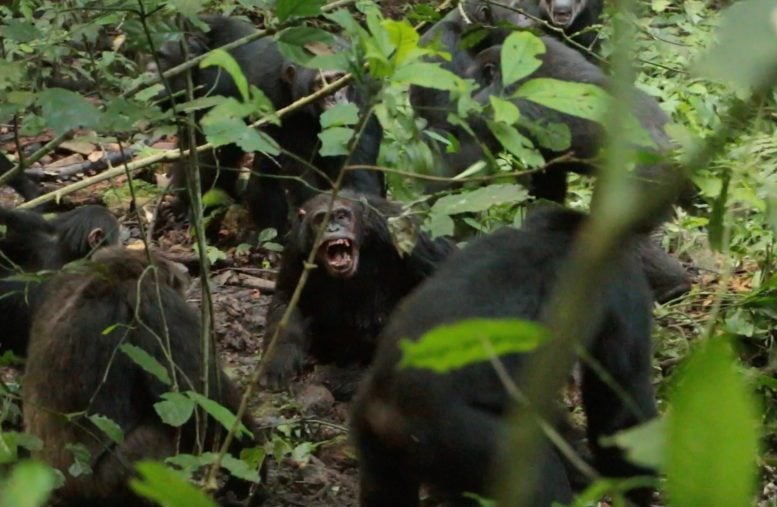
Wild chimpanzees in Uganda split into two separate communities and later engaged in deadly attacks against each other. Researchers believe the conflict shows how social relationships alone can fuel polarization and violence.
The world’s largest known community of wild chimpanzees has permanently divided into two separate groups. Researchers from the University of Texas at Austin and other institutions reported the rare event in the journal Science, documenting the first clearly confirmed permanent split among wild chimpanzees and the deadly violence that followed. The study is based on 30 years of observations of the Ngogo chimpanzees in Uganda’s Kibale National Park, a population featured in the Netflix series Chimp Empire.
For the first 20 years of research, the chimpanzee community remained united. Individuals regularly moved among flexible subgroups, known as “clusters,” while maintaining social bonds across the larger group. This fission-fusion social structure is common in chimpanzees, with members temporarily separating and later rejoining.
That pattern began to change in 2015, when researchers noticed growing division between the Western and Central clusters, which increasingly avoided one another. The shift happened alongside changes in the male dominance hierarchy and followed the deaths of several adult males who may have helped keep the larger community connected.
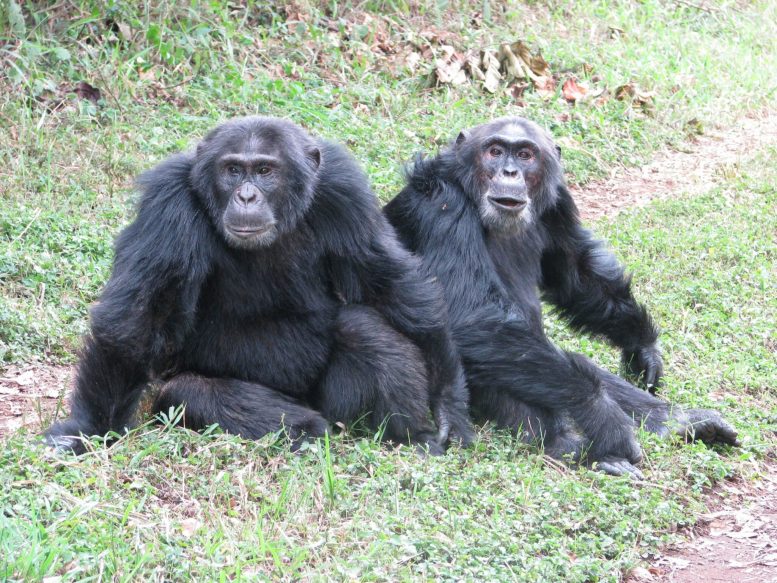
Deadly Violence Erupts Between Former Allies
By 2018, the split had become permanent. The chimpanzees formed two independent groups, Western and Central, each occupying its own territory. Afterward, the Western group launched a series of deadly attacks against members of the Central group. From 2018 through 2024, researchers directly observed or strongly inferred seven attacks on adult males and 17 attacks on infants.
“What’s especially striking is that the chimpanzees are killing former group members,” says Aaron Sandel, associate professor of anthropology at UT Austin and the study’s lead author. “The new group identities are overriding cooperative relationships that had existed for years.”
Why Permanent Chimpanzee Fissions Are So Rare
Many primate species naturally divide into smaller groups over time, often reducing competition for food and other resources. Permanent splits among chimpanzees, however, are extremely uncommon. Genetic evidence suggests they may happen only about once every 500 years. The only other documented case occurred in the 1970s at Gombe, Tanzania, during Jane Goodall’s long-running research project.
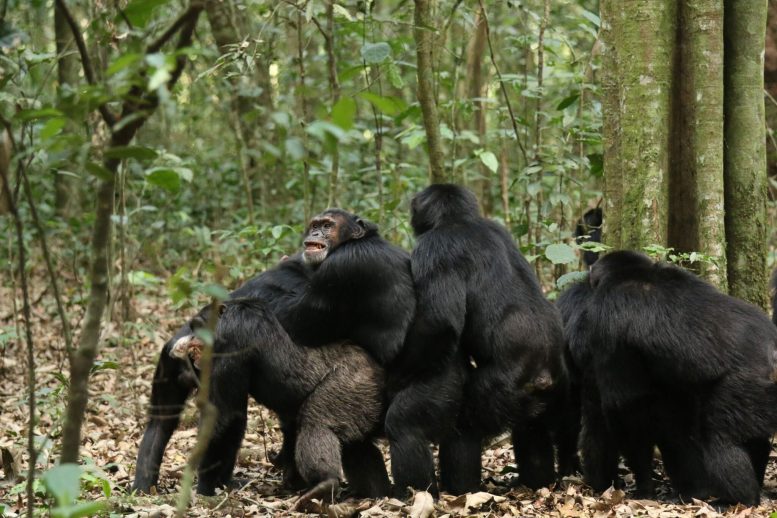
That earlier case has remained controversial because researchers at Gombe provided food to the chimpanzees. At Ngogo, no food provisioning took place, giving scientists a more complete and natural view of chimpanzee behavior. The research also benefited from nearly 30 years of work led by John Mitani, emeritus professor of anthropology at the University of Michigan, along with a large team of researchers and Ugandan field staff.
“I would caution against anyone calling this a civil war,” says Sandel. “But the polarization and collective violence that we have observed with these chimpanzees may give us insight into our own species.”
What Chimp Conflict Reveals About Human Violence
The researchers say their findings challenge the idea that human warfare, including civil wars, is driven mainly by cultural identities such as ethnicity or religion.
“If relational dynamics alone can drive polarization and lethal conflict in chimps without language, ethnicity, or ideology, then in humans, those cultural markers might be secondary to something more basic,” says Sandel. “If that’s true, then we may have the potential to reduce societal conflicts in our personal lives, and that gives me hope. As our paper concludes, it may be in the small, daily acts of reconciliation and reunion between individuals that we find opportunities for peace.”
Reference: “Lethal conflict after group fission in wild chimpanzees” by Aaron A. Sandel, Yixuan He, Junpeng Ren, Yik Lun Kei, Kevin C. Lee, Isabelle R. Clark, Rachna B. Reddy, Jacob D. Negrey, Charles Birungi, Blessing A. Apamaku, Diana Kanweri, Davis Kalunga, Christopher Aliganyira, Sebastián Ramírez-Amaya, Phionah Nakayima, Raymond Katumba, Brian Kamugyisha, Daniela Acosta-Florez, Bas van Boekholt, Godfrey Mbabazi, Erone Akamumpa, Sharifah Namaganda, Alfred Tumusiime, Samuel Angedakin, Gesine Reinert, Oscar Madrid-Padilla, Mihai Cucuringu, David Wipf, Kevin E. Langergraber, David P. Watts and John C. Mitani, 9 April 2026, Science.
DOI: 10.1126/science.adz4944
Never miss a breakthrough: Join the SciTechDaily newsletter.
Follow us on Google and Google News.
11 Comments
So psychopathic chimps also stir up trouble for their own ends. How very human.
Oh. So they’re devolving into trumpanzees. Right.
You are a asshole!! This is about chimpanzees. Always a demorat to put a story about chimpanzees in a comment about there dumb ass childlike feelings about the other side. Don’t you have a demonstration you have to go to with your fat ass green colored hair trans and old hippie men that have to do what there wife tells them to do.
Lol
Hey Frank
There = that way / in that place.
Their = belonging to them.
Therefore “their” wife NOT “there” wife.
Thank you
Maybe you should have tried a little harder to finish the third grade there Frank old boy.
It’s pretty apparent why you’re so sensitive about chimps.
But they look like the Obamuz.
thanks for this
I watched the documentary with Jackson and his reign and the violence between the 2 groups on Netflix, as a matter of fact i have watched the 4 Part series 4 times, the filming is incredible and the insight into their world was completely amazing and challenging for them and just to watch. It has given the world a completely new prospective on Chimp groups in the wild, it has been very interesting to watch although captures some very sad parts especially when Jackson passed with his Allie sat beside him holding his hand. The narration was calm and different to what we have come to know with other narrators. It was more their lives in their hands and the similarity between the social behaviour compared to ours was compelling.
Maybe you should have tried a little harder to finish the third grade there Frank old boy.
It’s pretty apparent why you’re so sensitive about chimps.
Mainstream scientists should all commit to dialectical materialism. Their speculation at the end of the article is a materialist worldview. Scientists must be part of the education of the people and spreading materialism and combating false ideologies like liberalism. When the base economic relationship of a society is capitalist exploitation of the worker, it doesn’t matter what ideology you put on top of it, society will never be good because the base relationship between people is exploitative. It’s not how we think about the world, it’s about how we produce it that ultimately produces our lives.