

Macaques unintentionally created stone fragments that bear a resemblance to some of the earliest stone artifacts crafted by early hominins.
The study focuses on fresh analyses of stone tools employed by long-tailed macaques in Thailand’s Phang Nga National Park. These primates utilize stone tools to open tough-shelled nuts, frequently causing their hammerstones and anvils to break in the process.
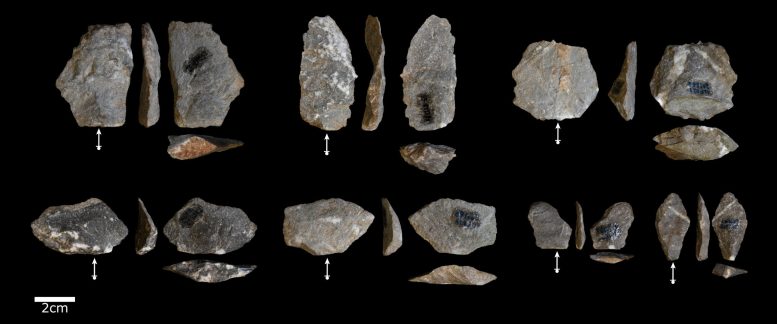
The collection of fragmented stones that results from this process is both significant in size and extensively distributed across the terrain. Furthermore, numerous artifacts exhibit the same traits typically associated with purposefully crafted stone tools found at some of the earliest archaeological sites in East Africa.
“The ability to intentionally make sharp stone flakes is seen as a crucial point in the evolution of hominins, and understanding how and when this occurred is a huge question that is typically investigated through the study of past artifacts and fossils. Our study shows that stone tool production is not unique to humans and our ancestors,” says lead author Tomos Proffitt, a researcher at the Max Planck Institute for Evolutionary Anthropology.
“The fact that these macaques use stone tools to process nuts is not surprising, as they also use tools to gain access to various shellfish as well. What is interesting is that, in doing so they accidentally produce a substantial archaeological record of their own that is partly indistinguishable from some hominin artifacts.”
New Insights Into the Evolution of Stone Tool Technology
By comparing the accidentally produced stone fragments made by the macaques with those from some of the earliest archaeological sites, the researchers were able to show that many of the artifacts produced by monkeys fall within the range of those commonly associated with early hominins.
Co-lead author Jonathan Reeves highlights: “The fact that these artifacts can be produced through nut cracking has implications for the range of behaviors we associate with sharp-edged flakes in the archaeological record..”
The newly discovered macaque stone tools offer new insights into how the first technology might have started in our earliest ancestors and that its origin may have been linked to similar nut cracking behavior which could be substantially older than the current earliest archaeological record.
“Cracking nuts using stone hammers and anvils, similar to what some primates do today, has been suggested by some as a possible precursor to intentional stone tool production. This study, along with previous ones published by our group, opens the door to being able to identify such an archaeological signature in the future,” says Lydia Luncz, senior author of the study and head of the Technological Primates Research Group at the Max Planck Institute for Evolutionary Anthropology.
“This discovery shows how living primates can help researchers investigate the origin and evolution of tool use in our own lineage”
Reference: “Wild macaques challenge the origin of intentional tool production” by Tomos Proffitt, Jonathan S. Reeves, David R. Braun, Suchinda Malaivijitnond and Lydia V. Luncz, 10 March 2023, Science Advances.
DOI: 10.1126/sciadv.ade8159
Never miss a breakthrough: Join the SciTechDaily newsletter.
Follow us on Google and Google News.
1 Comment
I think a lot of such developments came from something accidental like this. The trick is to make the connection between a cracked off flake and using it to cut something.
Some bored individual sat rubbing one piece of wood against another until there was a hot red spot which would quickly die out. So that person did it again, and again, discovering that blowing on it made it brighter, bits of dry grass touched to it also glowed red, and so on until a deliberately ignited fire. That was the turning point. Within a week everyone in the group would know how to do it. Not very long after that came organisation – having one fire burning continuously, where to place it, digging a fire pit or piling stones around it, clearing the surroundings.