
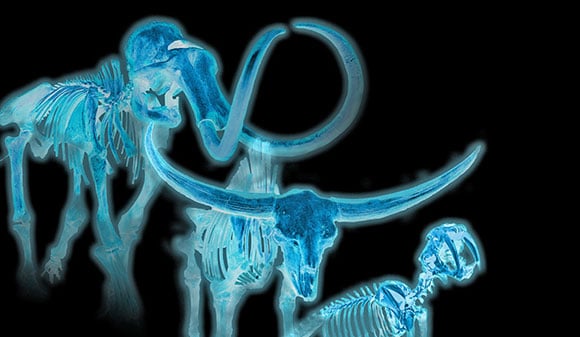
New research from Yale University is using data from prehistoric extinctions to teach valuable, real-world lessons about what happens to an ecosystem when its most distinct species go extinct.
Researcher Matt Davis tracked the history of some of the world’s largest mammals and the roles they played within their respective environments. The findings appear in the January 11 online edition of the journal Proceedings of the Royal Society B.
On the plus side, Davis said, the Ice Age wasn’t as hard on functional diversity — the role that an animal plays within an ecosystem — as previously thought. Animals that survived the Ice Age, such as the beaver, proved to be just as distinct as those that did not survive. On the minus side, Davis found, our planet has reached a point where losing even a handful of key mammals will leave as much of a gap as all of the Ice Age mammal extinctions put together.
The planet lost about 38% of its large-mammal, functional diversity during the Ice Age. Those species included wooly mammoths, giant ground sloths, stout-legged llamas, and giant beavers.
“You can think of it like a big tent where every animal is holding a pole to keep the tent up,” said Davis, a graduate student in Yale’s Department of Geology and Geophysics. “We lost a lot of species when humans first arrived in North America, so part of our tent fell down — but not as big of a part as we previously thought. However, now we only have a few animals left holding up those poles. If they die, the whole tent could collapse.”
The study looked at 94 large mammal species in North America over the last 50,000 years. These included Columbian mammoths, Canadian lynx, long-horned bison, and sabertooth, as well as cougars, moose, coyotes, elk, raccoons, dogs, and cows.
One aim of the study was to examine the relationship between functional diversity and extinction risk: Were the most distinct species the ones most at risk? Davis found that for large Ice Age mammals in North America, distinct species with unique traits were not more likely to go extinct. That is why the Ice Age extinctions were not as harsh on the surrounding ecosystems, Davis said.
In the case of mammoths, nothing was able to replace their lost function — essentially, being really, really big — once they were gone. However, Davis found that European domestic animals, introduced later, did restore some functional diversity. Another example of this is burros, which came along after the extinction of Shasta ground sloths. Both the burro and the Shasta ground sloth share similar diets and body masses.
For today’s species, such redundancies in functionality are much less frequent, Davis explained. Vulnerable species like polar bears, jaguars, and giant anteaters have no functional equivalent.
“Examining the past through the fossil record actually allows us to better predict future extinctions,” Davis said. “We can’t understand how valuable or vulnerable species are today without considering the ‘ghosts’ of those species that died before them.”
Partial funding for the study came from the Yale Institute for Biospheric Studies, the Geological Society of America, the American Society of Mammalogists, and a Smithsonian Institution Predoctoral Fellowship.
Reference: “What North America’s skeleton crew of megafauna tells us about community disassembly” Matt Davis, 11 January 2017, Proceedings of the Royal Society B.
DOI: 10.1098/rspb.2016.2116
Never miss a breakthrough: Join the SciTechDaily newsletter.
Follow us on Google and Google News.
1 Comment
Size of the animal in the history of evolution depends on 1)availability of food 2)Their adaptation to reach the food without themselves getting destroyed by their predators. 3) Their ability to fly to keep away from danger or to climb the trees to keep them away from dangers. 4) Their adaptation to metabolism to digest first plants and then carnivorous food if plant food is not available in plenty. Once they are adapted to cooked food they can’t go back to raw meat and irreversibility. The size of the animal is also dependent on availability of oxygen in the atmosphere which were less in the beginning calling for large lungs to inhale and once adequate oxygen is built up in the atmosphere size became smaller. Insects were built up without lungs being aerobic in the body throughout. Thus we can infer that man’s extinction will be in a very short period because he has built himself up with all the comforts of life which will become inevitable to survive without them. Animals have a small demand regimen to survive. By the by the longevity of the animals is also dependent on the size where if they are small they are destined to live much shorter life. The shorter life is compensated by fast reproduction rate like in insects where the life is still shorter. Thank You.