
Close Menu
    Facebook X (Twitter) Instagram
    SciTechDaily
    • Biology
    • Chemistry
    • Earth
    • Health
    • Physics
    • Science
    • Space
    • Technology
    Facebook X (Twitter) Pinterest YouTube RSS
    SciTechDaily
    Home»Science»Carbonemys Was a Giant Turtle From Late Paleocene
    Science

    Carbonemys Was a Giant Turtle From Late Paleocene

    By SciTechDailyMay 22, 20122 Comments2 Mins Read
    Facebook Twitter Pinterest Telegram LinkedIn WhatsApp Email Reddit
    Share
    Facebook Twitter LinkedIn Pinterest Telegram Email Reddit
    carbonemys-cofrinii-giant-turtle-paleocene
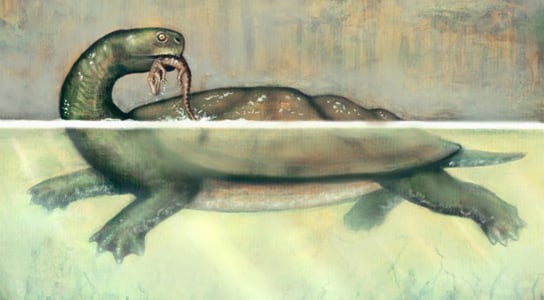
    Artist’s illustration of giant turtle Carbonemys cofrinii.

    Carbonemys roamed the Earth around the same time as the 40-foot (12-meter) Titanoboa, about 60 million years ago, during the late Paleocene, in the region that is now northern Colombia. In that era, reptiles were the dominant creatures on Earth.

    Carbonemys cofrinii was big by modern-day standards, and a team of paleontologists, led by Edwin Cadena and Daniel Ksepka, recently published their discovery in the Journal of Systematic Palaeontology about finding the creature’s skull. C. cofrinii was the size of a small car, and its skull was about 10 inches (25 centimeters) long. The fossilized carapace found nearby measures 5’7″ (1.7 meters) in length.
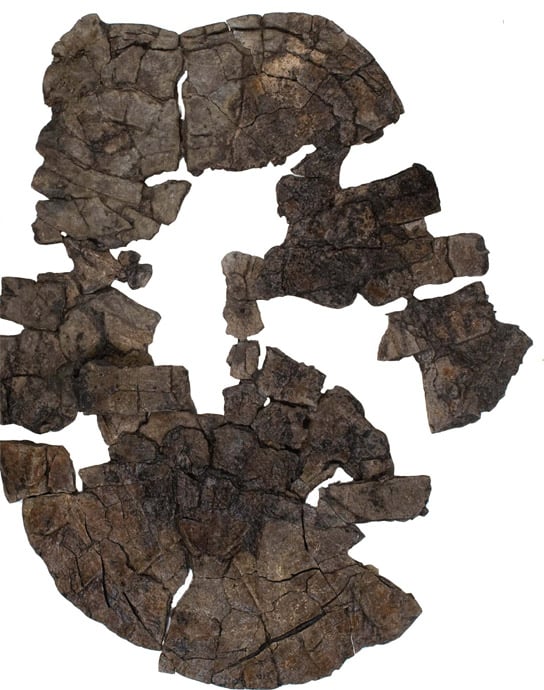
    carbonemys-cofrinii-giant-turtle-paleocene-carapace-shell

    While this doesn’t make C. cofrinii the biggest turtle of all, it was still large enough to prey upon other inhabitants of the Paleocene swamp. It might have been an enormous ambush predator, feasting on small crocodilians and other smaller animals.

    It’s hoped that future analysis will allow paleontologists to understand the turtle’s natural history. It’s also somewhat perplexing that there were so many large reptiles in the same area. One hypothesis entails that the growth of these reptiles is due to the warmer climate of the region, making them balloon to cope with the hothouse world. Then again, the largest turtles, panpelomedusidae, are present in the fossil record during a much cooler period.

    There might be some yet unknown ecological influences. The creature was most probably an omnivore, feasting on anything from mollusks to crocodilians to sate itself.

    Reference: “New pelomedusoid turtles from the late Palaeocene Cerrejón Formation of Colombia and their implications for phylogeny and body size evolution” by Edwin A. Cadena, Daniel T. Ksepka, Carlos A. Jaramillo and Jonathan I. Bloch, 17 May 2012, Journal of Systematic Palaeontology.
    DOI: 10.1080/14772019.2011.569031

    Never miss a breakthrough: Join the SciTechDaily newsletter.
    Follow us on Google and Google News.

    Fossils Paleocene Paleontology Turtle
    Share. Facebook Twitter Pinterest LinkedIn Email Reddit

    Related Articles

    50-Million-Year-Old Sea Turtle Unearthed in Syria Stuns Paleontologists

    The “Turtwig” Revelation: Unveiling a Baby Turtle Disguised as a Plant Fossil

    127 Million Years Old – First Side-Necked Turtle Ever Discovered in UK

    Turtles Share a Recent Common Ancestor with Birds and Crocodiles

    Burtele Foot Points to Other Past Hominins

    Titanoboa, a Paleogene Period 40-Foot Long Snake

    Microraptor Feathers Were Black With Iridescent Sheen

    Jurassic Period Super-Sized Fleas Had Armored Mouthparts to Attack the Thick Hide of Dinosaurs

    Hundreds of Lost Fossils From the Darwin Collection Rediscovered by the British Geological Survey

    2 Comments

    1. ww on May 18, 2020 6:59 pm

      w

      Reply
    2. Pixeldog on May 14, 2026 6:18 pm

      It’s tortoise, surely – no flippers, just legs and feet.

      Reply
    Leave A Reply Cancel Reply

    • Facebook
    • Twitter
    • Pinterest
    • YouTube

    Don't Miss a Discovery

    Subscribe for the Latest in Science & Tech!

    Trending News

    Your Blood Pressure Reading Could Be Wrong Because of One Simple Mistake

    Astronomers Stunned by Ancient Galaxy With No Spin

    Physicists May Be on the Verge of Discovering “New Physics” at CERN

    Scientists Solve 320-Million-Year Mystery of Reptile Skin Armor

    Scientists Say This Daily Walking Habit May Be the Secret to Keeping Weight Off After Dieting

    New Therapy Rewires the Brain To Restore Joy in Depression Patients

    Giant Squid Detected off Western Australia in Stunning Deep-Sea Discovery

    Popular Sugar-Free Sweetener Linked to Liver Disease, Study Warns

    Follow SciTechDaily
    • Facebook
    • Twitter
    • YouTube
    • Pinterest
    • Newsletter
    • RSS
    SciTech News
    • Biology News
    • Chemistry News
    • Earth News
    • Health News
    • Physics News
    • Science News
    • Space News
    • Technology News
    Recent Posts
    • Key Magic Mushroom Ingredient Increases Laziness and Reduces Aggression
    • Researchers Solve 15-Year Mystery Behind Cancer-Causing Gut Toxin
    • One of the World’s Most Popular Weedkillers May Be Fueling Deadly Superbugs
    • Scientists Create Laser “Whirlpools” That Spin Tiny Cells Without Touching Them
    • Scientists Discover “Hidden” Materials That Could Transform Clean Energy and Batteries
    Copyright © 1998 - 2026 SciTechDaily. All Rights Reserved.
    • Science News
    • About
    • Contact
    • Editorial Board
    • Privacy Policy
    • Terms of Use

    Type above and press Enter to search. Press Esc to cancel.