
Close Menu
    Facebook X (Twitter) Instagram
    SciTechDaily
    • Biology
    • Chemistry
    • Earth
    • Health
    • Physics
    • Science
    • Space
    • Technology
    Facebook X (Twitter) Pinterest YouTube RSS
    SciTechDaily
    Home»Space»The Behavior of Interstellar Dust Grains
    Space

    The Behavior of Interstellar Dust Grains

    By Harvard-Smithsonian Center for AstrophysicsNovember 13, 2012No Comments4 Mins Read
    Facebook Twitter Pinterest Telegram LinkedIn WhatsApp Email Reddit
    Share
    Facebook Twitter LinkedIn Pinterest Telegram Email Reddit
    Heliosphere Artist's Concept Image
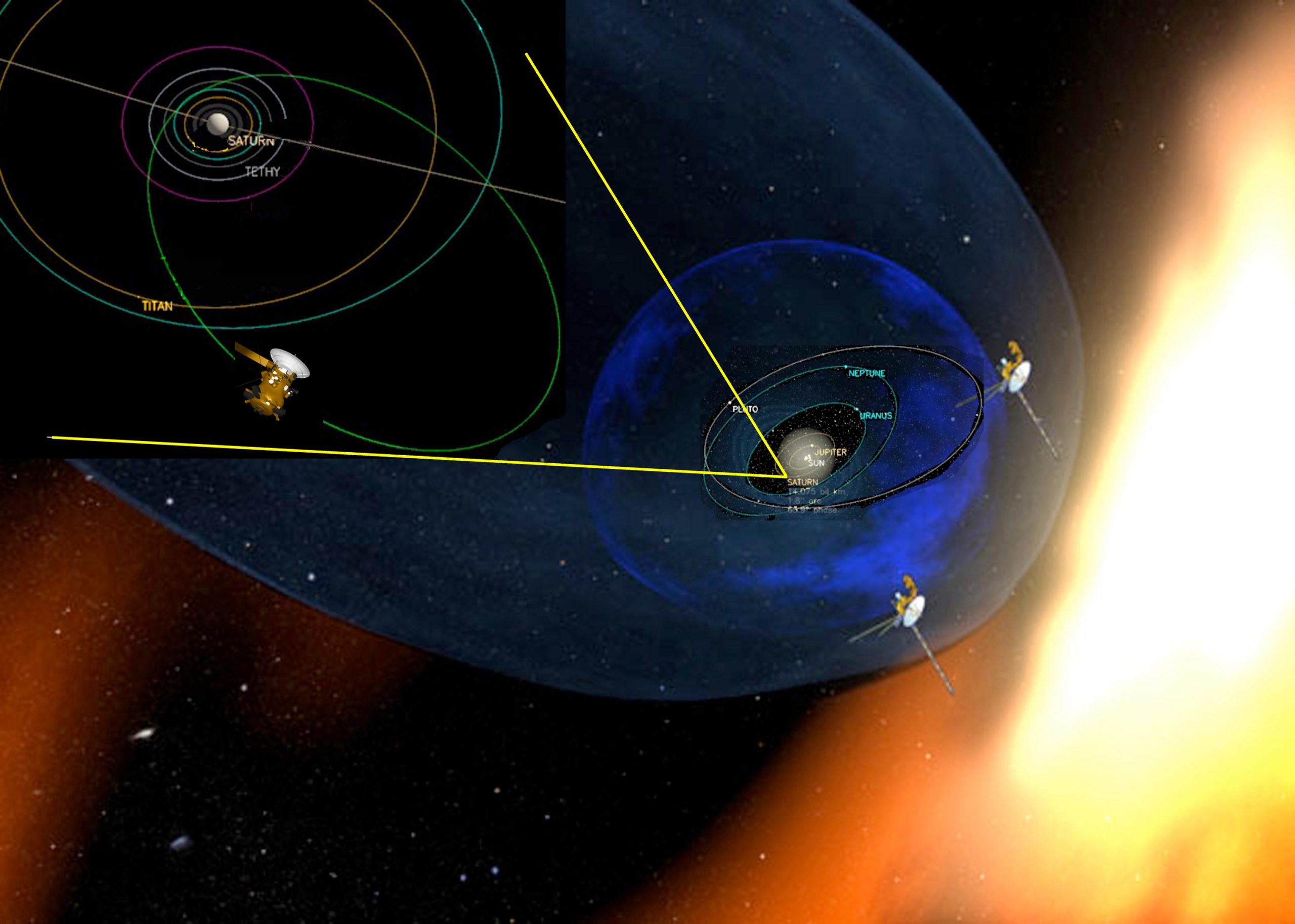
    An artist’s concept of the heliosphere (seen in blue, including a shocked region). The Earth is at 1 AU, and the two Voyager spacecraft are seen beyond 100 AU (the Cassini spacecraft at Saturn is also shown). A new study investigates what happens to interstellar dust that encounters the solar system and the Sun’s heliosphere. Credit: NASA and JHU/APL

    In a newly published study, a team of scientists report the results of their theoretical models of the behavior of interstellar dust grains as the Sun moves through space.

    The space between stars is not empty. It contains copious but diffuse amounts of gas and dust. In fact, about 5-10% of the total mass of our Milky Way galaxy is in interstellar gas. About 1% of the mass of this interstellar material, quite a lot in astronomical terms, is in the form of tiny dust grains made predominantly of silicates (sand too is made of silicates), though some grains are also composed of carbon and other elements.

    Dust grains are important. They block visible light while emitting infrared light, and thus help determine what astronomers can see while controlling much of the energy balance in the interstellar medium (ISM) by virtue of the absorption and subsequent re-emission at longer wavelengths of light from stars. Dust is also essential to the chemistry that takes place in the ISM because it provides gas molecules with a surface on which to react with other molecules. Not least, dust contains a large fraction of many important elements in the universe like silicon, carbon, and iron. Moreover, astronomers think that at some stage in the evolution of new stars, the dust around them will coagulate into large clumps — the first step towards forming planets.

    Harvard-Smithsonian Center for Astrophysics (CfA) astronomer Jonathan Slavin and a team of six other astronomers wondered what happens to interstellar dust when it wanders into the solar system and gets close enough to the Sun to fall under the influence of its radiation, winds, and gravity. They note that the Sun (and its planets) is moving through a low-density cloud of partially ionized gas. This motion, together with the wind of particles that the Sun emits, produces a bow-shaped region called the heliosphere, the bow-shaped end of which is about 100 AU from the Sun (one AU is the average distance of the Earth from the Sun).

    Writing in the latest issue of the Astrophysical Journal, the scientists report on the results of their theoretical models of the behavior of interstellar dust grains as the Sun moves through space. They build on in-situ observations of the heliosphere taken when the Voyager 1 and Voyager 2 spacecraft on their outward journey encountered the edges of the heliosphere, results that constrain its size and shape.

    Assuming typical grains made of olivine silicates, the team finds that the small grains (less than the wavelength of ultraviolet light) stay far away from the Sun, that gravity helps the large grains collect near the Sun, but that intermediate-sized grains — about the size of the wavelength of optical light — can actually pile up in diffuse structures at the edges of the heliosphere.

    Besides providing important new information on dust grains in the solar system, the new results suggest that radiation from these intermediate-sized grain structures could contaminate the images of the sky used to measure the cosmic backgrounds.

    Reference: “The Interstellar Magnetic Field Close to the Sun. II.” by P. C. Frisch, B-G Andersson, A. Berdyugin, V. Piirola, R. DeMajistre, H. O. Funsten, A. M. Magalhaes, D. B. Seriacopi, D. J. McComas, N. A. Schwadron, J. D. Slavin and S. J. Wiktorowicz, 9 November 2012, The Astrophysical Journal.
    DOI: 10.1088/0004-637X/760/2/106

    Never miss a breakthrough: Join the SciTechDaily newsletter.
    Follow us on Google and Google News.

    Astronomy Astrophysics Harvard-Smithsonian Center for Astrophysics NASA
    Share. Facebook Twitter Pinterest LinkedIn Email Reddit

    Related Articles

    Spacecraft Enters the Sun’s Blistering Hot Corona for the First Time in History

    Mysterious Dusty Object Discovered by Astronomers Using NASA’s TESS Planet Hunter

    Astronomers Spy Quartet of Enormous Cavities From Giant Black Holes

    Astronomers Use “X-Ray Magnifying Glass” To Enhance View of Distant Black Holes

    Astronomers Spot Unusual, Enormous Rings Around a Black Hole

    Chandra Catches Extraordinary “Slingshot” During Titanic Space Collision

    How Habitable Are Planets That Orbit Red Dwarfs – The Most Common Type of Stars in the Galaxy?

    How Do the Most Massive Stars Explode? Bubbles With Titanium Trigger Titanic Explosions

    New All-Sky Map of Milky Way’s Outer Reaches Released – Could Offer a New Test of Dark Matter Theories

    Leave A Reply Cancel Reply

    • Facebook
    • Twitter
    • Pinterest
    • YouTube

    Don't Miss a Discovery

    Subscribe for the Latest in Science & Tech!

    Trending News

    Breakthrough Bowel Cancer Trial Leaves Patients Cancer-Free for Nearly 3 Years

    Natural Compound Shows Powerful Potential Against Rheumatoid Arthritis

    100,000-Year-Old Neanderthal Fossils in Poland Reveal Unexpected Genetic Connections

    Simple “Gut Reset” May Prevent Weight Gain After Ozempic or Wegovy

    2.8 Days to Disaster: Scientists Warn Low Earth Orbit Could Suddenly Collapse

    Common Food Compound Shows Surprising Power Against Superbugs

    5 Simple Ways To Remember More and Forget Less

    The Atomic Gap That Could Cost the Semiconductor Industry Billions

    Follow SciTechDaily
    • Facebook
    • Twitter
    • YouTube
    • Pinterest
    • Newsletter
    • RSS
    SciTech News
    • Biology News
    • Chemistry News
    • Earth News
    • Health News
    • Physics News
    • Science News
    • Space News
    • Technology News
    Recent Posts
    • After 37 Years, the World’s Longest-Running Soil Warming Experiment Uncovers a Startling Climate Secret
    • NASA Satellite Captures First-Ever High-Res View of Massive Pacific Tsunami
    • ADHD Isn’t Just a Deficit: Study Reveals Powerful Hidden Strengths
    • Scientists Uncover “Astonishing” Hidden Property of Light
    • Scientists Discover Stem Cells That Could Regrow Teeth and Bone
    Copyright © 1998 - 2026 SciTechDaily. All Rights Reserved.
    • Science News
    • About
    • Contact
    • Editorial Board
    • Privacy Policy
    • Terms of Use

    Type above and press Enter to search. Press Esc to cancel.