
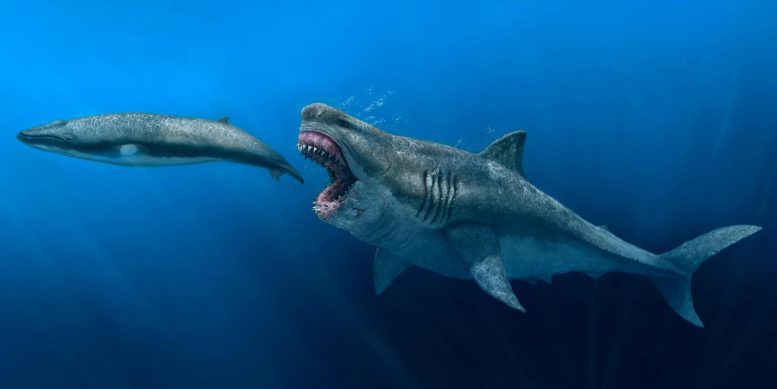
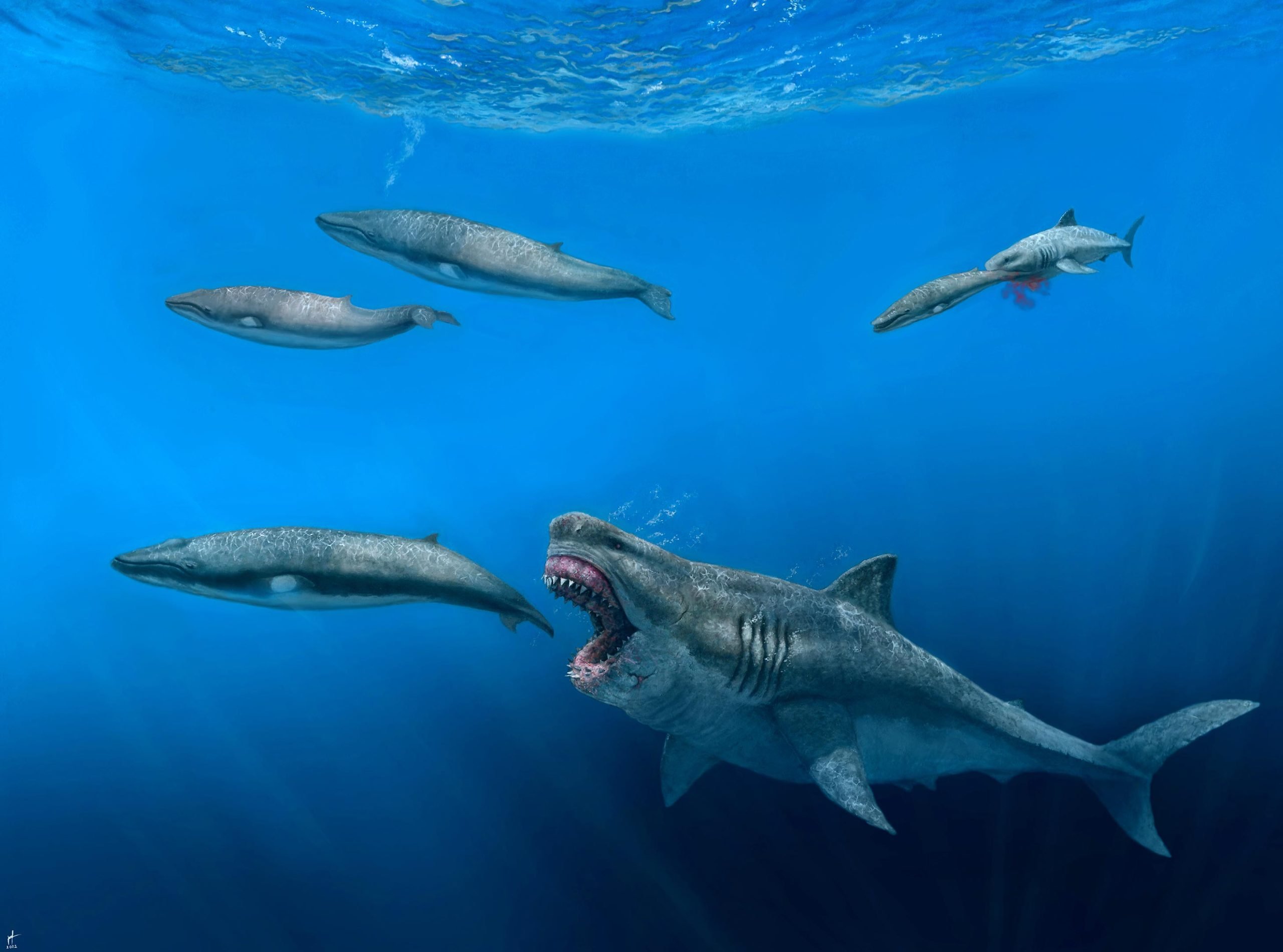
Megalodon, the largest shark that ever lived, is famous for its gigantic, human-hand-sized teeth. However, there is little fossil evidence of its whole body. International researchers in collaboration with the University of Zurich used an exceptionally preserved specimen to create a 3D computer model of its full body. According to their results, the megalodon could fully consume prey the size of today’s killer whales and then roam the seas without more food for two months.
The reconstructed megadolon (Otodus megalodon) was 16 meters (52 feet) long and weighed over 61 tons. It was estimated that it could swim at around 1.4 meters per second (3.1 mph), required over 98,000 kilo calories every day, and had a stomach volume of almost 10,000 liters (2,600 gallons). These results suggest that the megalodon could travel long distances and was capable of eating whole prey up to 8 meters (26 feet) long. Notably, this is the size of modern killer whales, today’s top ocean predator. An ability to eat large apex predators of comparable size millions of years ago places megalodon at a higher trophic level than modern top predators.
Well-Preserved Spine Enables Reconstruction
These are the findings of an international study carried out in collaboration with the University of Zurich and published on August 17 in Science Advances. The research was only possible due to the 3D modeling of one individual megalodon which was discovered in the 1860s. Against all odds, a sizeable portion of its vertebral column was left behind in the fossil record after the creature died in the Miocene oceans of Belgium about 18 million years ago. It is estimated that it was 46 years old when it died.
“These results suggest that this giant shark was a trans-oceanic super-apex predator.” Catalina Pimiento
“Shark teeth are common fossils because of their hard composition which allows them to remain well preserved,” says first author Jack Cooper, PhD student at Swansea University. “However, their skeletons are made of cartilage, so they rarely fossilize. The megalodon vertebral column from the Royal Belgian Institute of Natural Sciences is, therefore, a one-of-a-kind fossil.”
From single vertebra to whole body mass
The research team, which includes researchers from Switzerland, the UK, the United States, Australia, and South Africa, first measured and scanned every single vertebra, before reconstructing the entire column. Next, they attached the column to a 3D scan of a megalodon’s dentition from the United States. Finally, they completed the model by adding “flesh” around the skeleton using a 3D scan of the body of a great white shark from South Africa.
“Weight is one of the most important traits of any animal. For extinct animals we can estimate the body mass with modern 3D digital modeling methods and then establish the relationship between mass and other biological properties such as speed and energy usage,” says co-author John Hutchinson, professor at the Royal Veterinary College in the UK.
A Trans-Oceanic Super-Apex Predator
The high energetic demand would have been met by feeding on the calorie-rich blubber of whales, in which megalodon bite marks have previously been found in the fossil record. An optimal foraging model of potential megalodon prey encounters found that eating a single 8-meter-long (26-foot-long) whale may have allowed the shark to swim thousands of miles across oceans without eating again for two months.
“These results suggest that this giant shark was a trans-oceanic super-apex predator,” says Catalina Pimiento, Professor at the University of Zurich and senior author of the study. “The extinction of this iconic giant shark likely impacted global nutrient transport and released large cetaceans from a strong predatory pressure.”
The complete 3D model can now be used as a basis for future reconstructions and further research. The novel biological inferences drawn from this research represent a leap in our knowledge of this singular super predator. The study helps to better understand the ecological function that megafaunal species play in marine ecosystems and the large-scale consequences of their extinction.
Reference: “The extinct shark Otodus megalodon was a transoceanic superpredator: Inferences from 3D modeling” by Jack A. Cooper, John R. Hutchinson, David C. Bernvi, Geremy Cliff, Rory P. Wilson, Matt L. Dicken, Jan Menzel, Stephen Wroe, Jeanette Pirlo and Catalina Pimiento, 17 August 2022, Science Advances.
DOI: 10.1126/sciadv.abm9424
Never miss a breakthrough: Join the SciTechDaily newsletter.
Follow us on Google and Google News.