
Close Menu
    Facebook X (Twitter) Instagram
    SciTechDaily
    • Biology
    • Chemistry
    • Earth
    • Health
    • Physics
    • Science
    • Space
    • Technology
    Facebook X (Twitter) Pinterest YouTube RSS
    SciTechDaily
    Home»Science»Teenager’s Fossil Find Leads to Discovery of Shark Teeth in 5 Million-Year-Old Whale Skull
    Science

    Teenager’s Fossil Find Leads to Discovery of Shark Teeth in 5 Million-Year-Old Whale Skull

    By Bournemouth UniversityApril 2, 2026No Comments5 Mins Read
    Facebook Twitter Pinterest Telegram LinkedIn WhatsApp Email Reddit
    Share
    Facebook Twitter LinkedIn Pinterest Telegram Email Reddit
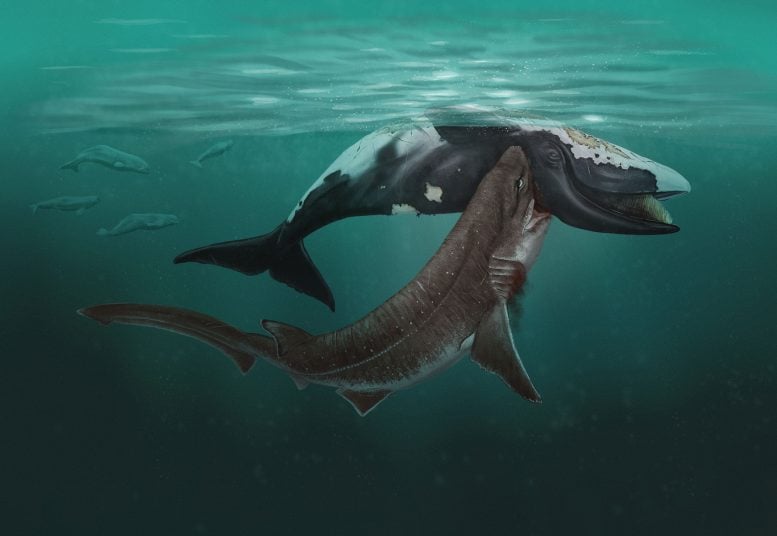
    Painting of a Shark Scavenging on a Whale
    A painted reconstruction of a bluntnose six-gill shark (or cow shark) scavenging on a tiny extinct right whale carcass during the Early Pliocene of the southern North Sea. A pod of an extinct whale related to today’s belugas swimming in the background. Credit: Alexander Lovegrove

    Shark teeth found in 5-million-year-old whale skulls provide direct evidence of ancient feeding behavior and predator-prey relationships in the North Sea.

    Researchers studying two fossilized whale skulls discovered pieces of shark teeth lodged inside the bones, providing rare physical evidence of prehistoric feeding behavior in northern European waters.

    The research, led by the Royal Belgian Institute of Natural Sciences (RBINS), used detailed CT scans to examine the skulls. These scans revealed broken shark teeth that became embedded in the whales’ skulls during feeding, allowing scientists to better understand how these predators interacted with their prey.

    Dr. Olivier Lambert, a paleontologist at the Institute of Natural Sciences who examined the fossils, said, “Our knowledge of past marine mammal assemblages in the North Sea remains rather fragmentary, so any new fossil may prove informative. In this case, the studied skulls revealed some unexpected and fascinating clues about the way these whales’ lives ended.”
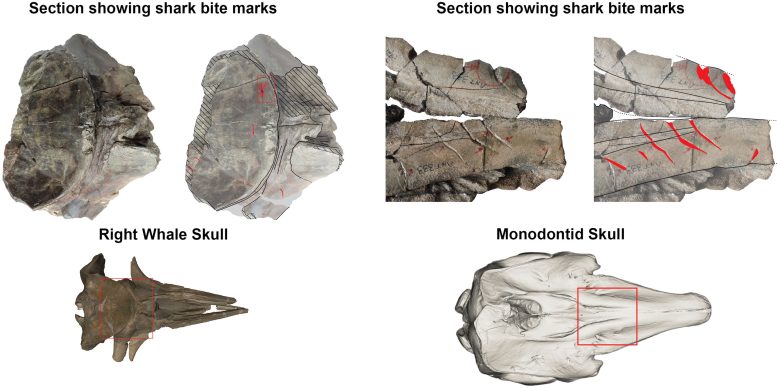
    Images of the Two Fossil Whale Skulls With Bite Marks
    Photographs (left) showing the extinct right whale partial skull with shark bite marks highlighted in red. The more complete skull on the lower part of the illustration is from another individual of the same right whale species. Photographs (right) showing shark bite marks on the rostrum of the monodontid cranium, targeting the fat-rich melon. The skull on the lower part of the illustration is the one of a modern beluga. Credit: Photos and illustrations by Olivier Lambert (RBINS)

    CT Scans and Fossil Discoveries in Belgium

    The skulls date back to the Early Pliocene period, about 4–5 million years ago, and were both found in Belgium. One skull, belonging to a small extinct right whale species, was discovered in the 1980s by Professor John Stewart, an evolutionary paleoecologist at Bournemouth University, while fossil hunting with his father in the Antwerp docks.

    The second skull comes from a monodontid, a relative of today’s beluga and narwhal, and was found by fossil enthusiast Dr. Paul Gigase, a pathologist, along with his son Pierre.
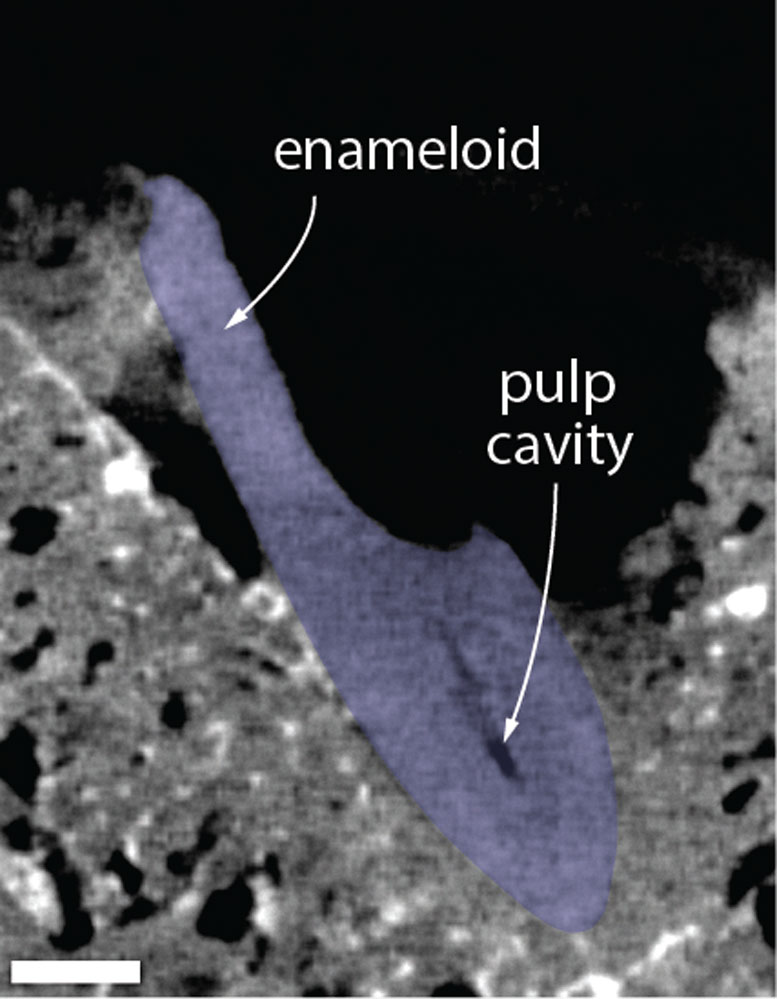
    CT Scan of the Embedded Shark’s Tooth
    CT scan view of the tip of a bluntnose six-gill shark (or cow shark) tooth (blue) found embedded in the extinct right whale skull. Scale bar = 1 mm). Credit: Illustration by Olivier Lambert (RBINS).

    Decades after the first discovery, modern imaging technology has revealed new details hidden inside the fossils. Dr. Lambert, lead author of the study, said, “The CT scans revealed the shape of the teeth, allowing the sharks’ identification without having to damage the skulls. The position of the bite marks in the upper part of the right whale skull tells us that the animal had probably already died when the shark scavenged its carcasses and that it was in a belly-up position, which is common for deceased whales.”

    One of the tooth fragments, found in Professor Stewart’s specimen, came from a cow shark. The other belonged to a species related to the modern great white shark. Neither of these sharks, nor their close relatives, inhabit the southern North Sea today.

    Prehistoric Predator-Prey Dynamics in the North Sea

    Together, these fossils provide a rare look at interactions between large marine predators and whales off the coast of Northern Europe millions of years ago.
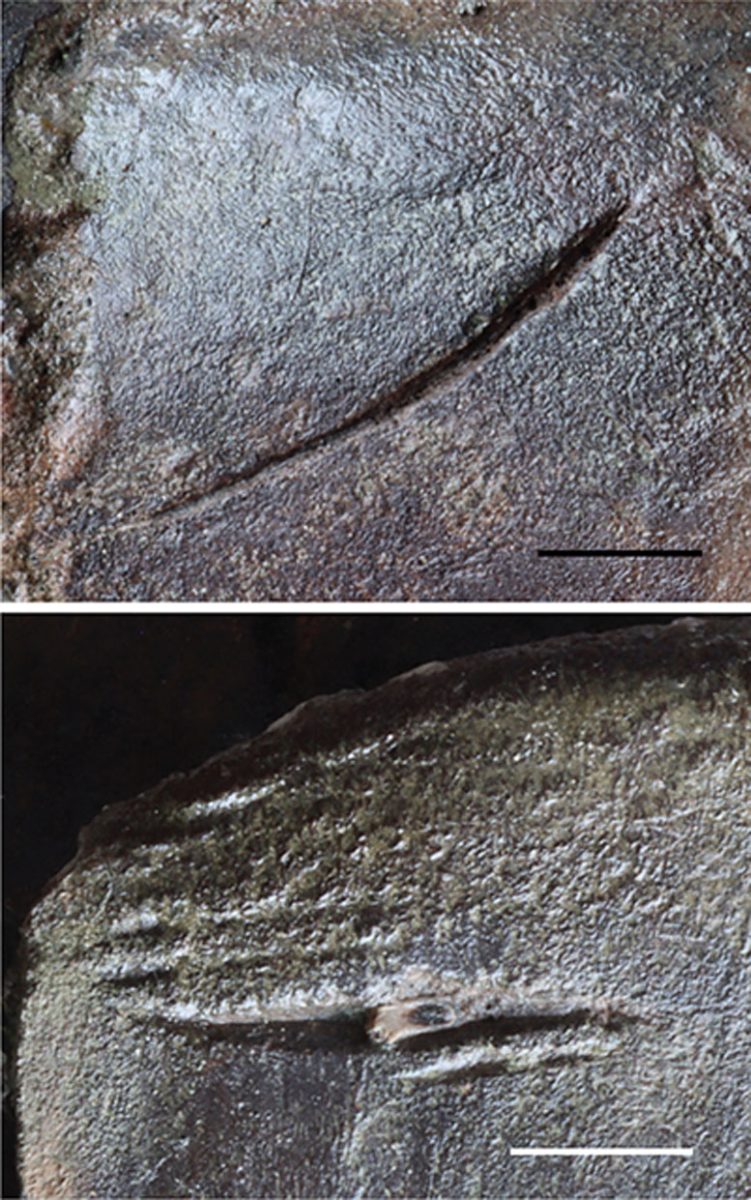
    Photograph of the Bite and Embedded Tooth
    Photo detail of some shark bite marks on the skull of the extinct right whale. The lower photo shows a bite made by the bluntnose six-gill shark, with a tooth tip deeply embedded in the bone. Scale bars = 10 mm. Credit: Photos by Olivier Lambert (RBINS).

    Professor Stewart said, “Paleontologists often have to make assumptions about the interactions between many of the species from this period. This study provides them with actual evidence they can work with—not just bite marks, but fragments from the predators who made the bites.”

    Today, the idea of whales and large predatory sharks sharing the same waters in Northern Europe may seem unusual. However, fossil evidence is helping scientists reconstruct a time when these species coexisted in the region.

    Dr. Lambert said, “These whale skulls provide a rare glimpse into the relationship between large predators and their prey off the coast of Northern Europe 5 million years ago. These findings are a first step towards understanding changes through time in the availability of prey in the southern North Sea and the loss of large predatory sharks in this area. Given that ongoing climate change is altering the distribution of marine mammals, including in the North Sea, it is likely that the distribution of their predators will also change. Could great white sharks return to the North Sea to feed on local seal populations?”

    Reference: “Evidence for different shark species feeding on a diminutive right whale and a relative of the beluga in the Early Pliocene of the southern North Sea” by Olivier Lambert, John R. Stewart, Stephen Louwye, Luc De Coninck, Mark Bosselaers, Lucile Crété, Stijn Goolaerts, Christophe Mallet and Frederik H. Mollen, 18 March 2026, Acta Palaeontologica Polonica.
    DOI:10.4202/app.01297.2025

    Never miss a breakthrough: Join the SciTechDaily newsletter.
    Follow us on Google and Google News.

    Fossils Paleontology Popular Sharks Whales
    Share. Facebook Twitter Pinterest LinkedIn Email Reddit

    Related Articles

    Bizarre 26-Million-Year-Old Fossil of “Shark-Whale” Discovered in Australia

    Bigger Than We Thought? Scientists Reveal New Megalodon Size Estimates

    Ancient Predator Unearthed: New Species of 65 Million-Year-Old Fossil Shark Discovered in Alabama

    Megalodon – The Largest Shark That Ever Lived – Could Eat Prey the Size of Entire Killer Whales

    Jaw Structures of Fossils Seems to Suggest That Three Homo Species Roamed Africa Concurrently

    Prehistoric Fossilized Eocene Epoch Turtles Died Locked In Coitus

    Cretaceous Period Sankofa Pyrenaica Fossilized Eggs Are Unusually Shaped

    Microraptor Feathers Were Black With Iridescent Sheen

    Hundreds of Lost Fossils From the Darwin Collection Rediscovered by the British Geological Survey

    Leave A Reply Cancel Reply

    • Facebook
    • Twitter
    • Pinterest
    • YouTube

    Don't Miss a Discovery

    Subscribe for the Latest in Science & Tech!

    Trending News

    The Universe Is Expanding Too Fast and Scientists Can’t Explain Why

    “Like Liquid Metal”: Scientists Create Strange Shape-Shifting Material

    Early Warning Signals of Esophageal Cancer May Be Hiding in Plain Sight

    Common Blood Pressure Drug Shows Surprising Power Against Deadly Antibiotic-Resistant Superbug

    Scientists Uncover Dangerous Connection Between Serotonin and Heart Valve Disease

    Scientists Discover a “Protector” Protein That Could Help Reverse Hair Loss

    Bone-Strengthening Discovery Could Reverse Osteoporosis

    Scientists Uncover Hidden Trigger Behind Stem Cell Aging

    Follow SciTechDaily
    • Facebook
    • Twitter
    • YouTube
    • Pinterest
    • Newsletter
    • RSS
    SciTech News
    • Biology News
    • Chemistry News
    • Earth News
    • Health News
    • Physics News
    • Science News
    • Space News
    • Technology News
    Recent Posts
    • Drinking Alcohol To Cope in Your 20s Could Damage Your Brain for Life
    • Scientists Crack Alfalfa’s Chromosome Mystery After Decades of Debate
    • Ancient Ant-Plant Alliance Collapses As Predatory Wasps Move In
    • Scientists Discover Tiny New Spider That Hunts Prey 6x Its Size
    • Natural Component From Licorice Shows Promise for Treating Inflammatory Bowel Disease
    Copyright © 1998 - 2026 SciTechDaily. All Rights Reserved.
    • Science News
    • About
    • Contact
    • Editorial Board
    • Privacy Policy
    • Terms of Use

    Type above and press Enter to search. Press Esc to cancel.