
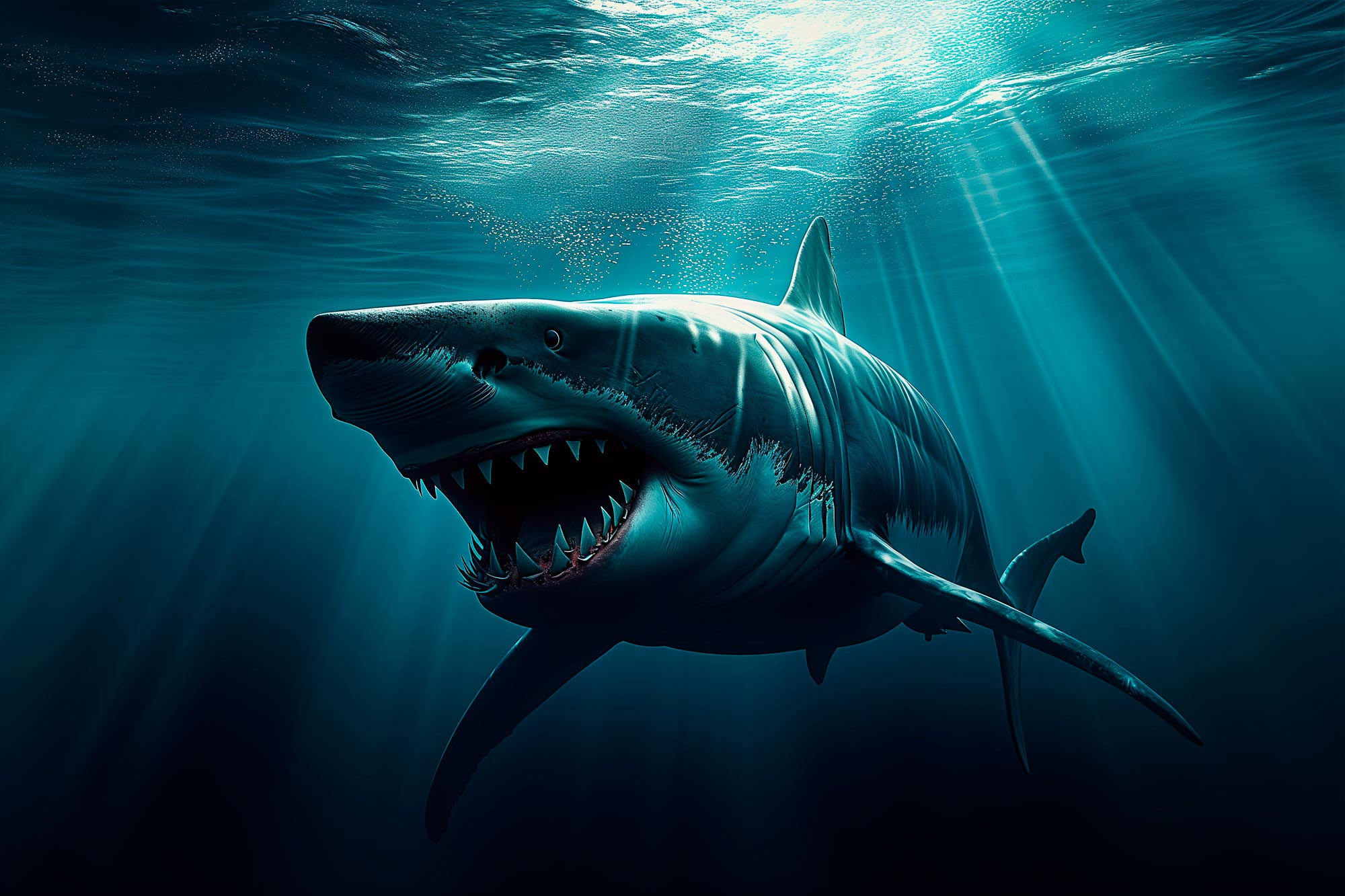
DePaul University Paleobiology Professor Kenshu Shimada is leading a study alongside 28 experts.
A new scientific study offers significant insights into the biology of Megalodon (formally Otodus megalodon), a massive prehistoric shark that lived nearly worldwide between 15 and 3.6 million years ago. Led by paleobiology professor Kenshu Shimada of DePaul University, the study involved 28 experts in shark biology, fossils, and vertebrate anatomy from around the world. The findings will be published in the journal Palaeontologia Electronica.
Megalodon is primarily known from its fossilized serrated teeth, vertebrae, and scales, as no complete skeleton has been discovered. Due to its similar serrated teeth, the modern great white shark (Carcharodon carcharias) has often been used as a model for reconstructing Megalodon’s appearance. Previous studies, along with novels and sci-fi films such as The Meg, have traditionally depicted Megalodon as an enormous version of the great white shark.
Nevertheless, a nearly complete, fossilized vertebral column, or the “trunk” portion, of O. megalodon measuring about 11 meters (36 feet) in length in Belgium has been well-researched. The new study asked a simple question, “How long were the parts not represented in the vertebral column specimen, notably the head and tail lengths of the O. megalodon individual?”
Estimating Megalodon’s True Size
To address the question, the team of researchers from Australia, Austria, Brazil, France, Italy, Japan, Mexico, the U.K., and the U.S. surveyed the proportions of the head, trunk, and tail relative to the total body length across 145 modern and 20 extinct species of sharks. Assuming that O. megalodon had a body plan consistent with the vast majority of sharks, the team determined that its head length and tail length possibly occupied about 16.6% and 32.6%, respectively, of the total body length.
Because the Belgian “trunk” vertebral specimen measures 11 meters, its head and tail were calculated to be about 1.8 meters (6 feet) and 3.6 meters (12 feet) long, respectively, making the estimated total length of 16.4 meters (54 feet) for the specific O. megalodon individual.
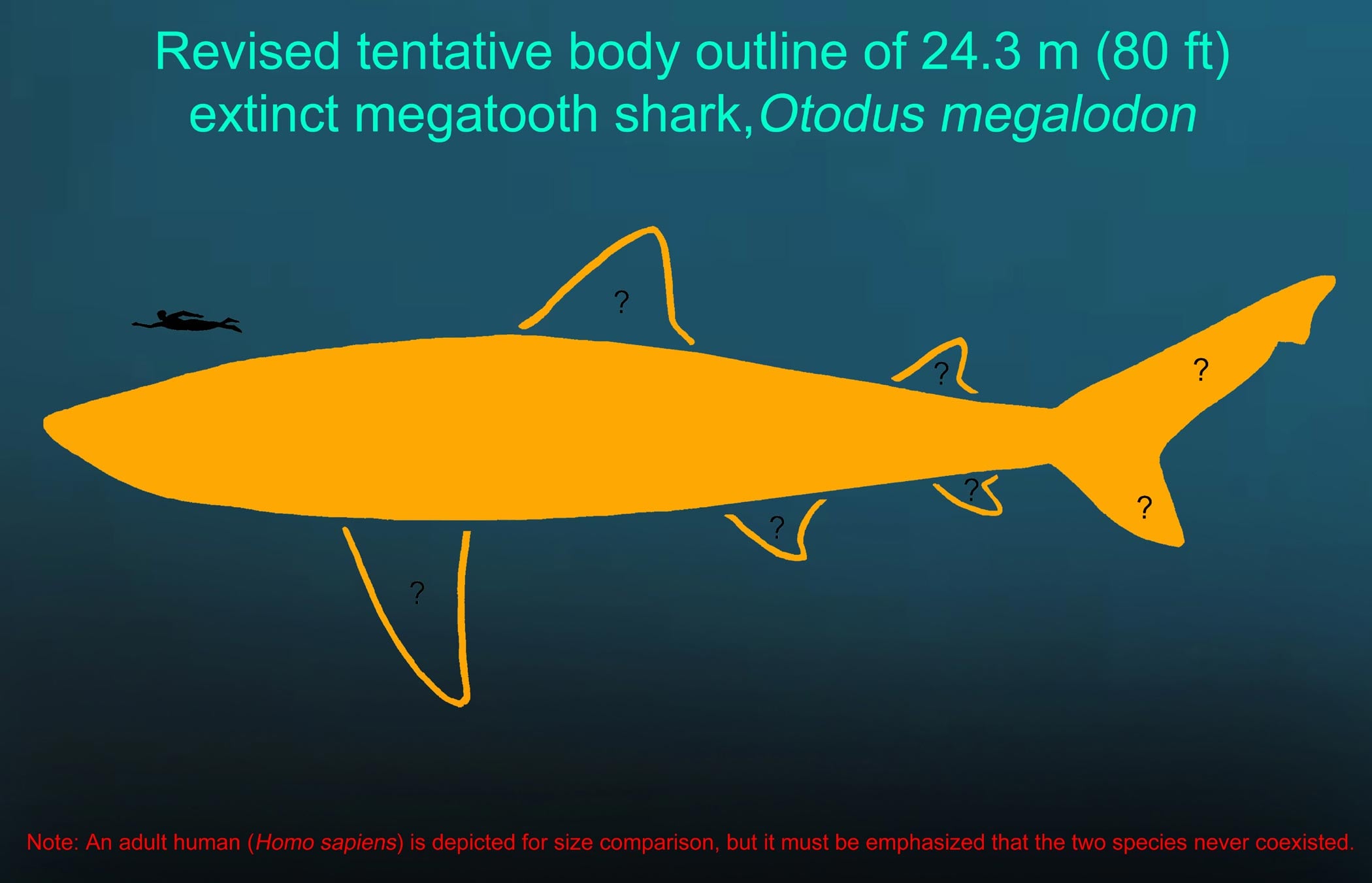
The largest vertebra of the Belgian specimen measures 15.5 centimeters (6 inches) in diameter, but putative O. megalodon vertebrae measuring as much as 23 centimeters (9 inches) in diameter are reported from Denmark. If the Danish vertebrae represent the largest vertebrae in the body, that individual could have measured about 24.3 meters (80 feet) long.
“The length of 24.3 meters is currently the largest possible reasonable estimate for O. megalodon that can be justified based on science and the present fossil record,” said Shimada, who belongs to DePaul University’s Department of Environmental Science and Studies and Department of Biological Sciences.
Shimada and his team’s study didn’t end there. Based on comparisons of their body part proportions, they determined that the body form of O. megalodon likely resembled superficially the modern lemon shark (Negaprion brevirostris), which has a more slender body than the modern great white shark. They also noticed that modern-day gigantic sharks, such as the whale shark (Rhincodon typus) and basking shark (Cetorhinus maximus), as well as many other gigantic aquatic vertebrates like whales (Cetacea), have slender bodies because large stocky bodies are hydrodynamically inefficient for swimming. In contrast, the great white shark with a stocky body that becomes even stockier as it grows can be large but cannot be gigantic (no more than 7 meters or 23 feet) because of hydrodynamic constraints. The implication is profound because the team unexpectedly unlocked the mystery of why certain aquatic vertebrates can attain gigantic sizes while others cannot.
Additional Findings on Growth and Behavior
The research team also included Shimada’s two former master’s students at DePaul University, Phillip Sternes and Jake Wood.
“Our new study has solidified the idea that O. megalodon was not merely a gigantic version of the modern-day great white shark, supporting our previous study,” said Sternes, who is now an educator at SeaWorld San Diego.
“What sets our study apart from all previous papers on body size and shape estimates of O. megalodon is the use of a completely new approach that does not rely solely on the modern great white shark,” added Wood, now a doctoral student at the Florida Atlantic University in Boca Raton, Florida.
The new study also reassessed other biological aspects. For example, a 24.3-meter-long O. megalodon would have weighed around 94 tons, and the cruising speed estimated from scale morphology was 2.1–3.5 kilometers (1.3–2.2 miles) per hour, which is no faster than the modern great white shark. The growth patterns recorded in the vertebral specimen from Belgium suggested that O. megalodon gave live birth to newborns measuring about 3.6–3.9 meters (12–13 feet) long and that embryos nourished themselves through egg-eating behavior. Additional newly inferred growth patterns along with the known fossil record of O. megalodon and the white shark lineage support the idea that the rise of the great white shark roughly 5 million years ago likely played a role in the ultimate demise of O. megalodon due to competition.
“Many interpretations we made are still tentative, but they are data-driven and will serve as reasonable reference points for future studies on the biology of O. megalodon,” said Shimada, who hopes a complete skeleton would be discovered someday to be able to put the interpretations to test.
Reference: “Reassessment of the possible size, form, weight, cruising speed, and growth parameters of the extinct megatooth shark, Otodus megalodon (Lamniformes: Otodontidae), and new evolutionary insights into its gigantism, life history strategies, ecology, and extinction” by Kenshu Shimada, Ryosuke Motani, Jake J. Wood, Phillip C. Sternes, Taketeru Tomita, Mohamad Bazzi, Alberto Collareta, Joel H. Gayford, Julia Türtscher, Patrick L. Jambura, Jürgen Kriwet, Romain Vullo, Douglas J. Long, Adam P. Summers, John G. Maisey, Charlie Underwood, David J. Ward, Harry M. Maisch IV, Victor J. Perez, Iris Feichtinger, Gavin J.P. Naylor, Joshua K. Moyer, Timothy E. Higham, João Paulo C.B. da Silva, Hugo Bornatowski, Gerardo González-Barba, Michael L. Griffiths, Martin A. Becker and Mikael Siversson, March 2025, Palaeontologia Electronica.
DOI: 10.26879/1502
Never miss a breakthrough: Join the SciTechDaily newsletter.
Follow us on Google and Google News.