
Close Menu
    Facebook X (Twitter) Instagram
    SciTechDaily
    • Biology
    • Chemistry
    • Earth
    • Health
    • Physics
    • Science
    • Space
    • Technology
    Facebook X (Twitter) Pinterest YouTube RSS
    SciTechDaily
    Home»Science»Body Size of Extinct Gigantic Megatooth Shark – Otodus Megalodon – Indeed off the Charts in the Shark World
    Science

    Body Size of Extinct Gigantic Megatooth Shark – Otodus Megalodon – Indeed off the Charts in the Shark World

    By DePaul UniversityOctober 5, 2020No Comments4 Mins Read
    Facebook Twitter Pinterest Telegram LinkedIn WhatsApp Email Reddit
    Share
    Facebook Twitter LinkedIn Pinterest Telegram Email Reddit
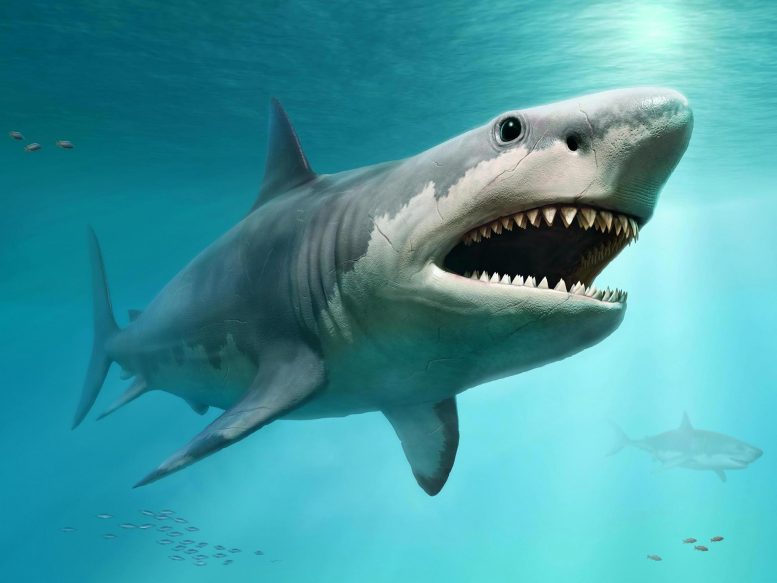
    Megalodon Illustration
    Artist’s illustration of Megalodon. The body size of the famous Megalodon or megatooth shark is confirmed to be anomalously large compared to the body sizes of its relatives, according to a recent study.

    A new study shows that the body size of the iconic gigantic Megalodon or megatooth shark, about 50 feet (15 meters) in length, is indeed anomalously large compared to body sizes of its relatives. Formally called Otodus megalodon, the fossil shark that lived nearly worldwide roughly 15-3.6 million years ago is receiving a renewed look at the significance of its body size in the shark world, based on a new study appearing in the international journal Historical Biology.​

    Otodus megalodon is commonly portrayed as a super-sized, monstrous shark, in novels and films such as the 2018 sci-fi thriller “The Meg,” but it is known that the scientifically justifiable maximum possible body size for the species is about 50 feet at present (15 meters; not 16 meters or larger in some previous studies). Nonetheless, it is still an impressively large shark, and the new study illuminates exactly how uniquely gigantic the shark was relative to other sharks, noted Kenshu Shimada, a paleobiologist at DePaul University in Chicago and lead author of the study.
    Schematic Shark Drawing
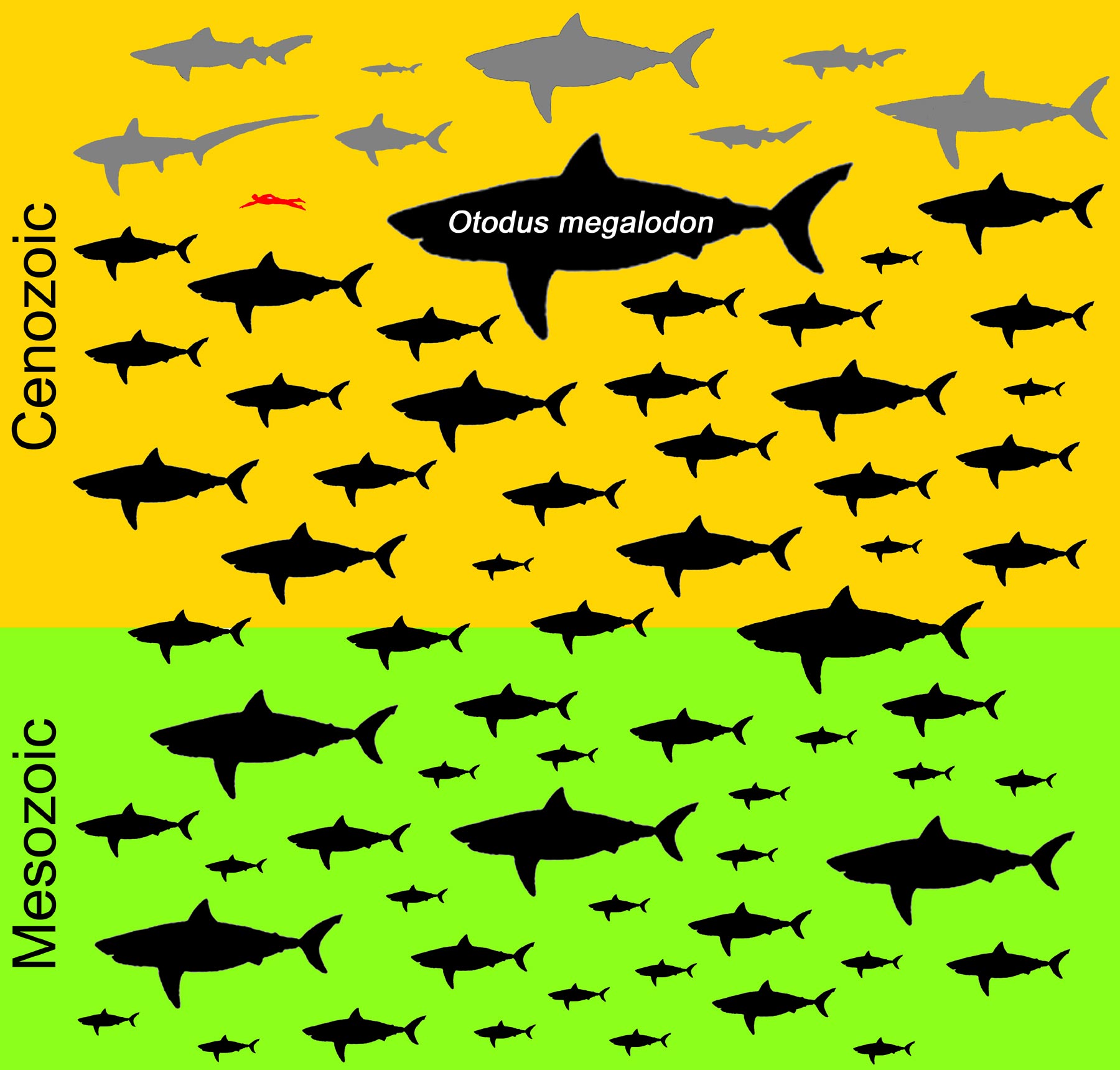
    Schematic drawing showing the distribution of maximum possible sizes of all known 70 non-planktivorous genera (groups) in the shark order Lamniformes, comprising modern (in gray) and extinct (in black; with hypothetical silhouettes) members and in comparison with an average adult human (in red) as scale. Note the anomalously large size of the iconic megatooth shark, Otodus megalodon (15 meters, or 50 feet), and the fact that the Cenozoic Era (after the age of dinosaurs, including today) saw more lamniform genera attaining larger body sizes than the Mesozoic (age of dinosaurs) Era. Credit: Kenshu Shimada, DePaul University

    Otodus megalodon belongs to the shark group called lamniforms with a rich fossil record, but the biology of extinct forms is poorly understood because these cartilaginous fishes are mostly known only from their teeth. The study used measurements taken from specimens of all 13 species of present-day macrophagous (non-planktivorous) lamniforms to generate functions that would allow estimations of body, jaw and dentition lengths of extinct macrophagous lamniforms from their teeth. These quantitative functions enabled the researchers to examine the body size distribution of all known macrophagous lamniform genera over geologic time.

    Kenshu Shimada
    DePaul University paleobiologist Kenshu Shimada holds a tooth of an extinct shark Otodus megalodon, or the so-called “Meg” or megatooth shark. Credit: DePaul University/Jeff Carrion

    The study demonstrates that O. megalodon reaching at least 46 feet (14.1 meters) is truly an outlier because practically all other macrophagous sharks, including extinct forms, have a general size limit of 23 feet (7 meters); and only a few plankton-eating sharks, such as the whale shark and basking shark, were equivalent or came close to the size. The study also reveals that the Cenozoic Era (after the age of dinosaurs, including today) saw more lamniform lineages attaining larger sizes than the Mesozoic Era (age of dinosaurs).

    Warm-bloodedness has previously been proposed to have led to the gigantism (20 feet, or over 6 meters) in multiple lamniform lineages. The new study proposes their live-bearing reproductive strategy with a unique cannibalistic egg-eating behavior to nourish early-hatched embryos to large sizes inside their mother to be another possible cause for the frequent evolution of gigantism achieved by lamniform sharks.

    Understanding the body sizes of extinct organisms is important in the context of ecology and evolution. “Lamniform sharks have represented major carnivores in oceans since the age of dinosaurs, so it is reasonable to assert that they must have played an important role in shaping the marine ecosystems we know today,” said Shimada.

    “This is compelling evidence for the truly exceptional size of megalodon,” noted co-author Michael Griffiths, a professor of environmental science at William Paterson University in Wayne, New Jersey. Co-author Martin Becker, also a professor of environmental science at William Paterson University, added, “This work represents a critical advancement in our understanding of the evolution of this ocean giant.”

    The new study, “Body, jaw, and dentition lengths of macrophagous lamniform sharks, and body size evolution in Lamniformes with special reference to ‘off-the-scale’ gigantism of the megatooth shark, Otodus megalodon,” will appear in the forthcoming issue of Historical Biology.

    Reference: “Body, jaw, and dentition lengths of macrophagous lamniform sharks, and body size evolution in Lamniformes with special reference to ‘off-the-scale’ gigantism of the megatooth shark, Otodus megalodon” by Kenshu Shimada, Martin A. Becker and Michael L. Griffiths, 4 October 2020, Historical Biology.
    DOI: 10.1080/08912963.2020.1812598

    Never miss a breakthrough: Join the SciTechDaily newsletter.
    Follow us on Google and Google News.

    Marine Biology Paleontology Popular Sharks
    Share. Facebook Twitter Pinterest LinkedIn Email Reddit

    Related Articles

    Bigger Than We Thought? Scientists Reveal New Megalodon Size Estimates

    The Megalodon Makeover: How Science Just Flipped the Script on the Ancient Shark

    Megalodon Was No Cold-Blooded Killer – And That Spelled Its Doom

    Prehistoric Shark Hid Its Largest, Sharpest Teeth

    Night of the Living Algae: To Survive Asteroid Impact, Algae Learned to Hunt

    Unexpected Discovery of a 410-Million-Year-Old Fossil Forces Rethink of Shark Evolution

    Finally Revealed: Gargantuan True Size of Legendary Prehistoric Mega-Shark Megalodon

    Underwater Titans: Giant Sea Scorpions – Some Larger Than Humans – Were Fierce Marine Predators

    “Enigmatic and Strange” – 300-Million-Year-Old Fish Resembles a Sturgeon, but With Key Differences

    Leave A Reply Cancel Reply

    • Facebook
    • Twitter
    • Pinterest
    • YouTube

    Don't Miss a Discovery

    Subscribe for the Latest in Science & Tech!

    Trending News

    Popular Sugar-Free Sweetener Linked to Liver Disease, Study Warns

    What Is Hantavirus? The Deadly Disease Raising Alarm Worldwide

    Scientists Just Discovered How the Universe Builds Monster Black Holes

    Scientists Unveil New Treatment Strategy That Could Outsmart Cancer

    A Simple Vitamin May Hold the Key to Treating Rare Genetic Diseases

    Scientists Think the Real Fountain of Youth May Be Hiding in Your Gut

    Ravens Don’t Follow Wolves, They Predict Them

    This Common Knee Surgery May Be Doing More Harm Than Good

    Follow SciTechDaily
    • Facebook
    • Twitter
    • YouTube
    • Pinterest
    • Newsletter
    • RSS
    SciTech News
    • Biology News
    • Chemistry News
    • Earth News
    • Health News
    • Physics News
    • Science News
    • Space News
    • Technology News
    Recent Posts
    • This Dazzling Green Snake Was Hiding in Plain Sight for Decades
    • Scientists Discover That a Single Dose of Psilocybin Changes the Human Brain
    • “Totally Unexpected” – Scientists Discover Pancreatic Cancer’s Fatal Addiction
    • A Strange Quantum Effect May Explain One of Biology’s Greatest Mysteries
    • NASA’s Psyche Spacecraft Is About To Fly Shockingly Close to Mars
    Copyright © 1998 - 2026 SciTechDaily. All Rights Reserved.
    • Science News
    • About
    • Contact
    • Editorial Board
    • Privacy Policy
    • Terms of Use

    Type above and press Enter to search. Press Esc to cancel.