
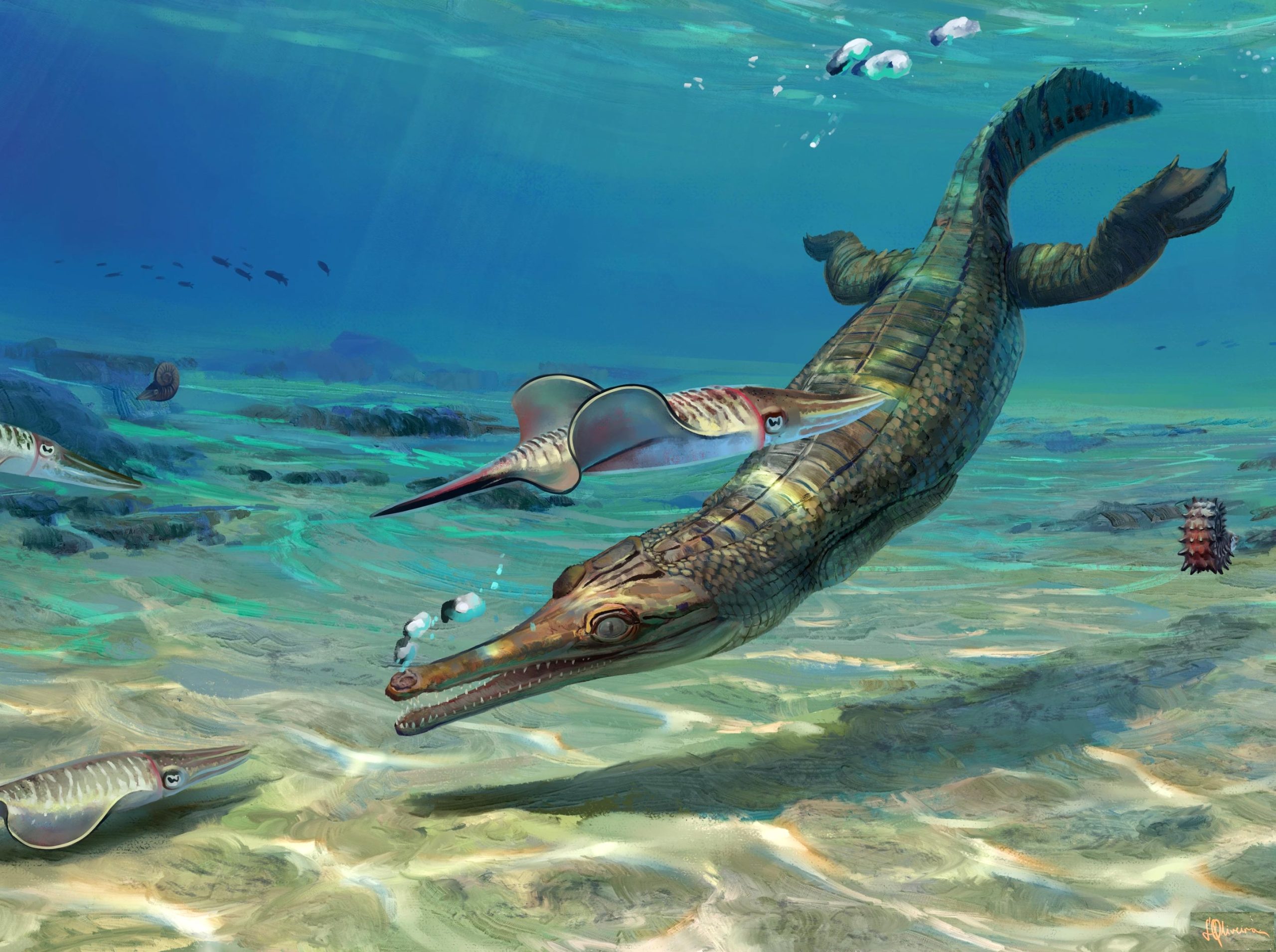
The discovery of Turnersuchus hingleyae, an Early Jurassic marine predator, bridges a gap in the fossil record and suggests thalattosuchians likely originated in the Triassic.
New research has uncovered a new thalattosuchian – an ancient ‘sister’ of modern-day crocodiles’ ancestors.
The recent discovery of Turnersuchus hingleyae is a result of a remarkable excavation of fossils on the Jurassic Coast in Dorset, UK, which included a partial head, backbone, and limbs. This excavation at the Charmouth Mudstone Formation was so fruitful that Turnersuchus is the only thalattosuchian of its age – dating back to the Early Jurassic, Pliensbachian period, around 185 million years ago – to be named to date due to its sufficient completeness.
Filling Gaps in the Fossil Record
Published in the peer-reviewed Journal of Vertebrate Paleontology, experts state the discovery of this new predator helps fill a gap in the fossil record and suggests that thalattosuchians, with other crocodyliforms, should have originated around the end of the Triassic period – around 15 million years further back in time than when Turnersuchus lived.
“We should now expect to find more thalattosuchians of the same age as Turnersuchus as well as older,” states co-author Dr. Eric Wilberg, Assistant Professor at the Department of Anatomical Sciences, at Stony Brook University.
“In fact, during the publication of our paper, another paper was published describing a thalattosuchian skull discovered in the roof of a cave in Morocco from the Hettangian/Sinemurian (the time periods preceding the Pliensbachian where Turnersuchus was found), which corroborates this idea. I expect we will continue to find more older thalattosuchians and their relatives. Our analyses suggest that thalattosuchians likely first appeared in the Triassic and survived the end-Triassic mass extinction.”
However, no digs have found thalattosuchians in Triassic rocks yet, which means there is a ghost lineage (a period during which we know a group must have existed, but we haven’t yet recovered fossil evidence). Until the discovery of Turnersuchus, this ghost lineage extended from the end of the Triassic until the Toarcian, in the Jurassic, “but now we can reduce the ghost lineage by a few million years” the expert team states.
Thalattosuchians are referred to colloquially as ‘marine crocodiles’ or ‘sea crocodiles’, despite the fact they are not members of Crocodylia, but are more distantly related. Some thalattosuchians became very well adapted to life in the oceans, with short limbs modified into flippers, a shark-like tail fin, salt glands, and potentially the ability to give live birth (rather than lay eggs).
Unique Skull and Lifestyle
Turnersuchus is interesting as much of these recognized thalattosuchian features had yet to fully evolve.
It lived in the Jurassic Ocean and preyed on marine wildlife. And, due to its relatively long, slender snout, would have looked similar in appearance to the currently living gharial crocodiles, which are found in all the major river systems of the northern Indian subcontinent.
“However,” co-author Dr. Pedro Godoy, from the University of São Paulo in Brazil says, “unlike crocodiles, this approximately 2-meter-long predator lived purely in coastal marine habitats. And though their skulls look superficially similar to modern gharials, they were constructed quite differently.”
Thalattosuchians had particularly large supratemporal fenestrae – a region of the skull housing jaw muscles. This suggests that Turnersuchus and other thalattosuchians possessed enlarged jaw muscles that likely enabled fast bites; most of their likely prey were fast-moving fish or cephalopods. It’s possible too, just as in modern-day crocodiles, that the supratemporal region of Turnersuchus had a thermoregulatory function – to help buffer brain temperature.
Its name ‘Turner’suchus ‘hingley’ae originates from those who discovered and donated the specimen to the Lyme Regis Museum: Paul Turner and Lizzie Hingley who discovered the fossil in 2017. The ending “suchus,” is the Latinized form of “soukhos,” Greek for crocodile. The specimen is currently on display at the Lyme Regis Museum in Lyme Regis, Dorset, England.
The excavation also involved colleagues from the Charmouth Heritage Coast Centre, who helped to unite the parts. These cliffs and the beach on the South Coast of England site have become synonymous for such finds with the discovery of ichthyosaurs and plesiosaurs, as well as the best preserved and most complete dinosaur found so far in Britain, Scelidosaurus, to name but a few.
Reference: “A new early diverging thalattosuchian (Crocodylomorpha) from the Early Jurassic (Pliensbachian) of Dorset, U.K. and implications for the origin and evolution of the group” by Eric W. Wilberg, Pedro L. Godoy, Elizabeth F. Griffiths, Alan H. Turner and Roger B. J. Benson, 20 January 2023, Journal of Vertebrate Paleontology.
DOI: 10.1080/02724634.2022.2161909
Never miss a breakthrough: Join the SciTechDaily newsletter.
Follow us on Google and Google News.
3 Comments
Say mesoeucrocodylia for turnersuchus or spinosauridae but if they say mesoeucrocodylia is easyer to find link with spinosauridae I see no problem with that .but clearly spinosauridaemesoeucrocodylia is very different from the rest of the thecodont .allready know spinosauridae is 200 million years old I have seen some of the fossil some have antorbital or signs of it not the size of early land mesoeucrocodylia I have seen some land mesoeucrocodylia it’s like most dinosaur big .crocodyliforms = early mesoeucrocodylia they cliam protosuchus is a crocodyliforms there is no link between protosuchus and spinosauridae .protosuchus is a primitive dinosaur close to triceratops these dinosaur lack Cingulum teeth .and clearly tetanuran dinosaur is a lot older than 200 million years more gator wider skull of tetanuran that is not bird like is way up in the Triassic allso 4 or more sacral is found in these gator ankle dinosaurs allso dinosaur fenestra allso pterosaur link they allso link with palate teeth dinosaur.and dinosaur was doing very good in Triassic but these were gator ankle dinosaur. They are still dinosaur !
Bird
Gator = dinosaur