
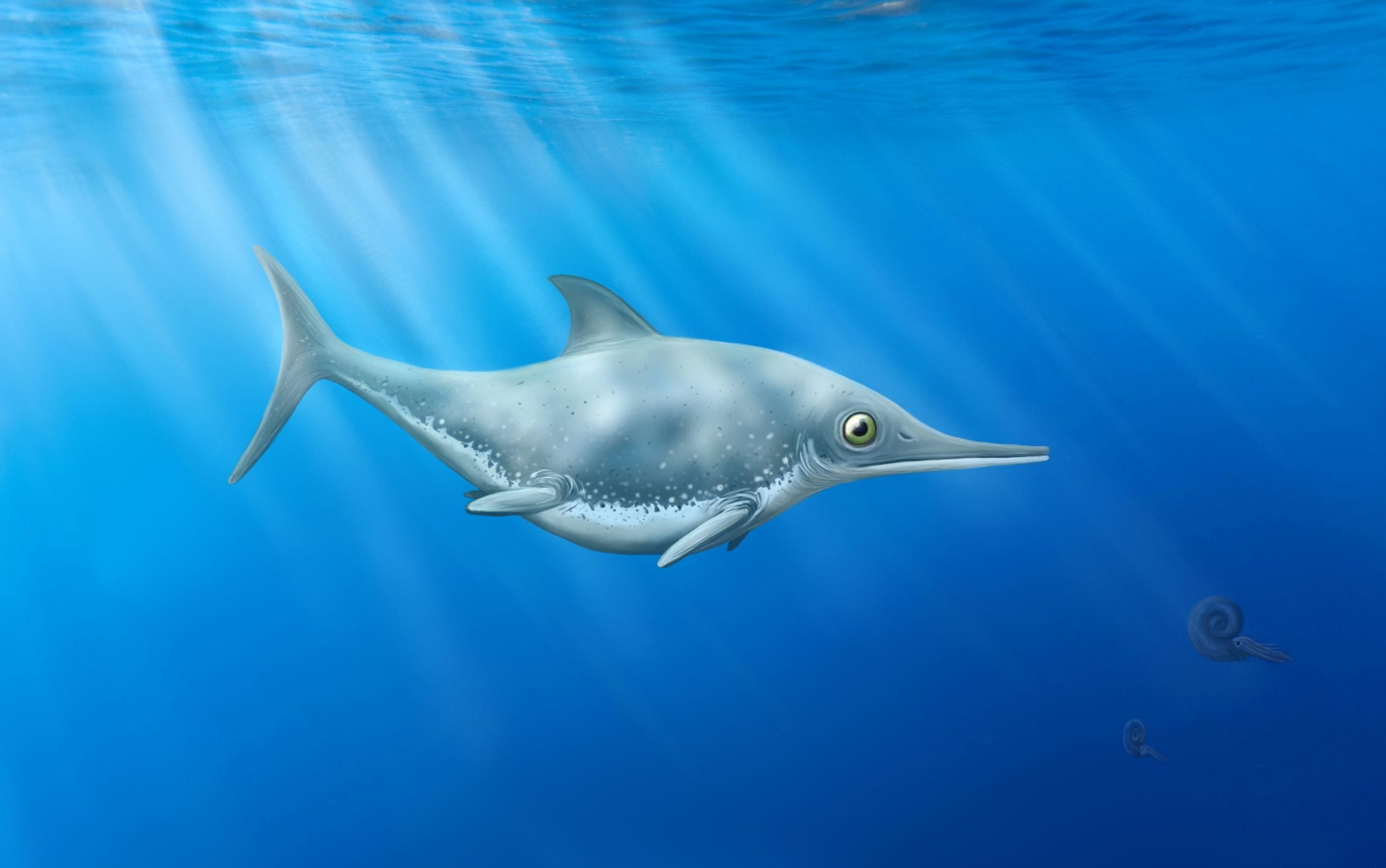
An amateur fossil hunter has unearthed a new type of prehistoric ‘sea dragon’ on the beach of the UK’s Dorset coast.
The new 2m-long ichthyosaurus is named ‘Etches sea dragon,’ after fossil collector Dr. Steve Etches MBE, who found it buried head-first in limestone. Ichthyosaurs are called sea dragons for their usually very large teeth and eyes.
He thought its teeth were unusual, so he passed it on to experts at the University of Portsmouth to identify.
There, a Masters student, Megan Jacobs, who has spent several years working on ichthyosaurs, identified it as a new genus and species, which lived 150 million years ago.
The find is the UK’s fifth known ichthyosaur from the Late Jurassic period, and by far the smallest so far.
The research is published in the online journal PLOS ONE.
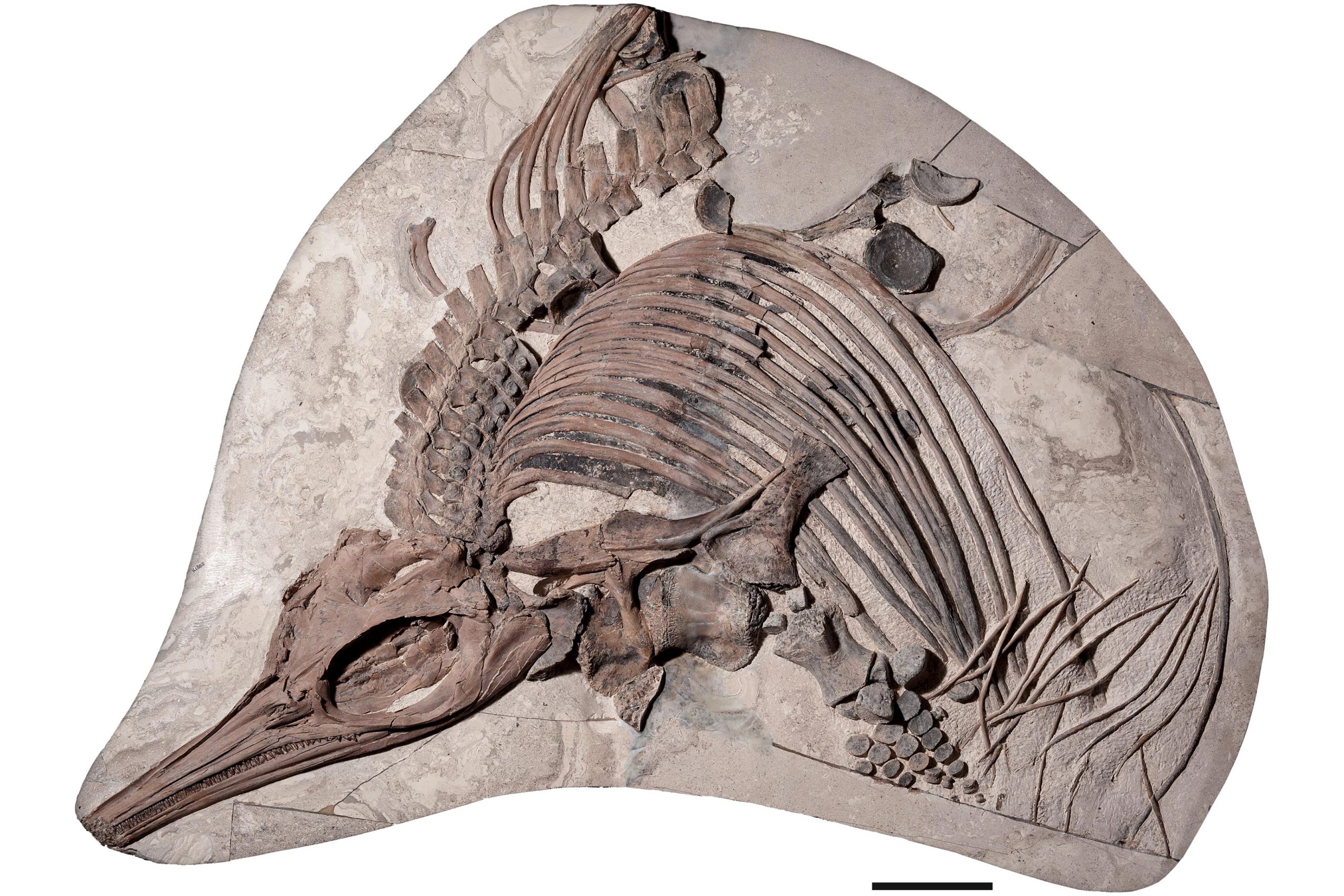
The specimen was found near Kimmeridge Bay — part of the Jurassic Coast World Heritage Site — in a limestone known as the white stone band. When it died, the seafloor would have been a very soft ooze, allowing the front half of the animal to sink into the mud, before scavengers came along and ate the tail end.
Being buried in a bed of soft ooze meant it was preserved in exceptional condition and even some of its soft tissues were preserved.
Megan said: “Skeletons of Late Jurassic ichthyosaurs in the UK are extremely rare, so, after doing some research, comparing it with those known from other Late Jurassic deposits around the world, and not being able to find a match was very exciting.
“Thalassodraco etchesi is a beautifully preserved ichthyosaur, with soft tissue preservation making it all the more interesting.
“Steve’s incredible collection contains many new and exciting animals, and being given the chance to describe this ichthyosaur was a real privilege.”
Ichthyosaurs were highly adapted marine predators, with a streamlined body for gliding through the water, incredibly large eyes for enhanced vision, and elongated jaws full of conical teeth, well suited for catching slippery fish and squid.
Thalassodraco etchesi has a deep ribcage, small forelimbs, and hundreds of tiny, delicate, smooth teeth.
Professor David Martill, who leads the vertebrate paleontology research at the University of Portsmouth, said: “Steve is an exceptional fossil collector and although he is sometimes referred to as an amateur collector, he has done so much for paleontology that he has been awarded an MBE, and is truly a pro.
“If it were not for collectors like Steve, scientists would have very few specimens to work on.”
Now that the new sea dragon has been named, work will begin on investigating its biology.
Professor Martill said: “There are a number of things that make this animal special, not least of which is its unusual rib cage and small flippers. It may have swum with a distinctive style from other ichthyosaurs.”
The specimen is on display alongside Dr. Etches’ other many fossils in his museum in Dorset, the Etches Collection, which he built to house the many discoveries he’s made over a lifetime of fossil hunting.
Dr. Etches said: “I’m very pleased that this ichthyosaur has been found to be new to science, and I’m very honored for it to be named after me.
“It’s excellent that new species of ichthyosaurs are still being discovered, which shows just how diverse these incredible animals were in the Late Jurassic seas.”
Thalassodraco etchesi is closely related to Nannopterygius, a genus widespread across Europe, Russia and the Arctic.
Ichthyosaurs were highly successful marine reptiles, living in the seas for most of the Mesozoic, appearing around 248 million years ago in the Triassic period, and becoming extinct in the Late Cretaceous at around 90 million years ago.
Some of the last surviving ichthyosaurs have been found in the chalk on the Isle of Wight, but the first specimens to be described scientifically were found by Mary Anning at Lyme Regis at the beginning of the 19th century from rocks of Early Jurassic age.
The largest ichthyosaurs are from the Triassic period of North America some of which had a skull length of nearly five meters — 10 times bigger than the skull of this newest discovery.
Read Prehistoric “Sea Dragon” Discovered on English Channel Coast Is Identified As New Species for more on this research.
Reference: “A new ophthalmosaurid ichthyosaur from the Upper Jurassic (Early Tithonian) Kimmeridge Clay of Dorset, UK, with implications for Late Jurassic ichthyosaur diversity” by Megan L. Jacobs and David M. Martill, 9 December 2020, PLOS ONE.
DOI: 10.1371/journal.pone.0241700
Never miss a breakthrough: Join the SciTechDaily newsletter.
Follow us on Google and Google News.