
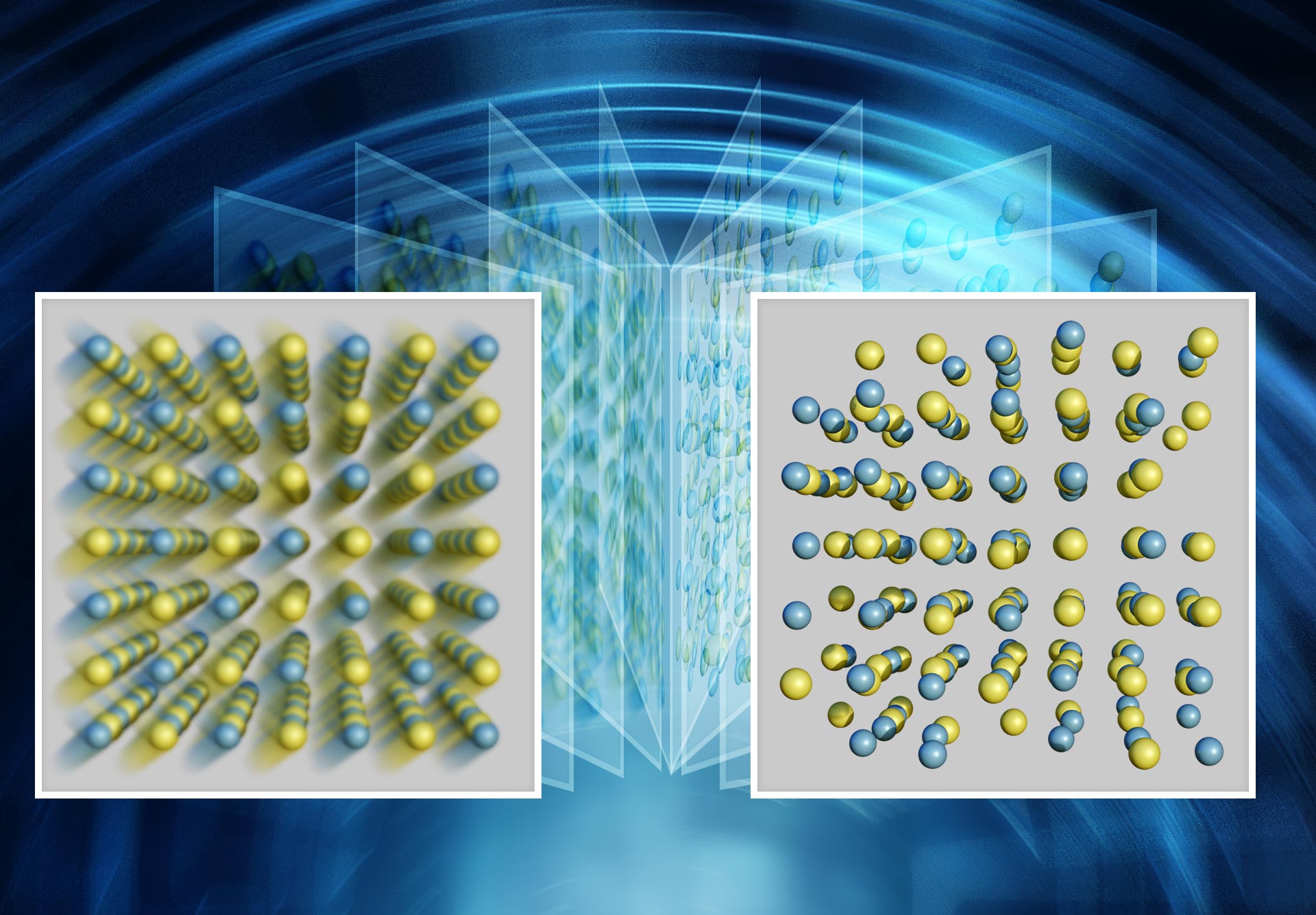
Speeding up a camera shutter a million million times enables researchers to understand how materials move heat around and is a major step in advancing sustainable energy applications.
Researchers are coming to understand that the best-performing materials in sustainable energy applications, such as converting sunlight or waste heat to electricity, often use collective fluctuations of clusters of atoms within a much larger structure. This process is often referred to as “dynamic disorder.”
Dynamic Disorder
Understanding dynamic disorder in materials could lead to more energy-efficient thermoelectric devices, such as solid-state refrigerators and heat pumps, and also to better recovery of useful energy from waste heat, such as car exhausts and power station exhausts, by converting it directly to electricity. A thermoelectric device was able to take heat from radioactive plutonium and convert it to electricity to power the Mars Rover when there was not enough sunlight.
When materials function inside an operating device, they can behave as if they are alive and dancing–parts of the material respond and change in amazing and unexpected ways. This dynamic disorder is difficult to study because the clusters are not only so small and disordered, but they also fluctuate in time. In addition, there is “boring” non-fluctuating disorder in materials that researchers aren’t interested in because the disorder doesn’t improve properties. Until now, it has been impossible to see the relevant dynamic disorder from the background of less relevant static disorder.
Revealing Atomic Structures with a “Neutron” Camera. Credit: Oak Ridge National Laboratory
New “Camera” Has Incredibly Fast Shutter Speed of Around 1 Picosecond
Researchers at Columbia Engineering and Université de Bourgogne report that they have developed a new kind of “camera” that can see the local disorder. Its key feature is a variable shutter speed: because the disordered atomic clusters are moving, when the team used a slow shutter, the dynamic disorder blurred out, but when they used a fast shutter, they could see it. The new method, which they call variable shutter PDF or vsPDF (for atomic pair distribution function), doesn’t work like a conventional camera–it uses neutrons from a source at the U.S. Department of Energy’s Oak Ridge National Laboratory (ORNL) to measure atomic positions with a shutter speed of around one picosecond, or a million million (a trillion) times faster than normal camera shutters. The study was published on February 20, 2023, in the journal Nature Materials.
“It’s only with this new vsPDF tool that we can really see this side of materials,” said Simon Billinge, professor of materials science and applied physics and applied mathematics. “It gives us a whole new way to untangle the complexities of what is going on in complex materials, hidden effects that can supercharge their properties. With this technique, we’ll be able to watch a material and see which atoms are in the dance and which are sitting it out.”
New Theory on Stabilizing Local Fluctuations and Converting Waste Heat to Electricity
The vsPDF tool enabled the researchers to find atomic symmetries being broken in GeTe, an important material for thermoelectricity that converts waste heat to electricity (or electricity into cooling). They hadn’t previously been able to see the displacements, or to show the dynamic fluctuations and how quickly they fluctuated. As a result of the insights from vsPDF, the team developed a new theory that shows just how such local fluctuations can form in GeTe and related materials. Such a mechanistic understanding of the dance will help researchers to look for new materials with these effects and to apply external forces to influence the effect, leading to even better materials.
Research Team
Billlinge’s co-lead on this work with Simon Kimber, who was at the University of Bourgogne in France at the time of the study. Billinge and Kimber worked with colleagues at ORNL and the Argonne National Laboratory (ANL), also funded by the DOE. The Inelastic neutron scattering measurements for the vsPDF camera were made at ORNL; the theory was done at ANL.
Next Steps
Billinge is now working on making his technique easier to use for the research community and applying it to other systems with dynamic disorder. At the moment, the technique is not turn-key, but with further development, it should become a much more standard measurement that could be used on many material systems where atomic dynamics are important, from watching lithium moving around in battery electrodes to studying dynamic processes during water-splitting with sunlight.
Reference: “Dynamic crystallography reveals spontaneous anisotropy in cubic GeTe” by Simon A. J. Kimber, Jiayong Zhang, Charles H. Liang, Gian G. Guzmán-Verri, Peter B. Littlewood, Yongqiang Cheng, Douglas L. Abernathy, Jessica M. Hudspeth, Zhong-Zhen Luo, Mercouri G. Kanatzidis, Tapan Chatterji, Anibal J. Ramirez-Cuesta and Simon J. L. Billinge, 20 February 2023, Nature Materials.
DOI: 10.1038/s41563-023-01483-7
Authors: Simon A. J. Kimber, Batiment Sciences Mirande; Jiayong Zhang, Oak Ridge National Laboratory; Charles H. Liang, University of Chicago; Gian G. Guzman-Verri, Universidad de Costa Rica; Peter B. Littlewood, University of Chicago, Argonne National Laboratory; Yongqiang Cheng, Oak Ridge National Laboratory; Douglas L. Abernathy, Oak Ridge National Laboratory; Jessica M. Hudspeth, ESRF, The European Synchrotron; Zhong-Zhen Luo, Northwestern University; Mercouri G. Kanatzidis, Northwestern University; Tapan Chatterji, Institut Laue-Langevin; Anibal J. Ramirez-Cuesta, Oak Ridge National Laboratory; Simon J. L. Billinge, Columbia Engineering, Columbia University, Brookhaven National Laboratory.
Funding: S.J.L.B. acknowledges support from the US DOE, Office of Science, Office of Basic Energy Sciences, under contract no. DE- SC0012704. C.H.L. acknowledges support from NSF GRFP DGE-1746045. G.G.G.-V. acknowledges support from the Vice-Rector for Research at the University of Costa Rica (project no. 816-C1-601). Work at Argonne (P.B.L.) is supported by the US DOE, Ofice of Science, Ofice of Basic Energy Sciences, Materials Sciences and Engineering, under contract no. DE-AC02-06CH11357. At Northwestern University (M.G.K.), work on thermoelectric materials is primarily supported by the US DOE, Ofice of Science, Ofice of Basic Energy Sciences, under award no. DE-SC0014520. This work was supported by the Programme of Investments for the Future, an ISITE-BFC project (contract no. ANR[1]15-IDEX-0003) (S.A.J.K.).
Never miss a breakthrough: Join the SciTechDaily newsletter.
Follow us on Google and Google News.
1 Comment
The verdict? Whatever you already had, get it again.