
Arctic Climate Models Face Accuracy Challenges
According to researchers at the University of Gothenburg, the current climate models utilized by the UN’s IPCC and other organizations to forecast climate change are inaccurate in predicting the Arctic’s future. They contend that the pace of warming in the Arctic will surpass projections significantly.
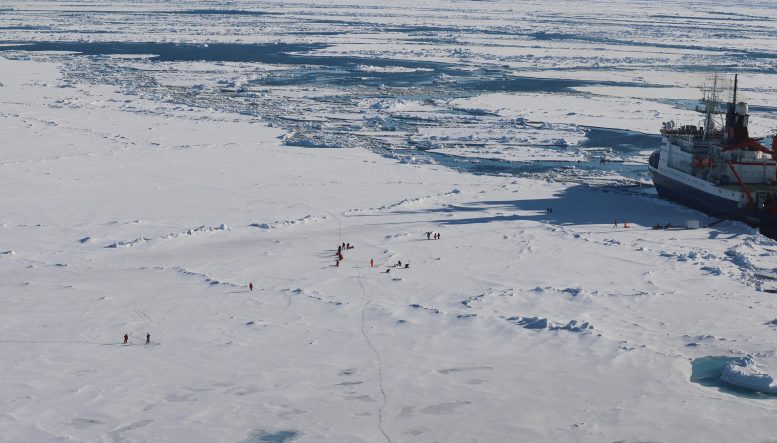
The scarcity of observations in the Arctic, caused by its severe climate and extensive sea ice coverage, has resulted in a relatively small amount of data being gathered from that region. Therefore, the climate models used to predict the Arctic’s future have not been as thoroughly calibrated as those employed in other regions of the world.
Two recent scientific studies involving researchers from the University of Gothenburg compared the results of the climate models with actual observations. They concluded that the warming of the Arctic Ocean will proceed at a much faster rate than projected by the climate models.
Climate Models Underestimate the Consequences
“These climate models underestimate the consequences of climate change. In reality, the relatively warm waters in the Arctic regions are even warmer, and closer to the sea ice. Consequently, we believe that the Arctic sea ice will melt away faster than projected,” explains Céline Heuzé, a climatologist at the University of Gothenburg and lead author of one of the studies.
Warm water flows into the Arctic Ocean via Fram Strait between Greenland and Svalbard. However, the volume of water in these ocean currents and its temperature in the climate models are too low, which is one of the reasons why the climate models’ projections will not be accurate. Even the stratification of the Arctic Ocean is incorrect. The researchers argue that since roughly half of the models project an increase and the other half a decrease in stratification, the consequences of global warming cannot be estimated accurately.
Acquiring Hard Data in the Arctic Must Be Prioritized
“This is a serious situation. If governments and organizations all over the world are going to rely on these climate models, they must be improved. Which is why research and data acquisition in the Arctic ocean must be prioritized. At present, we cannot provide a useful prediction of how quickly the Arctic sea ice is melting,” Céline Heuzé explains.
The Arctic is an important region for projecting what the future intensity of global warming will be. Its sea ice contributes an albedo effect – a white surface that reflects sunlight away from the planet. If the ice were to disappear, more solar radiation would reach the Earth.
“We need a climate model that is tailored to the Arctic. In general, you can’t use the same model for the entire planet, as conditions vary considerably. A better idea would be to create a specific model for the Arctic that correctly factors in the processes occurring in the Arctic Ocean and surrounding land areas,” Céline Heuzé explains.
References:
“The Deep Arctic Ocean and Fram Strait in CMIP6 Models” by Céline Heuzé, Hannah Zanowski, Salar Karam and Morven Muilwijk, 4 January 2023, Journal of Climate.
DOI: 10.1175/JCLI-D-22-0194.1
“Divergence in Climate Model Projections of Future Arctic Atlantification” by Morven Muilwijk, Aleksi Nummelin, Céline Heuzé, Igor V. Polyakov, Hannah Zanowski and Lars H. Smedsrud, 17 February 2023, Journal of Climate.
DOI: 10.1175/JCLI-D-22-0349.1
Never miss a breakthrough: Join the SciTechDaily newsletter.
Follow us on Google and Google News.
1 Comment
“The researchers argue that since roughly half of the models project an increase and the other half a decrease in stratification, the consequences of global warming cannot be estimated accurately.”
In other words, a battle of the models. And these authors are convinced that their mental model is superior to the existing formal computer models. It is good to question the status quo and I’m in favor of trying to improve the existing the models.
However, the statement, “Its sea ice contributes an albedo effect – a white surface that reflects sunlight away from the planet” suggests that we have another group of climatologists that don’t understand the physics of reflection, and are probably unfamiliar with Fresnel’s equation for specular reflection, and I would venture to guess are similarly unfamiliar with the Bi-directional Reflectance Distribution Function for the diffuse reflector, snow. At glancing angles, water can have a reflectivity higher than the average albedo of snow, and that reflected light is reflected away from Earth.
https://wattsupwiththat.com/2016/09/12/why-albedo-is-the-wrong-measure-of-reflectivity-for-modeling-climate/