
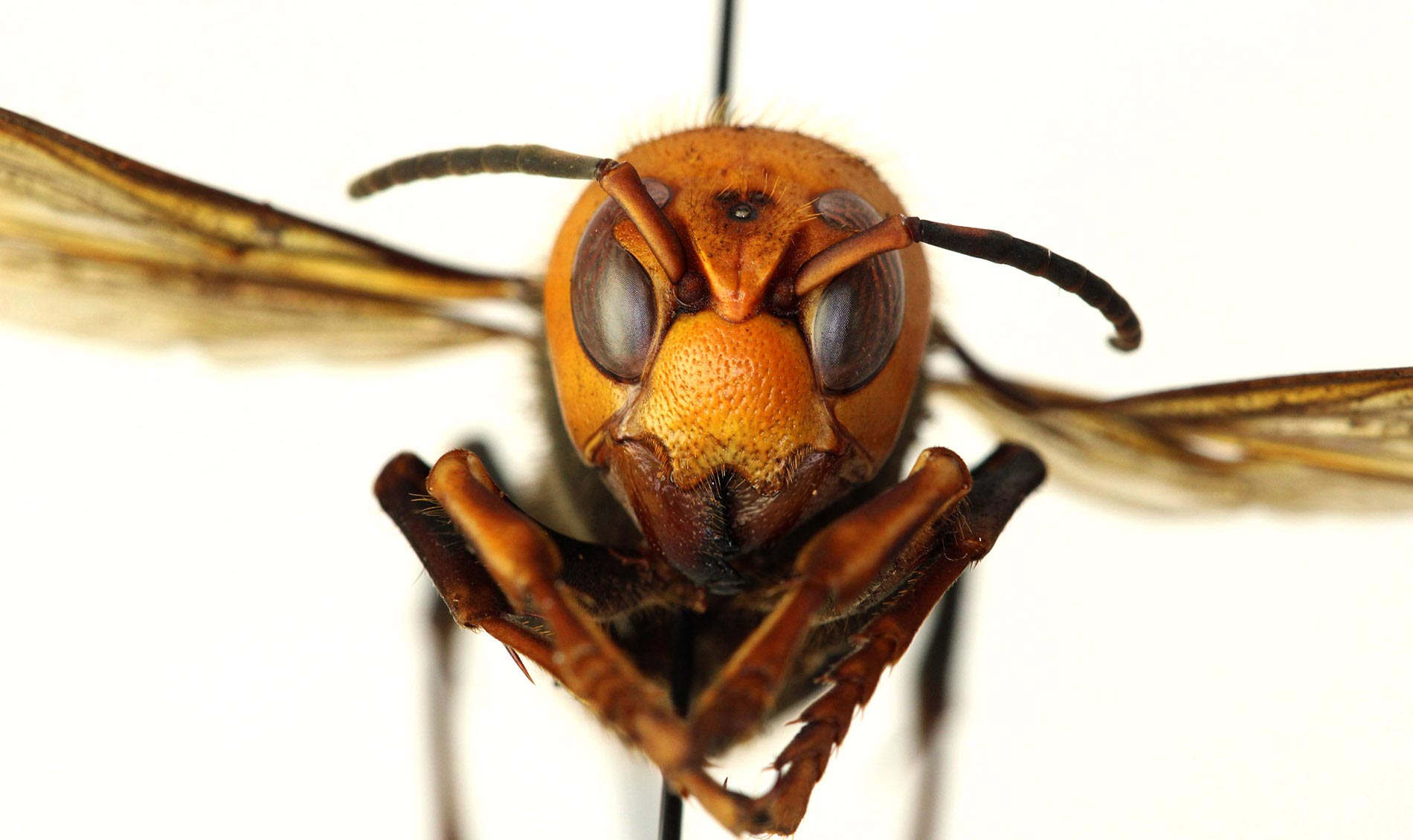
Honeybees spread animal dung on the entrance of their hives to effectively ward off giant hornets.
What’s the best way to ward off giant hornets if you’re a honeybee? Animal dung, according to a first-ever University of Guelph study.
U of G researchers have discovered honeybees in Vietnam collect and apply spots of animal dung around hive entrances to deter deadly nest raids by an Asian hornet (Vespa soror) whose North American cousins have been dubbed “murder hornets.”
This finding is also the first to document the use of tools by honeybees.
An invasive species in North America that came originally from Asia, giant hornets are almost as long as a golf tee and pack about seven times as much venom in a single sting as an ordinary honeybee.
Murder hornets (V. mandarinia) were discovered in 2019 in British Columbia and Washington. The arrival of the venomous insect to North America has raised concerns about human safety as well as threats to local honeybees and ecosystems.
U of G Prof. Gard Otis, who has studied honeybees in Vietnam for decades, said the hornets could ultimately carry out similar honeybee hive raids in North America.
“Giant hornets are the biggest wasps that threaten honeybees. They are one of their most significant predators,” said the environmental sciences professor.
Otis conducted the study with lead author Heather Mattila, who completed her PhD at the University of Guelph in 2006 and is now a biology professor at Wellesley College in Massachusetts. Other co-authors were former U of G grad students Hanh Pham and Olivia Knight, as well as Ngoc Pham and Lien Nguyen in Vietnam.
Published recently in the journal PLOS ONE, the study was conducted in Vietnam, where U of G researchers studied V. soror.
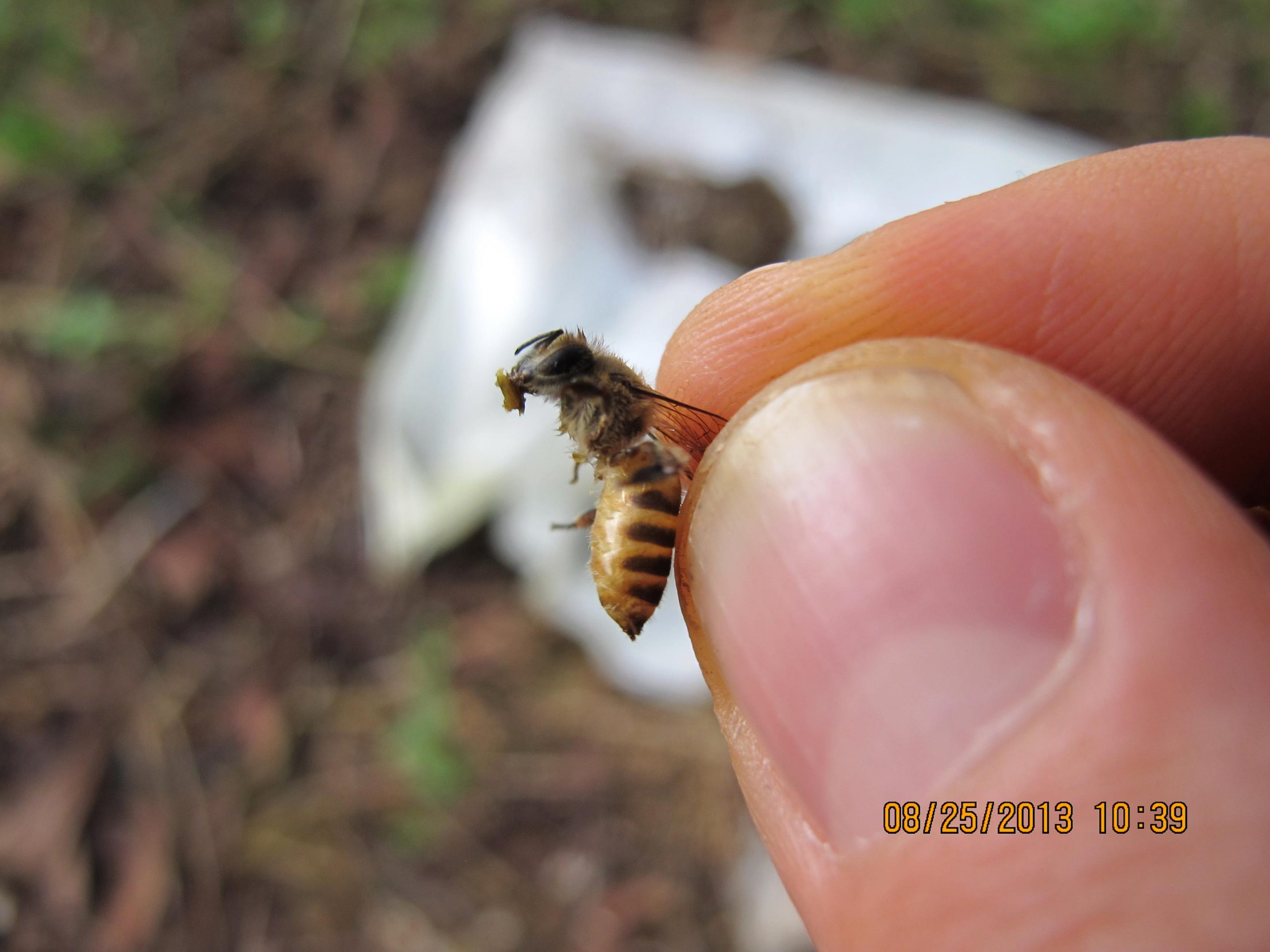
These two species are the only hornets that recruit nestmates in organized attacks that can lead to nest breaches, said Otis. The hornets raid the nests, killing the bees and carrying away larvae and pupae to feed their own developing brood.
The researchers found that honeybees have developed a pre-emptive defense by collecting animal dung and applying it to hive entrances.
“This study demonstrates a fairly remarkable trait these bees have to defend themselves against a really awful predator,” said Mattila.
She said unlike their Asian counterparts, honeybees in Canada lack similar defenses. That means North American beekeepers would have to rely on destroying the hornets’ nests, or hope that climate or other factors will limit the hornets’ spread.
Referring to Apis mellifera, the honeybee species commonly found in Canada, Mattila said, “They haven’t had the opportunity to evolve defenses. It’s like going into a war cold.”
Otis began the project after asking beekeepers in Vietnam about dark spots at hive entrances of Asian honeybees. As part of a successful beekeeping development project funded by the Canadian government, he ran fall workshops from 2007 to 2011 in rural villages with high levels of poverty.
During one visit, an experienced beekeeper explained that the substance was buffalo dung. All the beekeepers that Otis worked with linked these hive spots with hornets. “Dung collection is a behavior never previously reported for honeybees, and no one had studied the phenomenon,” he said.
In 2013, the U of G team received US$25,000 from the National Geographic Society for the study.

The researchers gathered dung from water buffalo, chickens, pigs and cows, and placed it in mounds near an apiary. By the end of the day, some 150 bees had visited the piles, particularly collecting more odoriferous manure of pigs and chickens.
The team marked individual bees to identify them at their hives. Minutes later, they recorded videos of the marked bees applying the material at nest entrances.
The hornets spent less than half as much time at nest entrances with moderate to heavy dung spotting as they did at hives with few spots, and they spent only one-tenth as much time chewing at the hive entrances to get at the bees’ brood. They were also less likely to launch mass attacks on the more heavily spotted hives.
The researchers are unsure just what deters the hornets, although they suspect the insects are repelled by the smell of the dung. Dung may also mask odors emitted by the bees.
To further understand the hornets’ behaviors, the researchers extracted the chemical pheromone applied by hornets when marking their target hive. When the pheromone was applied to the bees’ entrance, it prompted honeybees to apply dung to the hive.
Many scientists disagree over whether certain animals — let alone insects — use tools.
To qualify as tool users, animals must meet several criteria, including using an object from the environment — in this case, dung. The bees clearly use the material to alter the hive with purpose, said Otis. And they shape and mold it with their mouth parts, which he said meets the test of holding or manipulating a tool.
Beekeepers in Vietnam normally control hornets by standing guard and swatting away individuals, preventing them from escalating their attacks.
“If you allow them, a group of hornets assembles, attacks the colony and takes over. The beekeepers control them every day by moving among their hives and whacking hornets.”
Otis said he was terrified at first about working near the giant hornets. The hazmat suits typically worn for protection by researchers in Japan were impracticable in Vietnamese heat, he added. Within a few days, the team learned the hornets were not defensive when they were in the apiary and away from their own nest.
“I got stung by one and it was the most excruciating sting in my life.”
Reference: “Honey bees (Apis cerana) use animal feces as a tool to defend colonies against group attack by giant hornets (Vespa soror)” by Heather R. Mattila, Gard W. Otis, Lien T. P. Nguyen, Hanh D. Pham, Olivia M. Knight and Ngoc T. Phan, 9 December 2020, PLOS ONE.
DOI: 10.1371/journal.pone.0242668
Never miss a breakthrough: Join the SciTechDaily newsletter.
Follow us on Google and Google News.
36 Comments
A very good article
Can indigenous honeybees be taught the dung technique? Show them the film! On a loop.
Put some in your mouth and flap your arms like your flying. Maybe they will catch on
Is this relpy from the Aka “bee master” from Somerset, lol
Love your articles about smaller science or everyday about nature and the big labs or studies don’t focus on. Especially about the enivornment and how to heal or repair ecosystem a. Although given space nature will always heal and regenerate it’s self and animals and will always be above us. Because nature will be here long after humanity gone.
I think I have a picture of a murder hornet on my screen at work in Millbrook, AL.
Could the bee keeper not apply dung around the hive?
Start putting pig & chicken manure plastered near all commercial honeybee hives. It’s obvious it confuses the murder hornets chemical markers left behind to bring the pack to the target hive. Maybe the honeybees will get the idea themselves after a few months. It apparently didn’t hurt the bees in Vietnam.
How would Africanized honey bees stand up against the Murder hornets?
My family had about a dozen hives when i was a kid. Our bees did this same thing using chicken manure. We noticed we ONLY had invasive problems after we put a water source near the bees. We saw them combat all kinds of insects over the years. They always found a way to win. Never saw such an increase in wasps and hornets as when that pan of water was put out for them.
That reward should have been like a million really. That research was such an amazing finding and must open so many doors and ideas. Truly fascinating and we pray ur work is recognised far and wide and u are rewarded many times more. Good luck for ur future work :))
People, please do not try this on your own home.
Interesting article. Keep up the good work.
Loved the information.
You go, honey bees! ❤️🐝
We called them Japanese hornets, they’ve been around here (Virginia) for as long as I can remember. They’d get in the house when it starts to get cold. We’d make a fun game out of smashing them.
I’m in NC and have seen many of the hornets you speak of. I belive these are European Hornets. Smaller than the Asian Hornet but really pack a nasty punch. I’ve been stung several times by these little devils,they will cripple you for a day or two.
Outstanding article!
I have a mound just outside of patio in Arlington, Tx. These predators came in with the dust storm back in August. Please help.
This is an interesting article. I am just wondering if the honey could be contaminated by the dung.
Me too! That’s what I would like to know
Great and informative article. I’m very concerned that they will make it to MT in the near future. We already have the large “meat eating” bees.
I think I confused one of those with the Cicada Killer. Are they similar?
That’s exactly what i do to keep the johovas away.
Perhaps beekeepers themselves could apply the dung to the hive entrance. Could it be that the wasps think a chicken in close proximity might gobble them up?
I got inspired by this article and put poop on the outside of my room. Now my little sister stays away and leaves me alone!
If you applied the hormones that que an attack on a fake nest and wait for the hornets to try to attack, could you try to kill many at a time while they are out in the open? Then, smelling the dead hornets, they might freak out and stay away.
Why don’t they use decoys
Make fake bees 5 times larger a place them near the entrance of the hive, that should scare off the hornets.
I propose bringing some of the “experienced” honeybees or a hive with the knowledge and experience of using dung as a deterrent, over to Canada to share and spread the knowledge. I bet it would work. I think they can learn from eachother.
Bees have been known to feed on animal feed in times of dirth. The possibility that undigested material in the dung is what attracts the bees only to find it unacceptable in the hive and is then deposited in close proximity of the hive entrance.Food for thought and plenty of observation is always welcome.
Why can’t DARPA make a tracking chip for these hornets?
not sure gathering and using dung is a tool Otters use rocks to break open shells. Elephants use sticks to scratch themselves… But the bee is using its own body parts to spread the dung. Perhaps if they used sticks to spread it. that would be a tool. But using their wn mouths and legs to manipulate it is not a tool.
The research is invaluable , and I would be willing to bet other pilot programs of other animal and insects have the same type of adaptability instincts.
What a pity nothing has yet been found to protect honey-bees – and many more insects besides – from human agression, and all in the name of productivity ie. human productivity.
Very Interesting.
The markers left by the hornets need to be masked to protect the Candian Honeybee.
The Queen Bee in Canda may not know enough to protect the BeeHive and drones are worker bees who pollinate and gather necter from the flowers ….
The importance of Honey bee for the agricultural ecosystem in Canada (water rich Nation State with 3% of worlds fresh water resorces) shoulld not be under-estimated. Hornets do not have nationality or need visas to migrate!.
Coming back to the marker. , Pheramones may play a role in guiding the Hornet to attack the HoneyComb? Pheromones are attraction signals ( for sex and mating) and may be the markers for attcacking the BeeHive. Ensuring that these are completely nullified should be of great helpon a a temporary basis .
We have to let Nature restore the balance on its own over a period of time and cross breeding of the Canadian Queens Bees which have the knowledge to fight off the Hornets on their own with Canadian Queen Bees to produce a more knowledgeable Queen Bee may be along term solution!
Ideas shared are personal opinions and not binding on anyone!
there is a simple way to protect hives, surround the hives with a wire enclosure that has holes large enough for honey bees to easily fit in but too small to for a murder hornet, its would be like the small hare that escapes a dog by going through a chain link fence