
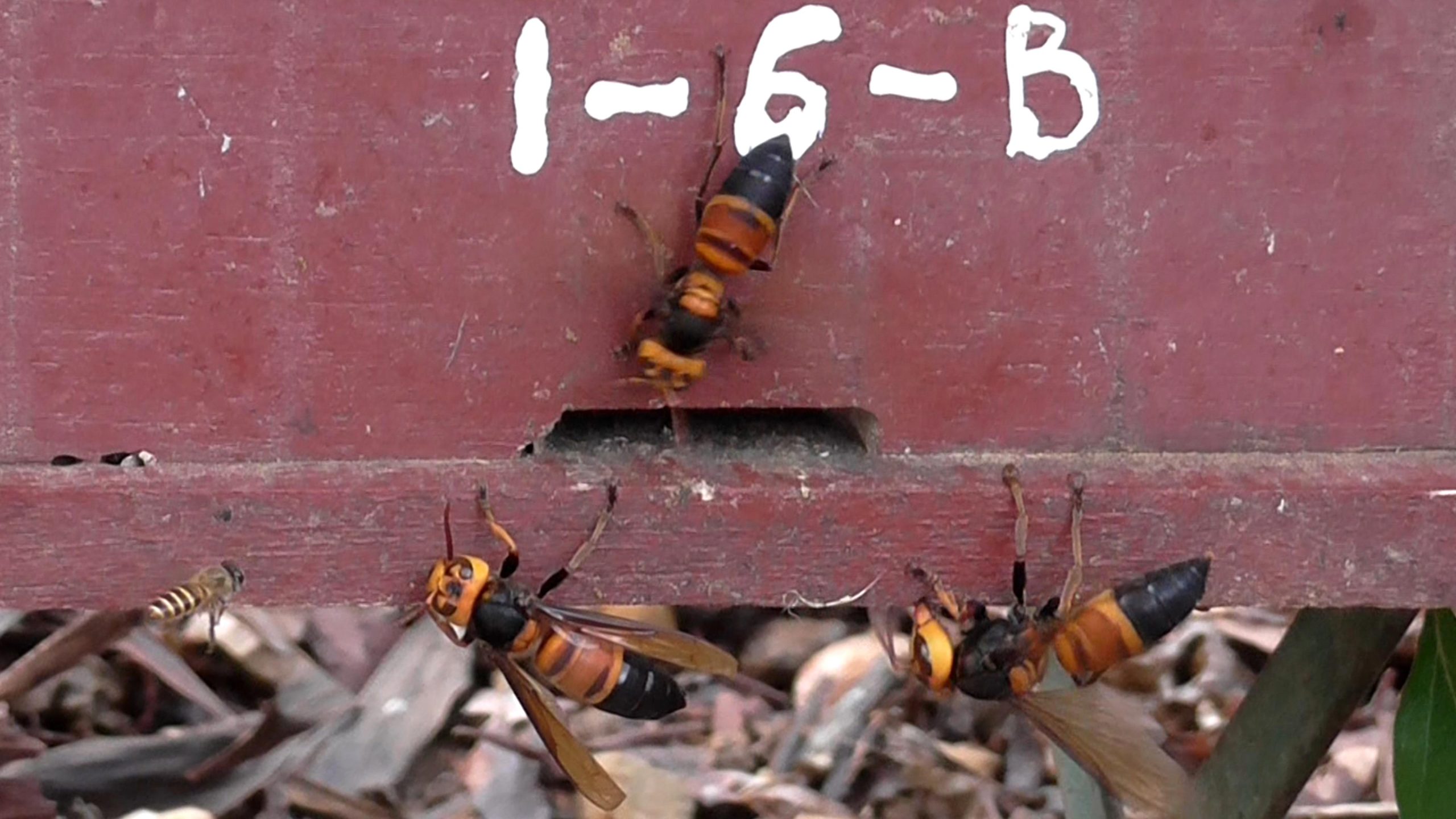
New research from Wellesley College finds for the first time that bees use a specific sound to communicate the threat of giant hornets as they initiate defenses against them.
For the first time, the unique sounds honey bees (Apis cerana) use to alert members of their hive when giant “murder” hornets attack have been documented. These signals—including a newly described “antipredator pipe”—are the focus of new research from Wellesley College associate professor of biological sciences Heather Mattila and her colleagues, whose findings were published in Royal Society Open Science.
Mattila and an international team of researchers observed that honey bees sound the alarm to their fellow bees to defend themselves against attacks by giant hornets (Vespa soror), which can wipe out whole colonies. Bees make sounds, and antipredator pipes in particular, at a frenetic pace when giant hornets are directly outside their hive. It’s a distress signal so distinctive that it gave Mattila the chills when she heard it. “The pipes share traits in common with a lot of mammalian alarm signals, so as a mammal hearing them, there’s something that is instantly recognizable as communicating danger,” she said. “It feels like a universal experience.”
New Signals Trigger Hive Defenses and Tool Use
Antipredator pipes are different from the sounds that have previously been observed in colonies, including “hisses” and “stop signals.” These newly discovered signals are harsh and irregular, and their frequencies shift abruptly, similar to the attention-grabbing alarm shrieks, fear screams, and panic calls primates, birds, and meerkats make in response to predators. In addition to warning the hive about the arrival of giant hornets, the signals result in an increase in bees at their hive’s entrance and the start of their defense actions, which include spreading animal dung around colony entrances to repel giant hornets (the first documented use of tools by bees) and forming bee balls to kill attacking hornets collectively.
Mattila and her fellow researchers have studied interactions between giant hornets and Asian honey bees in Vietnam for over seven years, collecting audio and video recordings of hornet attacks in apiaries of local beekeepers. Microphones in hives captured almost 30,000 signals made by bees over 1,300 minutes of monitoring.
Their recordings of colonies experiencing active attacks by giant hornets were noisy and frenetic, whereas recordings of control colonies were comparatively quiet and calm. Attacks by giant hornets caused bees to increase hive chatter to levels eight times higher than when there were no hornet threats. “[Bees] are constantly communicating with each other, in both good times and in bad, but antipredator signal exchange is particularly important during dire moments when rallying workers for colony defense is imperative,” the researchers wrote in their paper.
The Complexity of Bee Communication
“This research shows how amazingly complex signals produced by Asian hive bees can be,” said Gard Otis, one of Mattila’s colleagues and a professor emeritus in the School of Environmental Sciences within the University of Guelph’s Ontario Agricultural College. “We feel like we have only grazed the surface of understanding their communication. There’s a lot more to be learned.”
The team noticed that when bees make antipredator pipes, they raise their abdomens, buzz their wings, and run frantically, all while revealing their pheromone-producing Nasonov gland. The bees’ behavior suggests that they produce multiple types of information to get their nestmates’ attention. Mattila plans to further investigate this behavior as well.
For more on this research, read Giant Hornet Attacks Cause Honeybee Alarm Buzz in Hives – “I Literally Could Not Believe What I Was Hearing.”
Reference: “Giant hornet (Vespa soror) attacks trigger frenetic antipredator signalling in honey bee (Apis 2 cerana) colonies” by Heather R. Mattila, Hannah G. Kernen, Gard W. Otis, Lien T. P. Nguyen, Hanh D. Pham, Olivia M. Knight and Ngoc T. Phan, 9 November 2021, Royal Society Open Science.
DOI: 10.1098/rsos.211215
Funding for this study was provided by the National Geographic Society Committee for Research and Exploration, the Vietnam National Foundation for Science and Technology Development, and Wellesley College.
Never miss a breakthrough: Join the SciTechDaily newsletter.
Follow us on Google and Google News.