
Close Menu
    Facebook X (Twitter) Instagram
    SciTechDaily
    • Biology
    • Chemistry
    • Earth
    • Health
    • Physics
    • Science
    • Space
    • Technology
    Facebook X (Twitter) Pinterest YouTube RSS
    SciTechDaily
    Home»Earth»Kjer Glacier, Then and Now – Dramatic Change in the Past Few Decades
    Earth

    Kjer Glacier, Then and Now – Dramatic Change in the Past Few Decades

    By Kathryn Hansen, NASA Earth ObservatoryNovember 9, 2021No Comments3 Mins Read
    Facebook Twitter Pinterest Telegram LinkedIn WhatsApp Email Reddit
    Share
    Facebook Twitter LinkedIn Pinterest Telegram Email Reddit
    Kjer Glacier, September 2000 Annotated
    September 3, 2000
    Kjer Glacier, September 2021 Annotated
    September 21, 2021

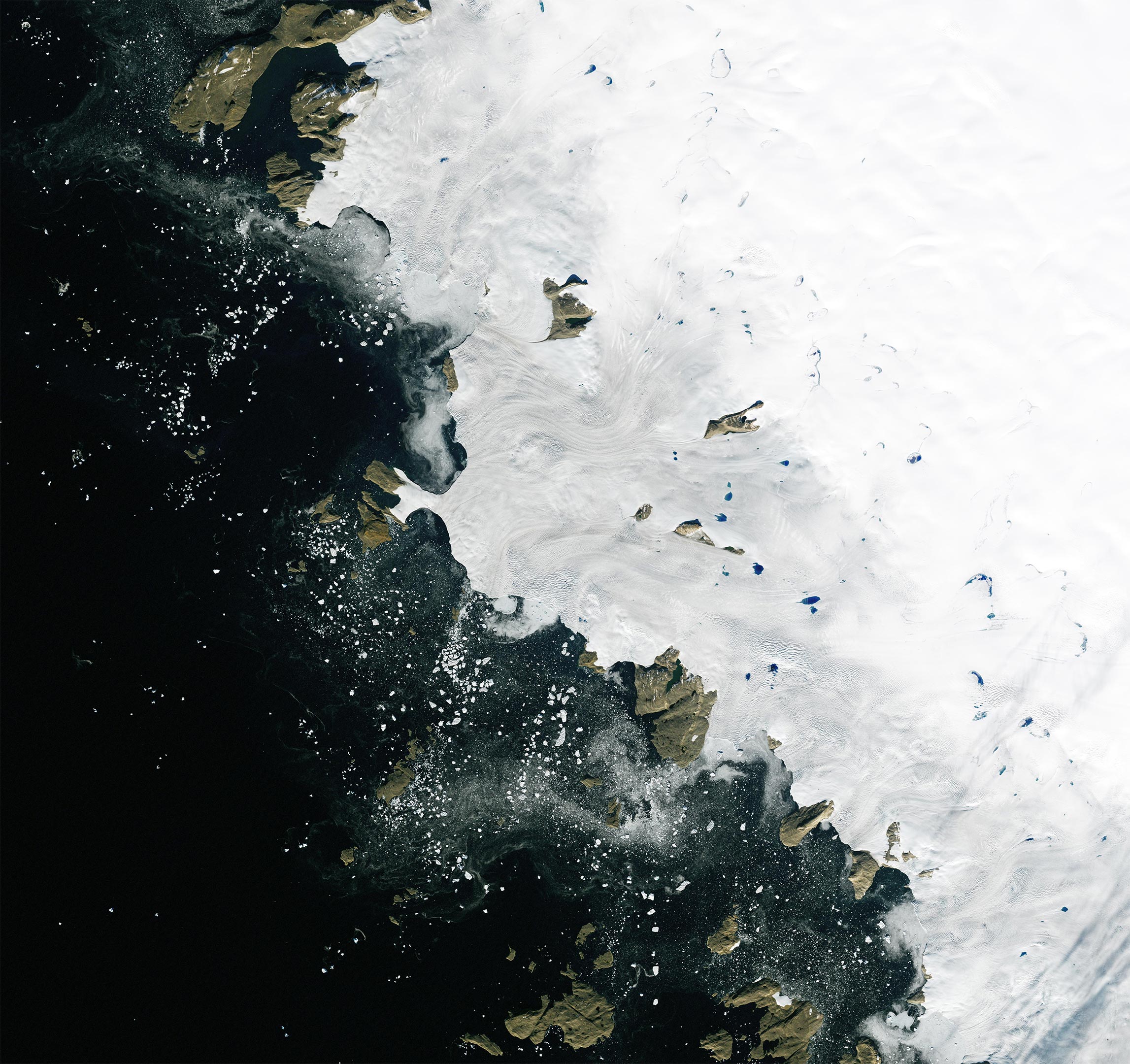
    Like so many glaciers in Greenland, Kjer has retreated significantly in recent decades and now flows more rapidly toward the ocean.

    Change is constant and common on Earth across geologic time. But in the icy polar regions, change has been dramatic and swift in the past few decades. One example is northwest Greenland, where quite a lot has changed in 21 years.

    The image pair above shows part of Greenland along Melville Bay (a sub-section of Baffin Bay) on September 3, 2000, and September 21, 2021. The images were acquired with the Enhanced Thematic Mapper Plus (ETM+) on Landsat 7 and the Operational Land Imager (OLI) on Landsat 8, respectively. (Note that Earth Observatory originally published a version of the 2000 image in false color. Both images above are natural color and show a slightly wider view.)

    The images show a 80-kilometer (50-mile) stretch of coastline. Like so many places around the edges of Greenland, a series of glaciers here carry ice from the island’s interior toward the coast and onto the ocean. Most of these marine-terminating glaciers are retreating. Kjer and Hayes—the two main outlet glaciers shown above—are also speeding up.

    Ice Shelf Collapse Speeds Up Kjer Glacier

    Notice that in 2000, Kjer Glacier abutted a few rocky outcrops. These rocks helped buttress the ice and slowed its oceanward flow. Then sometime in 2012, the glacier’s floating ice shelf disintegrated. The rocks became free-standing islands, surrounded in the 2021 image by open water and a mixture of sea ice and icebergs, or mélange. Having lost contact with the rocks, the glacier’s inland ice can flow even more rapidly toward the ocean.

    According to Alex Gardner, a snow and ice scientist at NASA’s Jet Propulsion Laboratory, data from the NASA MEaSUREs project ITS_LIVE show that one year before the ice shelf’s breakup, the glacier flowed at an average speed of 1,200 meters (0.75 miles) per year. By 2018, the glacier’s average speed was more than 4,000 meters (2.5 miles) per year.

    “Kjer is experiencing a nearly four-fold increase in ice flow due to the collapse of its floating ice shelf, likely due to melting by warmer ocean waters,” Gardner said. “This has led to increased contributions of ice to the ocean and is accelerating sea level rise.”

    In the 1970s, the Greenland Ice Sheet gained about as much ice as it lost—a balanced state that lasted until the mid 1990s, at which point ice loss sped up. Between 2002 and 2021, Greenland shed about 280 gigatons of ice per year, adding 0.8 millimeters (0.03 inches) per year to global sea level rise.

    NASA Earth Observatory images by Lauren Dauphin, using Landsat data from the U.S. Geological Survey.

    Never miss a breakthrough: Join the SciTechDaily newsletter.
    Follow us on Google and Google News.

    Climate Change Glacier NASA NASA Earth Observatory
    Share. Facebook Twitter Pinterest LinkedIn Email Reddit

    Related Articles

    Melting Mysteries: The Loss of Earth’s Frozen Records

    Alarming Shrinkage of Norway’s Ålfotbreen Glacier – “Cannot Survive the Current Climate”

    Unusual Late-Season Melting on Humboldt Glacier

    The Shrinking Giant: A 40-Year Look at Alaska’s Mendenhall Glacier

    Summer Breakout: Rapid Disintegration of Sea Ice in Northeast Greenland

    Losing a Long-Watched Glacier – 70% of Mass Depleted From Peyto Glacier in Alberta

    Ice Shelf Completely Disintegrates in East Antarctica

    Climate Change Reveals Military History: Melting Glaciers Recently Exposed Artifacts of War in the Alps

    Shrinking Glaciers and Growing Lakes As Temperatures Rise on the Tibetan Plateau

    Leave A Reply Cancel Reply

    • Facebook
    • Twitter
    • Pinterest
    • YouTube

    Don't Miss a Discovery

    Subscribe for the Latest in Science & Tech!

    Trending News

    Bone-Strengthening Discovery Could Reverse Osteoporosis

    Scientists Uncover Hidden Trigger Behind Stem Cell Aging

    Scientists Find Way to Reverse Fatty Liver Disease Without Changing Diet

    Could Humans Regrow Limbs? New Study Reveals Promising Genetic Pathway

    Scientists Reveal Eating Fruits and Vegetables May Increase Your Risk of Lung Cancer

    Scientists Reverse Brain Aging With Simple Nasal Spray

    Scientists Uncover Potential Brain Risks of Popular Fish Oil Supplements

    Scientists Discover a Surprising Way To Make Bread Healthier and More Nutritious

    Follow SciTechDaily
    • Facebook
    • Twitter
    • YouTube
    • Pinterest
    • Newsletter
    • RSS
    SciTech News
    • Biology News
    • Chemistry News
    • Earth News
    • Health News
    • Physics News
    • Science News
    • Space News
    • Technology News
    Recent Posts
    • What Makes Rubber So Strong? Scientists Finally Solve 100-Year-Old Mystery
    • Scientists Decode Mysterious Magnetic “Maze Domains” To Boost EV Efficiency
    • Scientists Say This Fungus Could Survive the Trip to Mars
    • The Universe Is Expanding Too Fast and Scientists Can’t Explain Why
    • Gaining Weight Young May Be More Dangerous Than You Think
    Copyright © 1998 - 2026 SciTechDaily. All Rights Reserved.
    • Science News
    • About
    • Contact
    • Editorial Board
    • Privacy Policy
    • Terms of Use

    Type above and press Enter to search. Press Esc to cancel.