
Enzyme Process Alters Spike Protein Function
Scientists at the National Institutes of Health have found that a process in cells may limit the infectivity of SARS-CoV-2, and that mutations in the alpha and delta variants overcome this effect, potentially boosting the virus’s ability to spread. The findings were published online in the Proceedings of the National Academy of Sciences. The study was led by Kelly Ten Hagen, Ph.D., a senior investigator at NIH’s National Institute of Dental and Craniofacial Research (NIDCR).
Since the coronavirus pandemic began in early 2020, several more infectious variants of SARS-CoV-2, the virus that causes COVID-19, have emerged. The original, or wild-type, virus was followed by the alpha variant, which became widespread in the United States in early 2021, and subsequently the delta variant, which is the most prevalent strain circulating today. The variants have acquired mutations that help them infect people and spread more easily. Many of the mutations affect the spike protein, which the virus uses to get into cells. Scientists have been trying to understand how these changes alter the virus’s function.
“Throughout the pandemic, NIDCR researchers have applied their expertise in the oral health sciences to answer key questions about COVID-19,” said NIDCR Director Rena D’Souza, D.D.S., Ph.D. “This study offers fresh insights into the greater infectivity of the alpha and delta variants and provides a framework for the development of future therapies.”
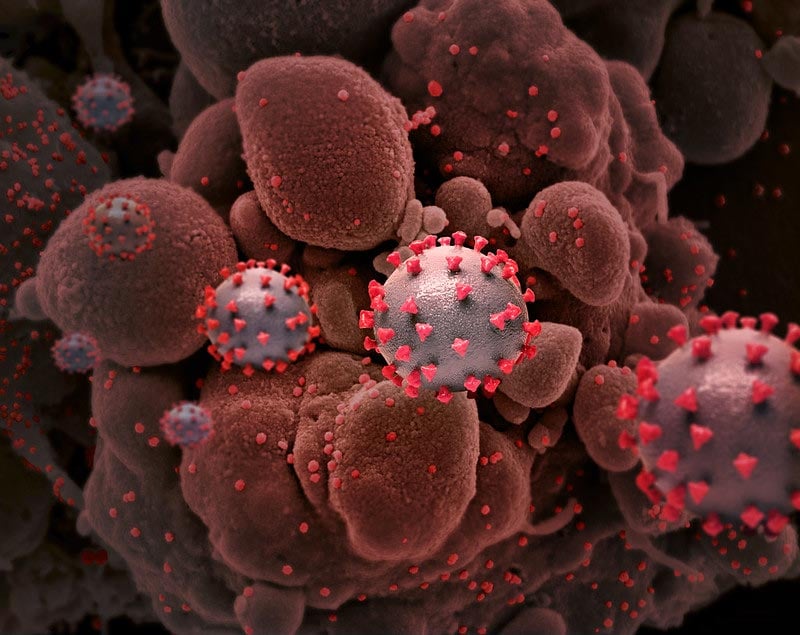
The outer surface of SARS-CoV-2 is decorated with spike proteins, which the virus uses to attach to and enter cells. Before this can happen, though, the spike protein must be activated by a series of cuts, or cleavages, by host proteins, starting with the furin enzyme. In the alpha and delta variants, mutations to the spike protein appear to enhance furin cleavage, which is thought to make the virus more effective at entering cells.
Studies have shown that in some cases protein cleavage can be decreased by the addition of bulky sugar molecules—a process carried out by enzymes called GALNTs—next to the cleavage site. Ten Hagen’s team wondered if this happens to the SARS-CoV-2 spike protein, and, if so, whether it changes the protein’s function.
GALNT1 Suppresses Furin Cleavage in Wild-Type Virus
To find out, the scientists studied the effects of GALNT activity on spike protein in fruit fly and mammalian cells. The experiments showed that one enzyme, GALNT1, adds sugars to wild-type spike protein, and this activity reduces furin cleavage. By contrast, mutations to the spike protein, like those in the alpha and delta variants, decrease GALNT1 activity and increase furin cleavage. This suggested that GALNT1 activity may partially suppress furin cleavage in wild-type virus, and that the alpha and delta mutations overcome this effect, allowing furin cleavage to go unchecked.
Further experiments supported this idea. The researchers expressed either wild-type or mutated spikes in cells grown in a dish. They observed the cells’ tendency to fuse with their neighbors, a behavior that may facilitate spread of the virus during infection. The scientists found that cells expressing mutated spike protein fused with neighbors more often than cells with the wild-type spike. Cells with wild-type spikes also fused less often in the presence of GALNT1, suggesting that its activity may limit spike protein function.
Mutations Override Natural Defense Mechanism
“Our findings indicate that the alpha and delta mutations overcome the dampening effect of GALNT1 activity, which may enhance the virus’s ability to get into cells,” said Ten Hagen.
To see if this process might also occur in people, the team analyzed RNA expression in cells from healthy volunteers. The researchers found wide expression of GALNT1 in lower and upper respiratory tract cells that are susceptible to SARS-CoV-2 infection, indicating that the enzyme could influence infection in humans. The scientists theorized that individual differences in GALNT1 expression could affect virus spread.
“This study suggests that GALNT1 activity may modulate viral infectivity and provides insight into how mutations in the alpha and delta variants may influence this,” Ten Hagen said. The knowledge could inform future efforts to develop new interventions.
Reference: “Furin cleavage of the SARS-CoV-2 spike is modulated by O-glycosylation” by Liping Zhang, Matthew Mann, Zulfeqhar A. Syed, Hayley M. Reynolds, E. Tian, Nadine L. Samara, Darryl C. Zeldin, Lawrence A. Tabak and Kelly G. Ten Hagen, 3 November 2021, Proceedings of the National Academy of Sciences.
DOI: 10.1073/pnas.2109905118
This research was supported by the NIDCR Division of Intramural Research. Support also came from the intramural program of the National Institute of Environmental Health Sciences.
Never miss a breakthrough: Join the SciTechDaily newsletter.
Follow us on Google and Google News.
2 Comments
Hospitals in USA and in first world countries are refusing life-saving Ivermectin treatment even with court orders. Big Pharma doing everything they can to jab us no matter what, while alternative COVID cures EXIST! There happens to be heavy censorship who are looking for these treatments. The Research Is Clear: Ivermectin Is a Safe, Effective Treatment for COVID.
It’s important to stop the spikes from infecting cells, but it’s more important to understand other possible ways the virus can increase its infection ability.
All the coronaviruses and all their variants have different protein spikes, with Delta having one that’s more efficient at getting around the vaccines. But the real problem is in the virus itself, not its protein shell, and why the most dangerous (MERS, SARS, and Covid-19) are so infectious. My independent research has found multiple one-in-a-million nucleotide sequence matches between all the coronaviruses and the human genome. Those sequences are the same as some of the loops of human tRNA. Using those loops and their amino acid code matches, viruses may be able to fool the nucleus membrane in cells to allow the virus to enter and associate with the human DNA, creating more opportunities for further infection. Our immune system may be compromised and may no longer be able to stop the virus and other diseases from attacking organs throughout the body. Vaccines that attack the virus protein shells while ignoring their contents are doomed to failure from the Darwin effect, but recognizing these loops suggests a possible approach to successful coronavirus vaccines. Only the infection process is considered in my work, not the innate virulence of the virus. For more info, check out this YouTube, Coronavirus – Using Your DNA Against You. https://www.youtube.com/watch?v=8dOIzD6ch8s