
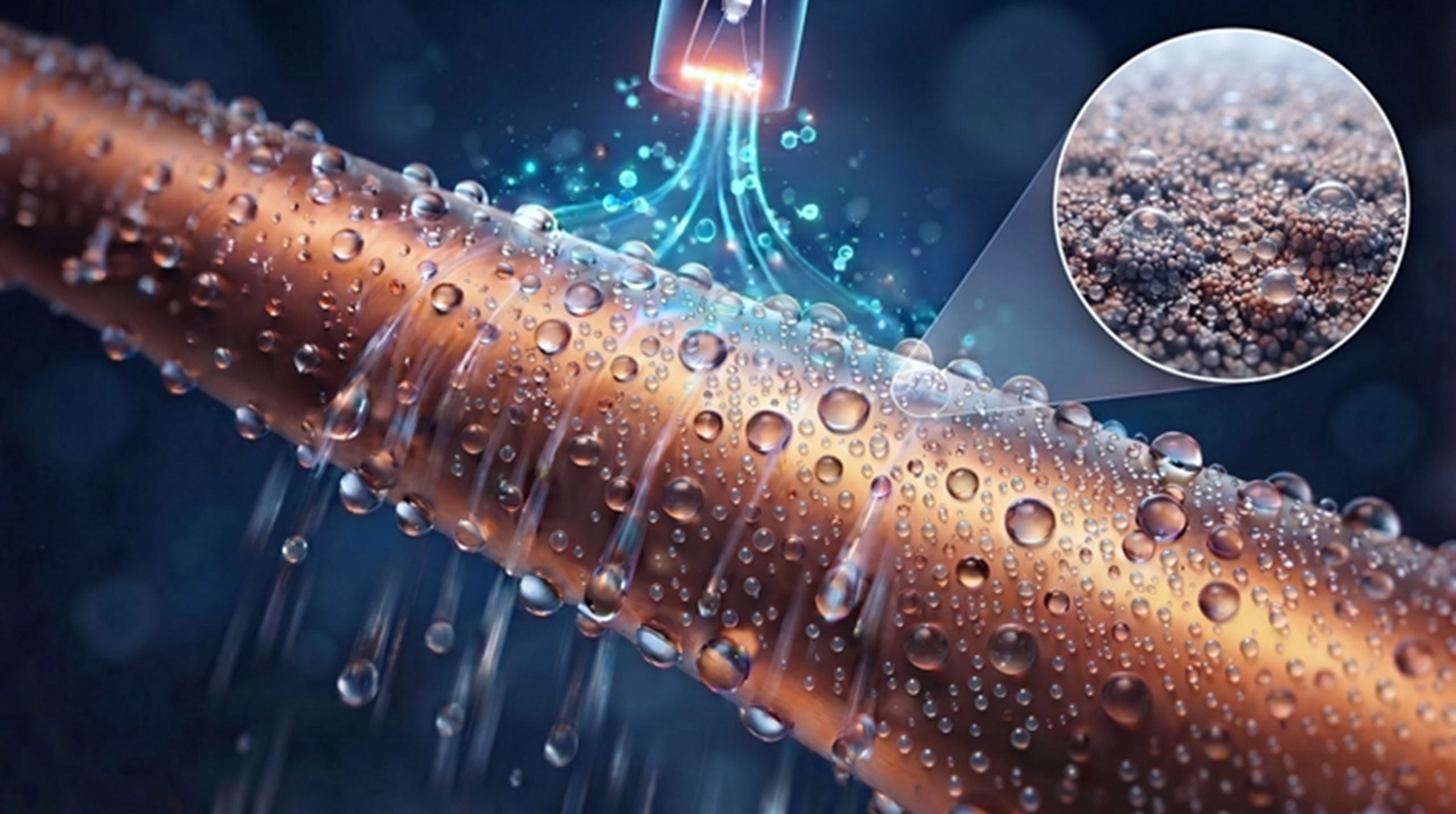
A new polymer coating helps water droplets form and detach faster, boosting condensation heat transfer by up to 5.5 times on copper surfaces.
Water droplets forming on a cold surface can either help move heat efficiently or create a thin insulating layer that slows the process down. KAIST researchers have developed an ultrathin polymer coating that encourages droplets to appear and leave the surface more quickly, increasing condensation heat transfer performance by as much as 5.5 times compared with conventional copper surfaces. The approach could eventually improve energy efficiency in power plants and desalination systems and strengthen cooling for electronic devices.
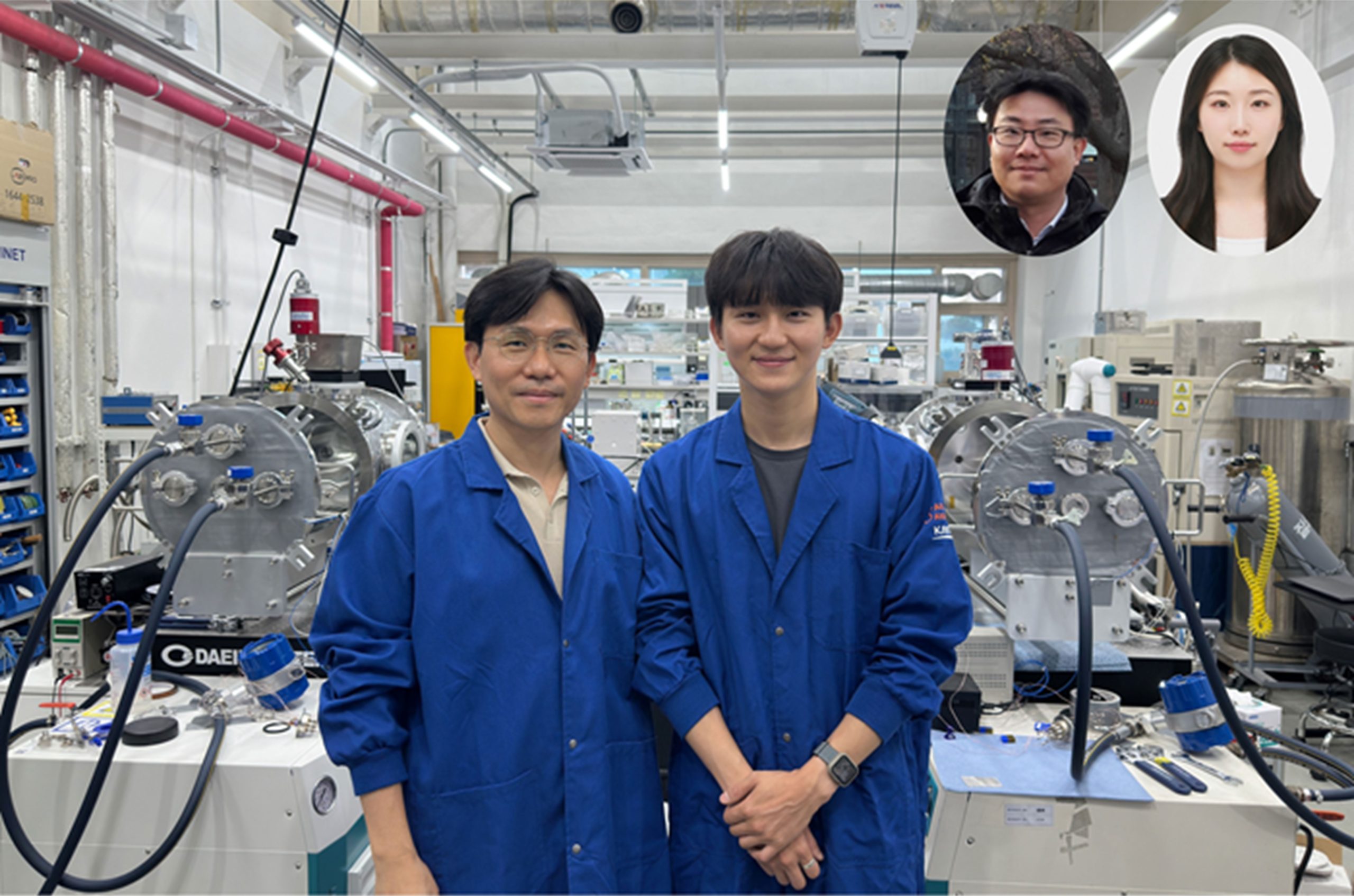
KAIST (President Choongsik Bae) announced on August 23 that a joint research group led by Professor Youngsuk Nam of the Department of Mechanical Engineering and Professor Sung Gap Im of the Department of Chemical and Biomolecular Engineering created the technology by controlling the thickness and structure of an ultrathin polymer layer. The coating allows more droplets to begin forming as water vapor condenses while also helping those droplets detach sooner.
Condensation occurs when water vapor changes into liquid water, a familiar process visible when moisture collects on the outside of a cold drink. Industrial systems depend on the same process to turn steam back into water at power plants, produce fresh water from seawater, and carry heat away from electronic devices.
Faster droplet removal improves heat transfer
Efficient condensation depends on clearing water away from the surface quickly. On conventional metal surfaces, small droplets tend to join together and create a thin film of water. That film acts as additional thermal resistance, slowing the movement of heat in much the same way that layers of winter clothing reduce heat loss from the body.
Heat transfer improves when condensation instead occurs as individual droplets that repeatedly form and detach, continually uncovering fresh surface underneath. This process is known as dropwise condensation. Rather than leaving the surface coated in water, the droplets form, fall away, and make room for new ones, allowing heat to move more effectively.
Previous surface designs struggled with a basic trade-off. Adding roughness creates more locations where droplets can begin forming, but those same structures can trap the droplets and make them difficult to remove. Making a surface smoother has the opposite effect: droplets can detach more easily, but fewer sites remain where new droplets can form.
Polymer defects solve a surface tradeoff
The researchers overcame this conflict by taking advantage of nanoscale polymer aggregates that had traditionally been treated as ‘defects’ in polymer coatings. They created the films using initiated chemical vapor deposition (iCVD), which deposits gas-phase precursors onto a surface to form an ultrathin polymer layer. When the film was made thinner, dense clusters of small polymer aggregates appeared across the surface and acted as nucleation sites where water droplets could begin forming. Thin films produced approximately three times as many droplets as thicker films.
The researchers then introduced heat treatment to weaken the force attaching droplets to the surface, allowing them to leave before growing too large. In effect, reducing film thickness increased the number of places available for droplets to form, while thermal treatment made those droplets easier to remove. This allowed the two competing factors to be controlled independently, with film thickness governing nucleation and heat treatment promoting droplet departure.
Once one droplet leaves, another can begin forming in the newly exposed location. Similar to a vacant seat being occupied as soon as the previous person leaves, faster cycles of droplet formation and removal continually refresh the surface and improve heat transfer during condensation.
Copper tubes transferred far more heat
To test the coating under more realistic conditions, the researchers applied it to copper tubes commonly used in condensers. The maximum condensation heat transfer coefficient reached about 88 kW·m⁻²·K⁻¹. That was up to approximately 5.5 times the heat transfer performance of an ordinary copper surface covered by a water film and more than 50% higher than a conventional hydrophobic coating.
Instead of relying only on smooth or water repelling surfaces, the approach deliberately used tiny surface ‘defects’ as useful features. Nanoscale particles that would normally be removed from polymer films instead became sites that encouraged droplets to form, providing a different strategy for designing condensation surfaces.
If adapted for power plants or industrial heat exchangers, the coating could improve energy efficiency by moving heat more effectively. The same principle could support more efficient water collection in desalination and water-harvesting systems and accelerate heat removal from electronic devices.
Professor Nam said, “This research is meaningful because it uses nanostructures previously regarded as defects as features that help droplets form. We have presented a new method for improving heat transfer efficiency by separately controlling droplet formation and removal.” He added, “Because this technology can form extremely thin, uniform coatings even on surfaces with complex shapes, we expect it to be used in various energy and environmental applications, including industrial heat exchangers.”
Reference: “Rational design of polymer film morphology via structure-performance linkage for enhanced condensation performance” by Jun Soo Kim, Minjeong Kang, Seokwan Roh, Donghyeong Lee, Wontae Jang, Sung Gap Im and Youngsuk Nam, 16 July 2026, Nature Communications.
DOI: 10.1038/s41467-026-75621-5
This research was supported by the Mid-Career Researcher Program (Ministry of Science and ICT and the National Research Foundation of Korea), the SME Technology Innovation Development Program (Ministry of SMEs and Startups and the Korea Technology and Information Promotion Agency for SMEs), and the Deep-Tech Startup Activation Support Program (Ministry of Science and ICT and Commercialization Promotion Agency for R&D Outcomes, COMPA).
Never miss a breakthrough: Join the SciTechDaily newsletter.
Follow us on Google and Google News.