
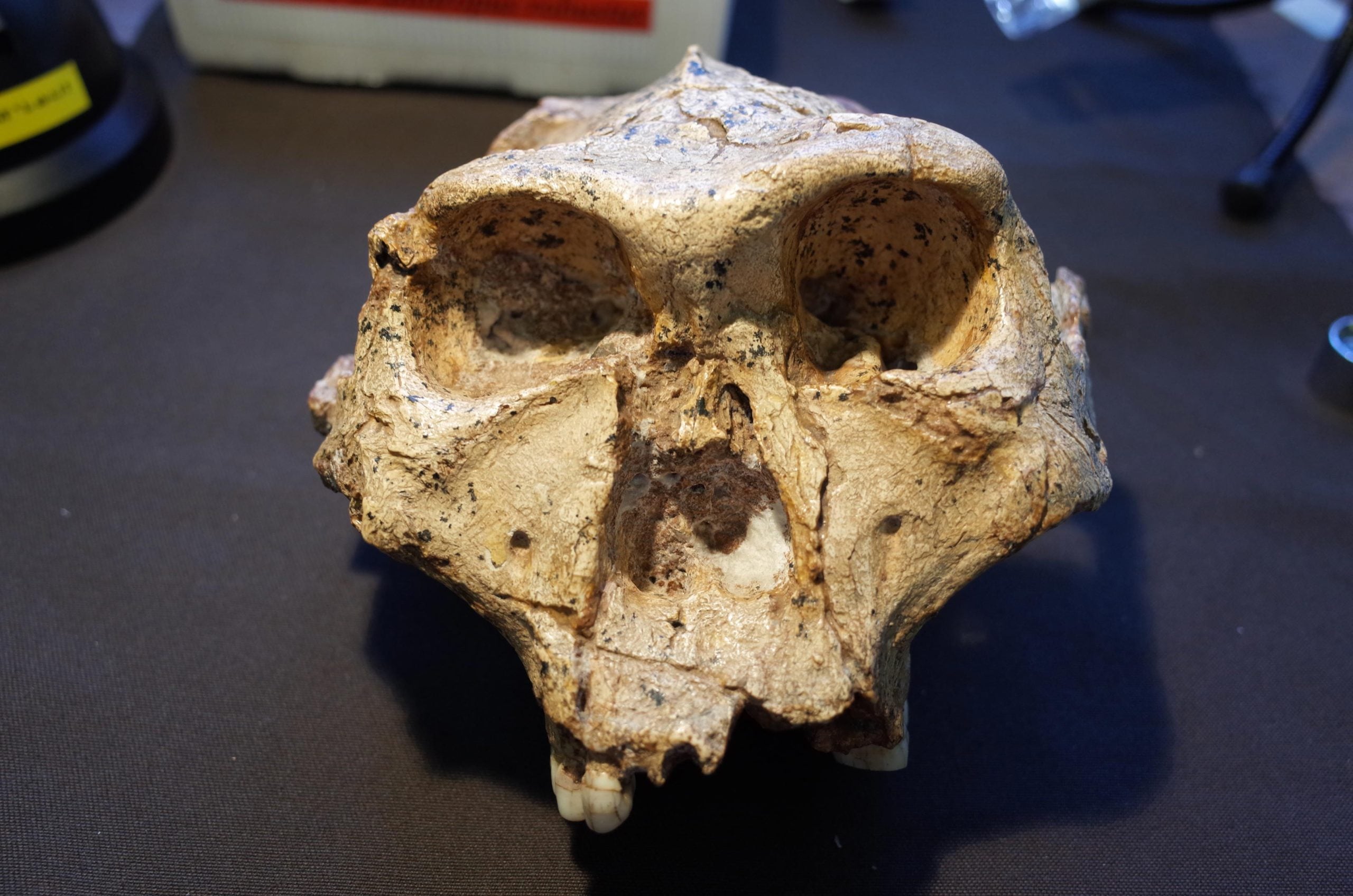
Growing evidence that early human relatives do not fit neatly into traditional categories is prompting a proposal to expand the genus Homo.
The human family tree is becoming harder to fit into the categories scientists have used for decades. Research from Monash University argues that recent discoveries are blurring the boundaries between our ancestors and close fossil relatives, raising questions about how they should be named and classified.
The work, published in the American Journal of Biological Anthropology, proposes placing all human species and closely related fossil forms from the past 4-5 million years within the genus Homo.
Human evolution is often depicted as a sequence of clearly separated species, beginning with ape-like ancestors, passing through Australopithecus and early members of Homo, and eventually leading to Homo sapiens.
The fossil record, however, reveals a far less orderly history. New finds have repeatedly weakened the traits once used to draw firm lines between humans and their close relatives.
Fossil discoveries blur old genus boundaries
Lead researcher Dr. Ian Towle, a Research Fellow at the Monash Biomedicine Discovery Institute, said accumulating evidence is making the current classification system less useful and less accurate. That includes species assigned to Homo, as well as Australopithecus and Paranthropus, all of which lived within the past 5 million years.
“Recent fossil discoveries and advances in evolutionary and genetic analysis make this an ideal time to reconsider whether our traditional taxonomy still accurately reflects human evolution,” Dr Towle said.
“These groups do not necessarily represent distinct evolutionary branches, or ‘clades,’ and differences in behavior and ecology once used to distinguish them have also become increasingly difficult to maintain.
“I propose expanding Homo to include these other groups to provide a more accurate and stable way to represent the complex evolutionary relationships revealed by the growing fossil record.”
Modern taxonomy favors shared ancestry
Over the past 50 years, advances in evolutionary biology have changed how scientists organize the living world.
Modern taxonomy, the system used to name and classify organisms, increasingly seeks to reflect actual evolutionary relationships by grouping species according to common ancestry.
Human evolution has been slower to adopt that approach.
In recent decades, classification has increasingly focused on clades, groups that include a common ancestor and all of its descendants.
Traditional Homo traits no longer hold
Members of Homo have traditionally been distinguished by traits such as larger brains, sophisticated tool use, and particular anatomical and behavioral characteristics.
Those boundaries have become harder to defend. Some accepted members of Homo had very small brains, while complex behaviors also appear to have been present in Paranthropus and Australopithecus.
Dr Towle argues that moving Australopithecus and Paranthropus species into Homo would provide a more consistent picture of human evolution and reduce the need to repeatedly redraw taxonomic boundaries as new fossils and evidence emerge.
“The more we learn about our ancestors and close fossil relatives, the more we realize how complex and non-linear our family tree is,” Dr Towle said.
“Expanding the Homo genus to also include species of Australopithecus and Paranthropus will allow us to account for differences without regularly reclassifying particular groups.”
Reference: “Clades, Grades, and the Genus Problem: A Case for Revising Hominin Taxonomy” by Ian Towle, 18 August 2026, American Journal of Biological Anthropology.
DOI: 10.1002/ajpa.70344
Never miss a breakthrough: Join the SciTechDaily newsletter.
Follow us on Google and Google News.
5 Comments
Great! Even as a Christian, I affirm the evolutionary descent of humanity, with God indeed involved, but playing a much larger “hands-off” approach, and letting individuals emerge who express passion, intelligence, wit, derring-do, and a desire for something visionary!
As we all know, or should know, with the last decade of tests validating the concordance cosmology the universe is now known to have been entirely produced by a fully natural process of space expansion leaving no room for magical agency such as the notions of your choice of organized superstition you describe. And even if we limit ourselves to evolution as before it has long been known that the same superstition notion of ‘ladder of descent’ producing humans is incorrect, evolution have no goal and most “species” are unicellular successes.
That is what the intelligence and derring-do of science with its desire for visionary knowledge has gained us. Meanwhile, with a century old observation that your chosen superstition is wrong on biology and now a decade old observation that it is entirely wrong, may I suggest that imposing falsehoods makes a moral problem for it. Especially poignant if these falsehoods are imposed on an innocent science thread. Think of the children that may be reading it!
William Stoertz comments.
Agreed! Toronto, Canada
I can agree with the paper current delimitation on evolutionary grounds:
“Given continued debate over the placement of proposed earlier homininans (or even their placement within this subtribe), restricting the genus to currently recognized Australopithecus, Homo, and Paranthropus (and Kenyanthropus) represents a convenient and defensible (at present) clade. These earlier taxa (including Sahelanthropus, Orrorin, and Ardipithecus) are sometimes interpreted as fitting elsewhere within the ape family tree, and some key homininan traits (or more specifically later homininan traits) have been argued to be absent in these groups (e.g., Strait 2013; Macchiarelli et al. 2020; Wood et al. 2020; Williams et al. 2026). Therefore, although some, or all three, of these taxa may well be homininans, there is little evidence to suggest they are in the expanded Homo clade proposed here. Indeed, the proposed expanded Homo framework does not preclude these genera from being considered homininans, as Homo need not encompass the entirety of homininan evolution, and multiple genera may be justified within this broader clade. However, the proposed expanded Homo constitutes a well-supported clade, which adding these additional taxa would undermine.”
Of course, we tetrapods can discuss monophyly of us fishes until we get blue in our faces. The paper ends on a realistic tone, suggesting this will remain a topic for a longer time:
“The proposal advanced here represents one possible solution to some of these problems. Given its limitations and the inevitable loss of some taxonomic information, it will likely not prove widely acceptable. Nevertheless, the issues discussed are not new, and recent discoveries have only amplified them. Therefore, there is an increasing need for greater consistency in how genera are defined and applied across the homininan fossil record.”
We should understand that classifying organisms into species is as much an artifact of the way humans think than a reflection of actual biological phenomena. Humans think in finite discrete terms. We can only hold so many distinct pieces of information in our working memory at one time. Something around 7 is the average, I think. So knowledge and information has to be cut up and organized into discrete pieces for our minds to be able to process and understand it.
Speciation is not a well-ordered process that allows us to pinpoint clear genetic/morphological or temporal boundaries between species. But pretending it is is helpful given how our brains handle information.