
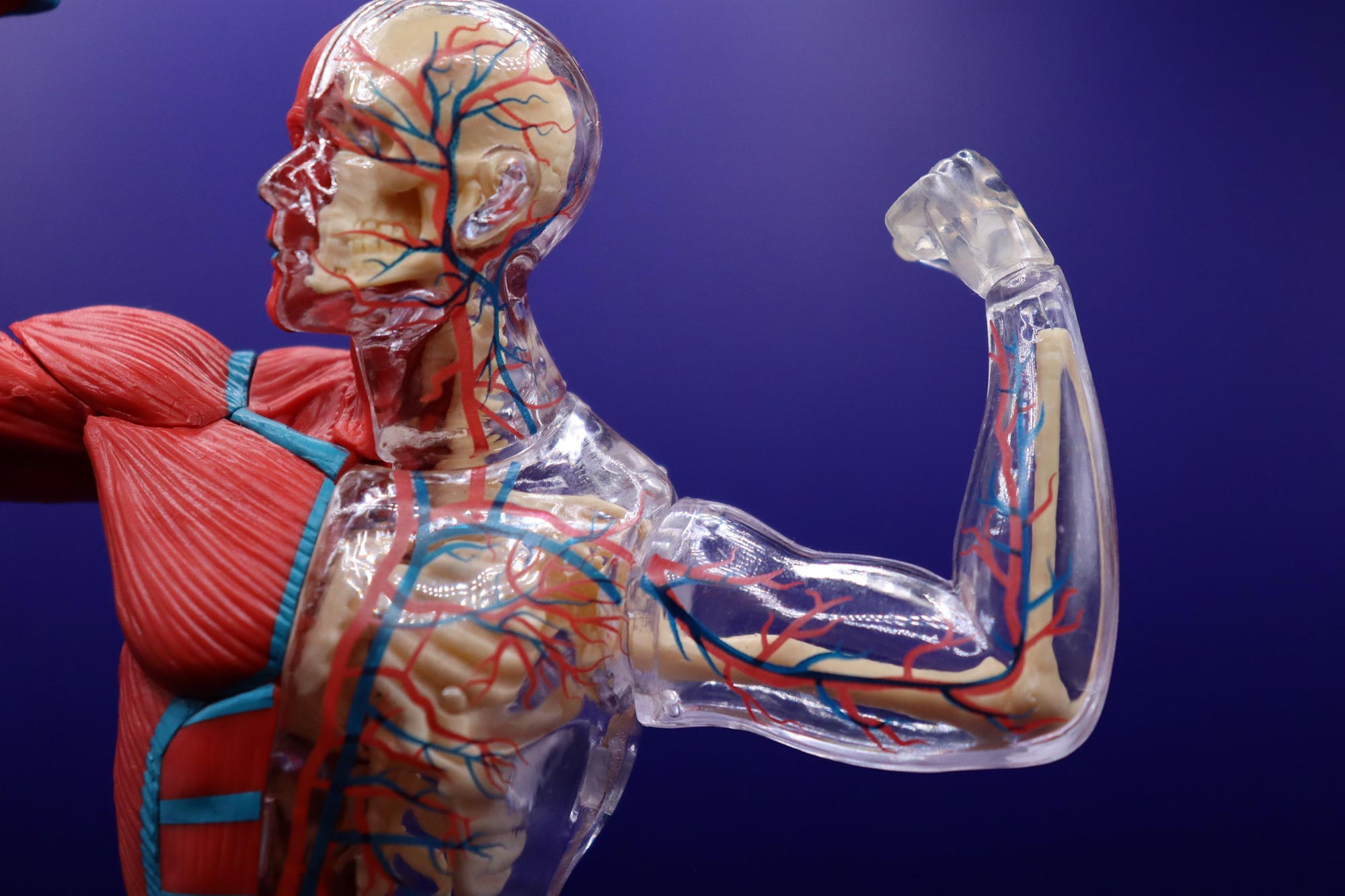
Researchers directly observed muscle actin filaments growing from an end long thought unable to support growth, revealing how the protein leiomodin 2 helps maintain their structure.
Muscle cells face a peculiar problem. Their actin filaments must remain precisely the right length for muscles to contract properly, yet those same filaments continually age, degrade, and need to be rebuilt. How muscle cells accomplish both has remained unresolved for decades.
Biophysicists at Emory University have now identified a mechanism that helps explain the process. Their work, published in Nature Communications, shows that actin can grow from an end long thought unable to support this kind of assembly. The discovery could also improve understanding of muscle disorders such as dilated cardiomyopathy, one of the leading causes of heart failure.
“We’ve made a fundamental advance in understanding how the cellular cytoskeleton is assembled, especially in muscle cells,” says Shashank Shekhar, assistant professor of physics at Emory University and senior author of the study.
The findings overturn part of a model used for more than 40 years to describe how actin filaments form and maintain their length.

“Our work challenges a long-standing paradigm by uncovering a new mechanism, previously thought impossible, by which the protein leimodin builds actin filaments in muscle,” Shekhar says.
The result also connects this basic mechanism to disease.
“We also provide a molecular explanation for how defects in leimodin can disrupt the assembly of the contractile machinery of the heart,” says Sudipta Biswas, an Emory PhD candidate and first author of the paper.
A genetic mutation affecting leimodin, for example, has been linked to dilated cardiomyopathy, a disease that progressively weakens heart muscle and reduces its ability to pump blood effectively.
Muscle actin defies the usual growth rule
The Shekhar Lab investigates the mechanical and chemical regulation of actin, one of the body’s most abundant and versatile proteins.
Actin forms filaments that contribute to the internal skeleton of living cells and help determine their shape. These filaments also generate forces involved in cell movement. As they lengthen, they can press against a cell membrane and push the cell forward. Similar actin dynamics allow cells to change shape, split into two daughter cells, and enable immune cells to engulf and kill invading bacteria.
In many cells, actin filaments are arranged in loose, mesh-like networks. Muscle cells require a much more orderly configuration. There, actin and myosin are organized into straight, stable structures called sarcomeres — the smallest organized units responsible for muscle contraction.
Within a sarcomere, actin filaments slide past myosin toward the center. This shortens the sarcomere much like pulling a drawstring, while the individual filaments themselves maintain the same length.
“How well your muscles contract is controlled by the length of these actin filaments,” Shekhar explains. “From birth, to death, the length of the actin filaments in muscle cells stays the same. It’s very tightly controlled.”
Yet keeping their overall length constant does not mean the filaments themselves remain unchanged. They still need to replace aging material as proteins turn over and degrade.
That apparent contradiction posed a key puzzle: the filaments remain the same length even as their individual proteins are continually replaced.
Each actin filament has two distinct ends. One is called the pointed, or minus, end, while the other is the barbed, or plus, end. For decades, the standard model held that actin units are lost from the minus end while newly energized units are added at the plus end.
This process — losing an actin subunit from the minus end while gaining one at the plus end — is called “treadmilling,” since the filament appears to move forward as new building blocks are added.

Muscle cells create a complication for that model. Within sarcomeres, actin filament length is tightly controlled, and the barbed, plus end is capped by a protein that prevents new molecules from being added there.
“And yet, the actin filaments in the sarcomeres you’re born with are not the same ones in your sarcomeres today,” Shekhar says. “No one knew how they keep assembling and remodeling themselves.”
A bacterial toxin suggested another route
A clue came from earlier work by Shekhar and colleagues at Ohio State University involving a toxin produced by Vibrio cholerae, the bacterium that causes cholera. In non-muscle cells, the toxin can hijack actin machinery and reverse normal treadmilling, causing filaments to grow from the minus end instead.
That unusual behavior led Shekhar and Biswas to ask whether healthy muscle cells might use a comparable mechanism. If so, some catalyst would need to promote actin growth from the minus end.
“Sudipta did some really clever experiments to test this idea,” Shekhar says.
Biswas focused on leiomodin 2, a form of leiomodin located near the pointed ends of actin filaments in cardiac muscle cells. “It has domains similar to the Vibrio toxin,” she says.
Previous evidence had already suggested that leiomodin 2 influences filament length.
“Previous laboratory dish experiments,” she adds, “showed that if you delete leiomodin 2 from cardiac muscle cells, their actin filaments get shorter. And if you have too much leiomodin 2, the filaments grow longer than normal.”
To determine what the protein was actually doing at the molecular level, Biswas turned to microfluidic-assisted total internal reflection fluorescence microscopy (mf-TIRF), a specialized method for watching individual protein molecules move as actin filaments assemble and disassemble.
The Shekhar Lab is one of only a handful of laboratories worldwide using mf-TIRF for this purpose. Researchers attach different fluorescent colors to individual proteins, introduce them into a microfluidic system, and follow their movements through the emitted light.
Single molecules revealed pointed end growth
Biswas first attached molecules of leimodin 2 to the bottom of a microfluidic chamber. She labeled individual actin molecules with red fluorescence and added them to the system. The actin began assembling into filaments that remained fixed at their pointed ends through the anchored leimodin 2, appearing like tiny, growing red fluorescent worms.
The crucial question was whether new actin was actually being added at those pointed, minus ends.
Biswas tested that directly by introducing another supply of actin molecules, this time labeled green. The green molecules accumulated at the leiomodin base. With each addition of green actin there, the existing red sections of the filaments shifted farther from the base in the direction of fluid flow.
The color shift provided direct evidence that new building blocks were being added at the pointed end rather than only at the opposite end.
“We provided the first direct molecular evidence that actin filaments grow from their pointed ends,” Biswas says. “We proved those who thought this wasn’t possible wrong.”
The findings also offer a mechanistic explanation for why mutations in Leiomodin2 can produce either shorter, thin actin filaments or abnormally long, thin filaments in heart muscle cells.
“Understanding how a mutation causes a disease is often the first step towards finding ways to treat or prevent a disease,” Biswas says.
Reference: “Leiomodin 2 is a processive pointed-end elongator of actin filaments” by Sudipta Biswas, Tania M. Larrinaga, Sandeep Choubey, Carol C. Gregorio and Shashank Shekhar, 20 July 2026, Nature Communications.
DOI: 10.1038/s41467-026-74809-z
This work was supported by NIH R35GM143050 (S.S.), R01GM120137 (C.C.G.) and R01HL123078 (C.C.G. and S.S.).
Never miss a breakthrough: Join the SciTechDaily newsletter.
Follow us on Google and Google News.