
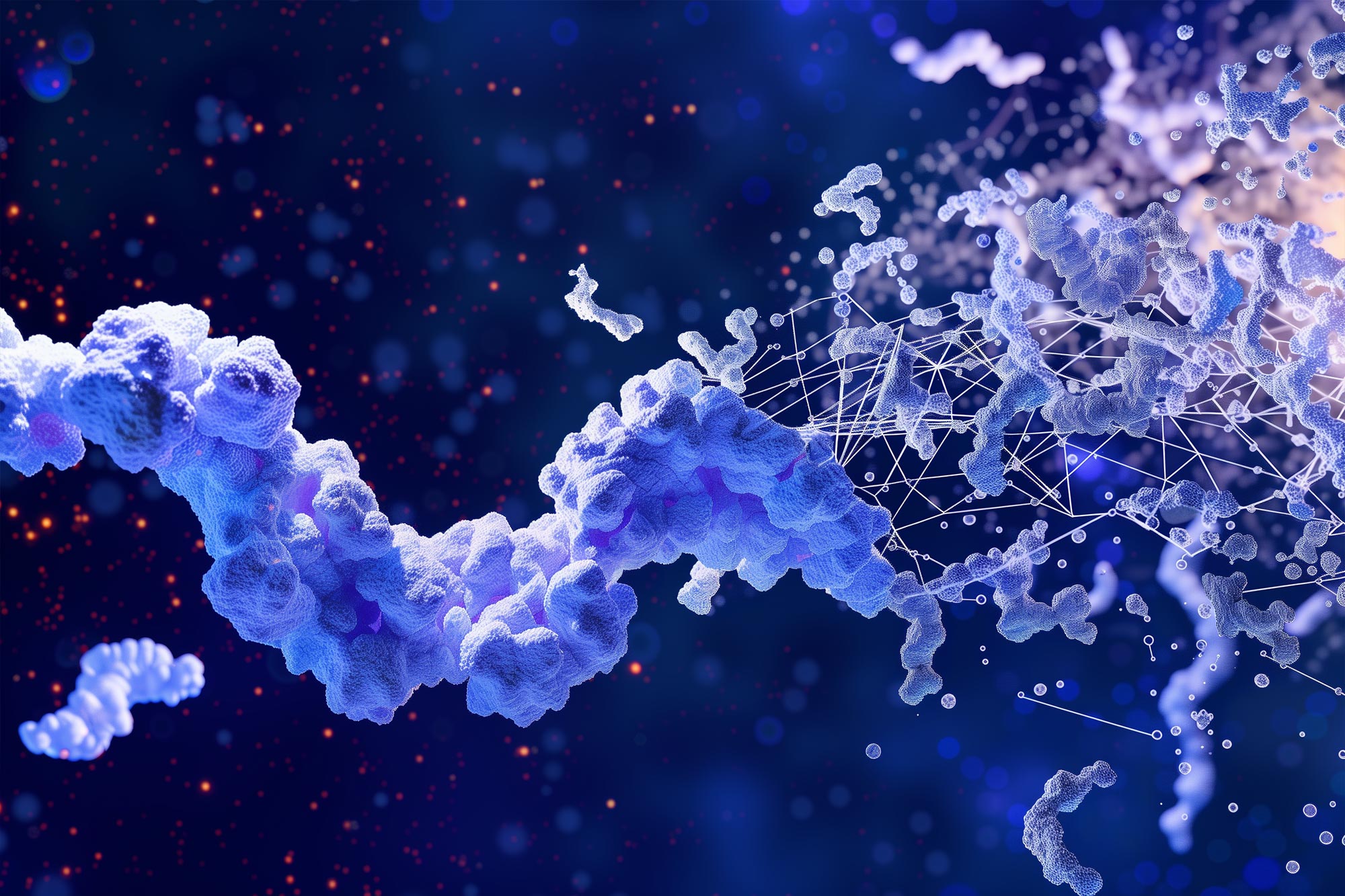
Scientists have uncovered how a surprisingly structured protein helps disordered molecules regulate gene expression, upending previous ideas in molecular biology.
Inside every human cell, proteins play a crucial role in determining which genes are turned on or off, and they do so with remarkable precision. Surprisingly, many of the key proteins responsible for this process do not have a fixed shape. Instead, they exist in a disorganized, flexible form. This has sparked an ongoing debate among molecular biologists: how can these seemingly chaotic molecules lead to such finely tuned gene expression?
A significant portion of the proteins that regulate genes consist of what scientists call “disordered regions.” These are segments that lack a stable, defined structure. In recent years, researchers proposed that these floppy regions interact in a loose and fluid manner, resembling the way tiny oil droplets merge together. This concept suggested that gene-regulating proteins come together in a soft, dynamic fashion rather than through rigid structural frameworks.
A Surprising Role for Structured Proteins
Now, researchers at Baylor College of Medicine have discovered that key components of this machinery instead rely on a structured “bridge” protein to interact and carry out gene activation.
Baylor scientists studied this issue using factors called “BAF complexes,” which open DNA, a key early step needed to make genes ready for expression.
“The majority of each BAF complex is disordered and acts like a floppy noodle without a structure,” said Dr. H. Courtney Hodges, senior corresponding author of the study and associate professor of molecular and cellular biology and with the Center for Environmental Health at Baylor. “Without a fixed shape, it has been difficult to analyze how these disordered regions interact.”
In the new paper published in Molecular Cell, Hodges and an international team of colleagues show that disordered parts of BAF use a protein called beta-catenin as an adapter to link up with other proteins.
“Beta-catenin has a stable molecular structure that acts like a docking station so the noodle-like regions of other proteins can stick together and function properly,” said Hodges. “Beta-catenin links together BAF and other disordered proteins involved in gene regulation.”
From Cancer Clues to Broader Insights
Hodges and his collaborators first began by studying adrenocortical carcinoma (ACC), an aggressive adrenal cancer that produces high levels of steroids. The team sought to find the molecular contacts that explain how this cancer causes hormonal imbalances that can lead to depression, immune suppression, and other symptoms.
“We aimed to understand the root molecular mechanisms driving these hormone disruptions to find a better way to treat this disease,” said Dr. Yuen San Chan, first author of the study and postdoctoral researcher with Hodges.
The researchers focused on factors that control the expression of enzymes involved in steroid hormone production in ACC tumors. Their results revealed that the disordered regions on BAF interact with the structured region of beta-catenin directly, enabling BAF to find and open genes encoding steroid enzymes.
Excitingly, the researchers found that this mechanism isn’t unique to steroid hormone production. Other major regulators of gene expression – including proteins involved in stress responses, stem cell maintenance, and cancer progression – also rely on beta-catenin to link up with BAF.
“Our findings challenge the way we think about disorder in biology. Interactions between disordered molecules with structured protein give rise to a kind of hidden organization,” said Dr. Katerina Cermakova, co-corresponding author and assistant professor of biochemistry and molecular pharmacology at Baylor. “We’ve shown how disordered gene-regulating proteins find and bind specific targets.”
The team’s findings reveal that despite their disordered nature, the protein interactions that drive gene expression are surprisingly modular and even have an underlying organization. While more work is needed, the team’s work shows that the involved factors may be potential targets for drug development and therapies.
Reference: “β-catenin functions as a molecular adapter for disordered cBAF interactions” by Yuen San Chan, Qinyu Gao, Sarah A. Robinson, Wenzhi Wang, Ruzena Filandrova, Lisa-Maria Weinhold, Mario Loeza Cabrera, Miao Zhang, Chandra Shekar R. Ambati, Antonio M. Lerario, Nagireddy Putluri, Katja Kiseljak-Vassiliades, Margaret E. Wierman, Mouhammed Amir Habra, Gary D. Hammer, Vaclav Veverka, Katerina Cermakova and H. Courtney Hodges, 21 July 2025, Molecular Cell.
DOI: 10.1016/j.molcel.2025.06.026
Never miss a breakthrough: Join the SciTechDaily newsletter.
Follow us on Google and Google News.
1 Comment
Brilliant