
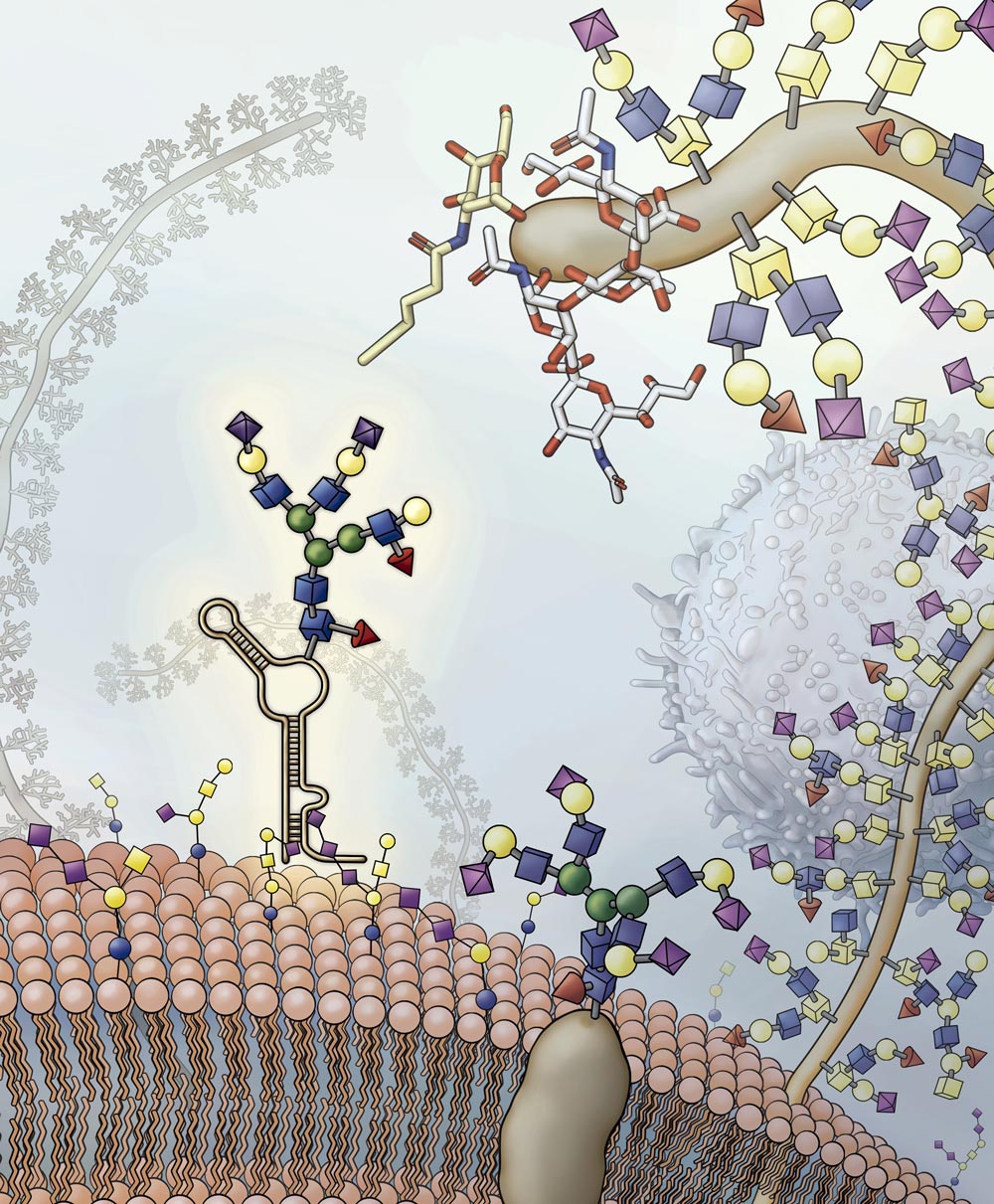
Some RNA Molecules Have Unexpected Sugar Coating
Sugars attach to certain RNA molecules on the outside membrane of the cell. The newly discovered “glycoRNAs” may be involved in immune signaling.
In a surprise find, scientists have discovered sugar-coated RNA molecules decorating the surface of cells.
These so-called “glycoRNAs” poke out from mammalian cells’ outer membrane, where they can interact with other molecules. This discovery, reported May 17, 2021, in the journal Cell, upends the current understanding of how the cell handles RNAs and glycans.
“This was probably the biggest scientific shock of my life,” says study author Carolyn Bertozzi, a Howard Hughes Medical Institute Investigator at Stanford University. “Based on the framework by which we understand cell biology, there’s no place where glycan sugars and RNA would physically touch each other.”
Normally, RNA is made in the nucleus and transported to the cytoplasm, where it serves as a template for making proteins. Until now, scientists thought glycans were kept separate. But the new work suggests that the two molecules actually meet up, and the sugar-coated RNAs take a trip to the cell surface.
Bertozzi’s team’s initial findings drew considerable attention when she posted them on the preprint server bioRxiv.org in 2019. Now, the scientists report a new physical position for the glycoRNAs, opening a possible role for the sugar-coated RNAs in immune disease.
A Molecule That Shouldn’t Exist
Researchers have been studying “glycobiology” for decades. Sugars serve a key role in cellular communication, among other functions. Previously, scientists had found glycans attached to proteins and fats. Glycomolecules even stud the cell walls of bacteria and fungi, helping cells communicate and infect their hosts.
Until now, glycobiology and RNA biology did not overlap. Scientists in the two fields use different chemistry and techniques to study their molecules. Study coauthor Ryan Flynn, who spent his graduate school years working on RNA, hadn’t encountered glycobiology until a chance meeting with a student in Bertozzi’s lab. “Glycans are critical in biology, and I somehow didn’t know anything about them,” he says. Flynn was intrigued.
“This was probably the biggest scientific shock of my life.”
Carolyn Bertozzi, HHMI Investigator at Stanford University
Bertozzi brought Flynn on as a postdoc in 2017. The more he learned, the more he wondered whether glycans might link up with RNAs. The team knew, for instance, of a glycan enzyme that could bind RNAs. That made Flynn wonder if RNA itself could connect with the sugars. And although most glycans reside in a cellular compartment called the Golgi, one type of glycan does mingle in the cytoplasm, where RNA typically dwells.
So Flynn went hunting for glycoRNAs. He chemically tagged glycans within the cell and then looked for RNAs among the tagged molecules. A hit would mean he found a molecule that contained both RNA and a sugar. He ran experiments for months. In all that time, “I didn’t find anything,” he says. But that wasn’t quite true.
Flynn had also been looking for glycoRNAs in the Golgi. Because RNA was not expected to be there, the test served as a negative control – a way to confirm that his experiment was not detecting RNAs everywhere he looked.
But the negative control kept coming back positive. Somehow, RNAs were hooking up with sugars in the Golgi. The team thought the experiment must have been contaminated, Bertozzi says. “We were trying to come up with a million answers as to how this sugar would be physically associated with RNA.”
Flynn did every experiment he could think of to rule out the possibility that the signal was coming from something besides RNA. The answer never changed. He found the glycoRNAs in every type of cell he could grow in the lab. He even found them in tissues from mice, and, more recently, discovered glycoRNAs on the cell surface.

“They applied every possible way one can imagine to confirm the presence of glycan-modified RNA,” says chemical biologist Chuan He, an HHMI Investigator at the University of Chicago who was not involved with the new work.
Bertozzi and Flynn credit the discovery to their unusual intersection of skills. Combining tools and expertise from both RNA biology and glycobiology let them discover a phenomenon that was seemingly in plain view – if you knew how to look for it.
An Unexpected Connection
Meanwhile, researchers in Bertozzi’s lab had also been studying a type of cell surface protein called “Siglecs.” These molecules bind to glycans and play a role in the immune system. Flynn wondered if Siglecs could also bind to the newly discovered glycoRNAs.
“This was one of those, ‘let’s just give it a try, who knows’ experiments,” Bertozzi says. Flynn tested 12 different Siglec molecules and found that two of them stuck to glycoRNAs.
A literature search revealed that one of the Siglec molecules had been previously linked to the autoimmune disease lupus. Finding connections between these different kinds of molecules starts to fill in a new and emerging picture of biology, Bertozzi says. That picture may look something like this: RNA hangs out on the cell surface, decorated with sugars. These sugars stick to Siglec proteins that help the immune system distinguish friend from foe.
Scientists have much more to learn before understanding how – or if – glycoRNAs are involved in immune signaling, Flynn says. He is now running his own lab at Boston Children’s Hospital and Harvard University’s stem cell and regenerative biology department and plans to investigate these questions.
Bertozzi says the freedom to pursue an unlikely observation made the glycoRNA discovery possible. “That’s what HHMI provided,” she says. “If I were a junior scientist who stumbled into this and put out an NIH grant, we’d get laughed out of the study section.”
Reference: “Small RNAs are modified with N-glycans and displayed on the surface of living cells” by Ryan A. Flynn, Kayvon Pedram, Stacy A. Malaker, Pedro J. Batista, Benjamin A.H. Smith, Alex G. Johnson, Benson M. George, Karim Majzoub and Peter W. Vil, 17 May 2021, Cell.
DOI: 10.1016/j.cell.2021.04.023
Never miss a breakthrough: Join the SciTechDaily newsletter.
Follow us on Google and Google News.