

Close Menu
    Facebook X (Twitter) Instagram
    SciTechDaily
    • Biology
    • Chemistry
    • Earth
    • Health
    • Physics
    • Science
    • Space
    • Technology
    Facebook X (Twitter) Pinterest YouTube RSS
    SciTechDaily
    Home»Chemistry»Nano-Photosynthesis: An Illuminating Possibility for Stroke Treatment
    Chemistry

    Nano-Photosynthesis: An Illuminating Possibility for Stroke Treatment

    By American Chemical SocietyMay 19, 20212 Comments3 Mins Read
    Facebook Twitter Pinterest Telegram LinkedIn WhatsApp Email Reddit
    Share
    Facebook Twitter LinkedIn Pinterest Telegram Email Reddit
    Technology Brain Treatment Concept
    Blocked blood vessels in stroke patients prevent oxygen-rich blood, causing severe damage to cells. Researchers demonstrated a proof-of-concept by inducing photosynthesis in cells and mice using blue-green algae and special nanoparticles.

    A novel stroke therapy using photosynthetic microbes and nanoparticles improved brain recovery in mice by producing oxygen where blood was blocked.

    Blocked blood vessels in the brains of stroke patients prevent oxygen-rich blood from getting to cells, causing severe damage. Plants and some microbes produce oxygen through photosynthesis. What if there was a way to make photosynthesis happen in the brains of patients? Now, researchers reporting in ACS’ Nano Letters have done just that in cells and in mice, using blue-green algae and special nanoparticles, in a proof-of-concept demonstration.

    Strokes result in the deaths of 5 million people worldwide every year, according to the World Health Organization. Millions more survive, but they often experience disabilities, such as difficulties with speech, swallowing or memory. The most common cause is a blood vessel blockage in the brain, and the best way to prevent permanent brain damage from this type of stroke is to dissolve or surgically remove the blockage as soon as possible. However, those options only work within a narrow time window after the stroke happens and can be risky.

    Blue-green algae, such as Synechococcus elongatus, have been studied previously to treat the lack of oxygen in heart tissue and tumors using photosynthesis. But the visible light needed to trigger the microbes can’t penetrate the skull, and although near-infrared light can pass through, it is insufficient to directly power photosynthesis. “Up-conversion” nanoparticles, often used for imaging, can absorb near-infrared photons and emit visible light. So, Lin Wang, Zheng Wang, Guobin Wang and colleagues at Huazhong University of Science and Technology wanted to see if they could develop a new approach that could someday be used for stroke patients by combining these parts — S. elongatus, nanoparticles and near-infrared light — in a new “nano-photosynthetic” system.
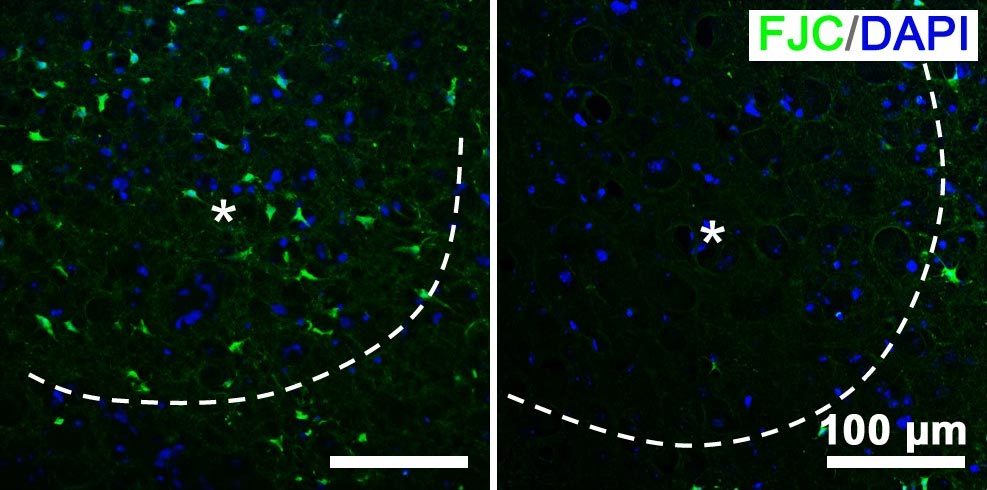
    Nano-Photosynthetic Therapy Brain Slices
    Brain slices of mice that received nano-photosynthetic therapy (right) have fewer damaged neurons, shown in green, than control mice (left). Credit: Adapted from Nano Letters 2021, DOI: 10.10.21/acs.nanolett.1c00719

    Nanoparticles Bring Light to the Brain

    The researchers paired S. elongatus with neodymium up-conversion nanoparticles that transform tissue-penetrating near-infrared light to a visible wavelength that the microbes can use to photosynthesize. In a cell study, they found that the nano-photosynthesis approach reduced the number of neurons that died after oxygen and glucose deprivation. They then injected the microbes and nanoparticles into mice with blocked cerebral arteries and exposed the mice to near-infrared light. The therapy reduced the number of dying neurons, improved the animals’ motor function and even helped new blood vessels to start growing. Although this treatment is still in the animal testing stage, it has promise to advance someday toward human clinical trials, the researchers say.

    Reference: “Oxygen-Generating Cyanobacteria Powered by Upconversion-Nanoparticles-Converted Near-Infrared Light for Ischemic Stroke Treatment” by Jian Wang, Qiangfei Su, Qiying Lv, Bo Cai, Xiakeerzhati Xiaohalati, Guobin Wang, Zheng Wang and Lin Wang, 19 May 2021, Nano Letters.
    DOI: 10.1021/acs.nanolett.1c00719

    The authors acknowledge funding from the National Key Basic Research Program of China, the National Natural Science Foundation of China, the Chinese Ministry of Education’s Science and Technology Program, the Major Scientific and Technological Innovation Projects in Hubei Province, and the Joint Fund of Ministry of Education for Equipment Pre-research.

    Never miss a breakthrough: Join the SciTechDaily newsletter.
    Follow us on Google and Google News.

    American Chemical Society Brain Nanotechnology Neuroscience Photosynthesis Stroke
    Share. Facebook Twitter Pinterest LinkedIn Email Reddit

    Related Articles

    Sweet Memories: Sugars Affect Brain “Plasticity” Helping With Learning, Memory, Recovery

    Mind-Controlled Robots: New Graphene Sensors Are Turning Science Fiction Into Reality

    Stretchable Conductive Hydrogel Developed That Could Help Repair Damaged Nerves

    Machinery of Photosynthesis Supercharges Solar Energy to Hydrogen Fuel Conversion

    Watch a Brain Drown in Its Own Fluid After a Stroke

    Five Adorable Animals That Can Kill You [Video]

    Human Cells Made Magnetic With Engineered Protein Crystals

    New Model Could Help Scientists Design Materials for Artificial Photosynthesis

    A Better Understanding of “Muscle Synergies” Could Lead to Improved Stroke Rehabilitation

    2 Comments

    1. michael Jordan on February 6, 2023 9:59 am

      Michael Jackson daddydydyydsa8yfeha

      Reply
    2. Michael Jordan on February 6, 2023 10:01 am

      tickle chicken finger 69696996

      Reply
    Leave A Reply Cancel Reply

    • Facebook
    • Twitter
    • Pinterest
    • YouTube

    Don't Miss a Discovery

    Subscribe for the Latest in Science & Tech!

    Trending News

    Mezcal “Worm” in a Bottle Mystery: DNA Testing Reveals a Surprise

    New Research Reveals That Your Morning Coffee Activates an Ancient Longevity Switch

    This Is What Makes You Irresistible to Mosquitoes

    Shockingly Powerful Giant Octopuses Ruled the Seas 100 Million Years Ago

    Scientists Stunned by New Organic Molecules Found on Mars

    Rewriting Dinosaur Evolution: Scientists Unearth Remarkable 150-Million-Year-Old Stegosaur Skull

    Omega-3 Supplements Linked to Cognitive Decline in Surprising New Study

    First-of-Its-Kind Discovery: Homer’s Iliad Found Embedded in a 1,600-Year-Old Egyptian Mummy

    Follow SciTechDaily
    • Facebook
    • Twitter
    • YouTube
    • Pinterest
    • Newsletter
    • RSS
    SciTech News
    • Biology News
    • Chemistry News
    • Earth News
    • Health News
    • Physics News
    • Science News
    • Space News
    • Technology News
    Recent Posts
    • This Gene Tweak Turns Strawberries Into Healthier, Tastier Superfruit
    • This New Chip Could Make GPUs Far More Efficient
    • This Tiny World in the Outer Solar System Should Be Airless, but It Has an Atmosphere
    • NASA’s Webb Space Telescope Reveals a Dark Airless Super-Earth That Looks Like Mercury
    • These Simple Daily Habits Can Quickly Improve Blood Pressure and Heart Risk Factors
    Copyright © 1998 - 2026 SciTechDaily. All Rights Reserved.
    • Science News
    • About
    • Contact
    • Editorial Board
    • Privacy Policy
    • Terms of Use

    Type above and press Enter to search. Press Esc to cancel.