
Nanofiber Filters Revolutionize Virus Protection
A filter made from polymer nanothreads blew three kinds of commercial masks out of the water by capturing 99.9% of coronavirus aerosols in an experiment.
“Our work is the first study to use coronavirus aerosols for evaluating filtration efficiency of face masks and air filters,” said corresponding author Yun Shen, a UC Riverside assistant professor of chemical and environmental engineering. “Previous studies have used surrogates of saline solution, polystyrene beads, and bacteriophages — a group of viruses that infect bacteria.”
The study, led by engineers at UC Riverside and The George Washington University, compared the effectiveness of surgical and cotton masks, a neck gaiter, and electrospun nanofiber membranes at removing coronavirus aerosols to prevent airborne transmission. The cotton mask and neck gaiter only removed about 45%-73% of the aerosols. The surgical mask did much better, removing 98% of coronavirus aerosols. But the nanofiber filter removed almost all of the coronavirus aerosols.
The World Health Organization and Centers for Disease Control have both recognized aerosols as a major mechanism of COVID-19 virus transmission. Aerosols are tiny particles of water or other matter that can remain suspended in air for long periods of time and are small enough to penetrate the respiratory system.
People release aerosols whenever they breathe, cough, talk, shout, or sing. If they are infected with COVID-19, these aerosols can also contain the virus. Inhaling a sufficient quantity of coronavirus-laden aerosols can make people sick. Efforts to curb aerosol spread of COVID-19 focus on minimizing individual exposure and reducing the overall quantity of aerosols in an environment by asking people to wear masks and by improving indoor ventilation and air filtration systems.
Studying a contagious new virus is dangerous and done in labs with the highest biosecurity ratings, which are relatively rare. To date, all studies during the pandemic on mask or filter efficiency have used other materials thought to mimic the size and behavior of coronavirus aerosols. The new study improved on this by testing both aerosolized saline solution and an aerosol that contained a coronavirus in the same family as the virus that causes COVID-19, but only infects mice.
Electrospinning Creates Ultra-Fine, Virus-Trapping Threads
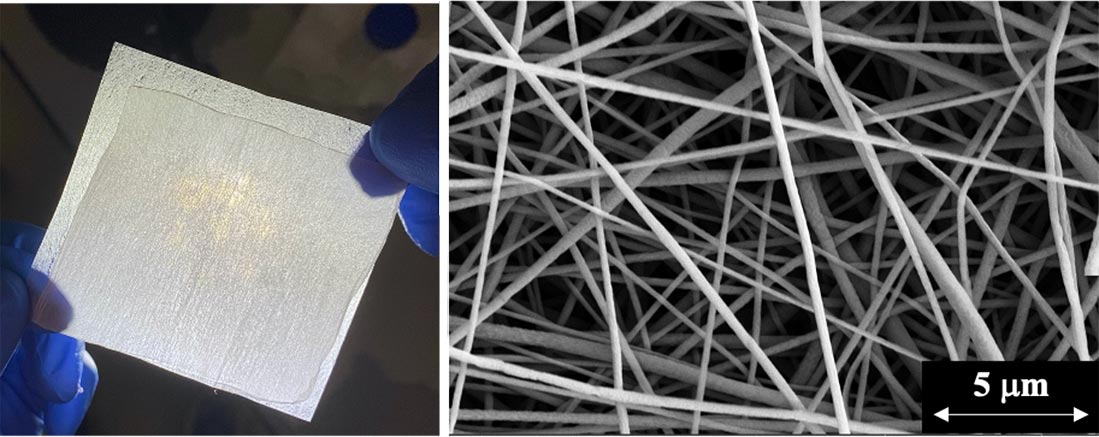
Shen and George Washington University colleague Danmeng Shuai produced a nanofiber filter by sending a high electrical voltage through a drop of liquid polyvinylidene fluoride to spin threads about 300 nanometers in diameter — about 167 times thinner than a human hair. The process created pores only a couple of micrometers in diameter on the nanofiber’s surfaces, which helped them capture 99.9% of coronavirus aerosols.
The production technique, known as electrospinning, is cost effective and could be used to mass produce nanofiber filters for personal protective equipment and air filtration systems. Electrospinning also leaves the nanofibers with an electrostatic charge that enhances their ability to capture aerosols, and their high porosity makes it easier to breathe wearing electrospun nanofiber filters.
“Electrospinning can advance the design and fabrication of face masks and air filters,” said Shen. “Developing new masks and air filters by electrospinning is promising because of its high performance in filtration, economic feasibility, and scalability, and it can meet on-site needs of the masks and air filters.”
Reference: “Development of electrospun nanofibrous filters for controlling coronavirus aerosols” by Hongchen Shen, Zhe Zhou, Haihuan Wang, Mengyang Zhang, Minghao Han, David P. Durkin, Danmeng Shuai and Yun Shen, 17 May 2021, Environmental Science & Technology Letters.
DOI: 10.1021/acs.estlett.1c00337
The paper is published in Environmental Science & Technology Letters. Other authors include Hongchen Shen, Zhe Zhou, Haihuan Wang, Mengyang Zhang, Minghao Han, and David P. Durkin. This work is funded by the National Science Foundation.
Never miss a breakthrough: Join the SciTechDaily newsletter.
Follow us on Google and Google News.
2 Comments
WANT A HEALTHY HOME. The ionic paint additive, permanently Eliminates, Airborne Pathogens, Smoking odors, Pet urine odors, without using electricity, fans, or filters.
… one idea, if cov19 is a virus, it means that is a particle, that will imply that one can have its resonant frequency and one could use some stuff to blast it.
Instead of making those stupid movies about earthquakes one should consider an application of the technology in a useful way, that benefits all stake holders…
… this way it is paranoia over practice, which is thought stuck in wrong corner of mind…
or local maximums can be fun, but stupid…