
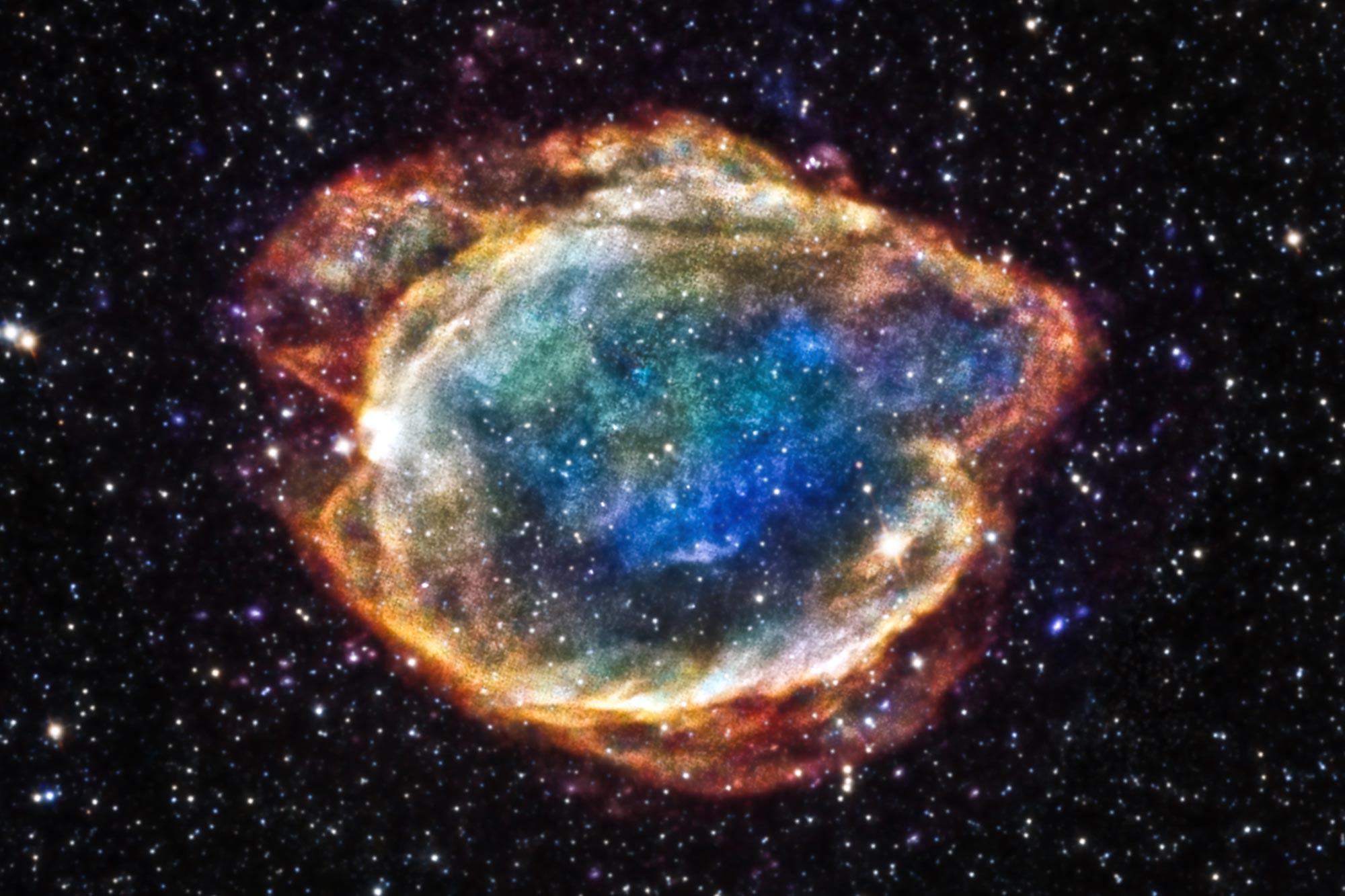
Scientists observe year-long plateaus in decline of type Ia supernova light curves, which is a surprising finding as astronomers had expected that the light curve would not only continue decreasing but even experience a sharp drop, rather than flattening into a plateau.
The discovery is a huge step forward for astronomers as they use the brightness of this kind of supernovae to measure the rate of expansion of the universe.
The project began when scientists at the Center for Astrophysics | Harvard & Smithsonian (CfA) in the US first noticed strange light curve behaviors while studying late-time Type Ia supernovae in 2015. This year they then confirmed light curve plateaus in Type Ia supernovae.
To better understand the strange behavior, the CfA teamed up with Adam Riess of The Johns Hopkins University and the Space Telescope Science Institute to study nearby supernovae using Riess’s already-set HST programs.
Dr. Luke Shingles from Queen’s University Belfast played a role in interpreting the data. He commented: “This finding is a big surprise and will lead to advanced new simulations to analyze the plateau behavior in more detail. The discovery will also impact the way astronomers use Type Ia supernova light curves to measure distances, and give us more precise data on the expansion of the universe.”
Or Graur from CfA said: “Most supernova research is conducted in the weeks or months immediately following an explosion, but we wanted to see how light curves behave at late times, around 500 to 1,000 days after the explosion.
“Optical observations of SN2012gc in 2015 revealed a slowdown in the light curve as expected, but as we studied additional supernovae over time, it became apparent that other mechanisms were at play, so we started looking for patterns to explain what was going on.”
He added: “Even though these were all nearby supernovae, at these late times they were very faint. We needed Hubble’s resolving power to be able to tell them apart from other stars in their respective galaxies.
“But what made the difference to our observations was that Adam’s programs on Hubble also had near-infrared data in the H-band. What started as a fishing expedition revealed a portion of time where the light curve is flat, and that period lasts for up to a year. That was a surprise. I didn’t expect to see that.”
The idea of supernova light curve plateaus is not completely new to astrophysics. Type IIP supernovae, which are born of the collapse and explosion of hydrogen-rich super giants, commonly experience light curve plateaus roughly 100 days in length.
Dr. Shingles said: “One hundred days is not only shorter than the year-long plateau that we found here but a bigger problem is that we think the plateau in Type IIP supernova is caused by hydrogen colliding with electrons, and Type Ia supernovae don’t contain any hydrogen. This means we need a completely different explanation for the plateau in these objects.”
Dr. Matt Nicholl, in the School of Physics and Astronomy at the University of Birmingham, says: “Type Ia supernovae produce a lot of iron. We think that the plateau might be related to how the iron atoms behave as they cool. They can absorb ultraviolet light and re-emit it in the infrared, so what we are seeing could be this fluorescence.
“This study really shows the importance of continuing to track supernovae even as they get older and fainter. You see things that are really quite different to the early behavior, and sometimes we get a nice surprise like this that changes our picture of these explosions.”
Reference: “A year-long plateau in the late-time near-infrared light curves of type Ia supernovae” by O. Graur, K. Maguire, R. Ryan, M. Nicholl, A. Avelino, A. G. Riess, L. Shingles, I. R. Seitenzahl and R. Fisher, 7 October 2019, Nature Astronomy.
DOI: 10.1038/s41550-019-0901-1
The results of the study are published in Nature Astronomy. In addition to Graur—who also serves as a Research Associate at the American Museum of Natural History—and Riess, the study involved CfA scientist Arturo Avelino along with scientists Kate Maguire, Trinity College Dublin; Russell Ryan, Space Telescope Science Institute; Matt Nicholl, University of Birmingham; Luke Shingles, Queen’s University Belfast; Ivo R. Seitenzahl, University of New South Wales Canberra; and, Robert Fisher, University of Massachusetts Dartmouth.
Never miss a breakthrough: Join the SciTechDaily newsletter.
Follow us on Google and Google News.