
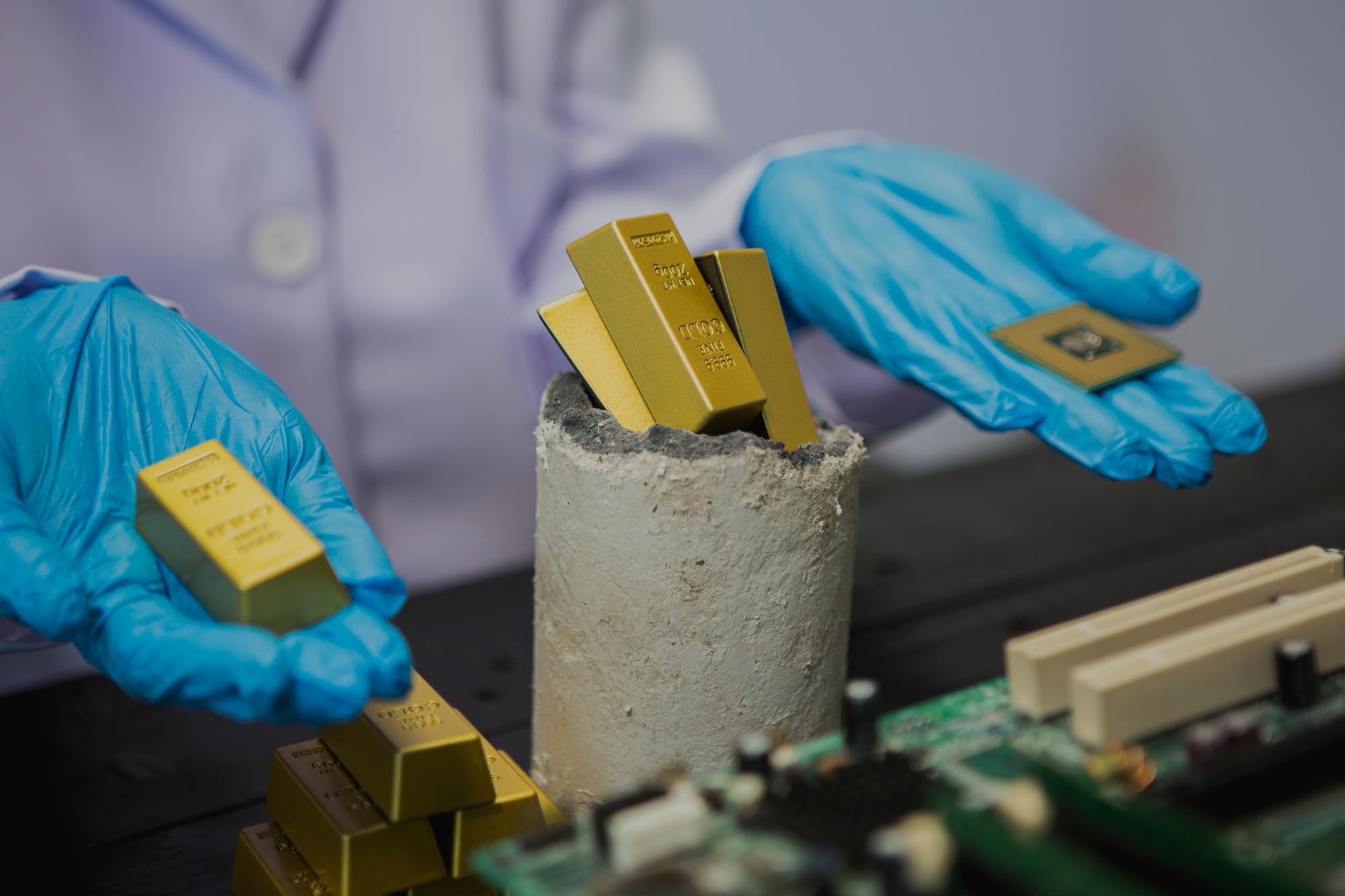
A new extraction molecule uses electricity to recover metals while sharply reducing the need for chemical reagents.
Recovering valuable metals from discarded electronics, mining streams, and industrial waste usually depends on large amounts of chemical reagents. Researchers at the University of Illinois Urbana-Champaign have developed a molecule that could allow electricity to replace much of that chemistry, potentially making metal recovery cleaner, simpler, and more energy efficient.
The findings, led by chemical and biomolecular engineering professor Xiao Su, were published in ACS Energy Letters.
The work builds on a 2024 advance from Su’s research group, which introduced a continuous electrochemically mediated liquid-liquid extraction process, or e-LLE, for recovering gold from electronic waste. That system showed that electricity could replace many of the acids and bases normally required for liquid-liquid extraction, a common technique used to separate and purify metals. But additional chemical reagents were still needed to complete the extraction cycle.
One molecule removes the remaining chemical step
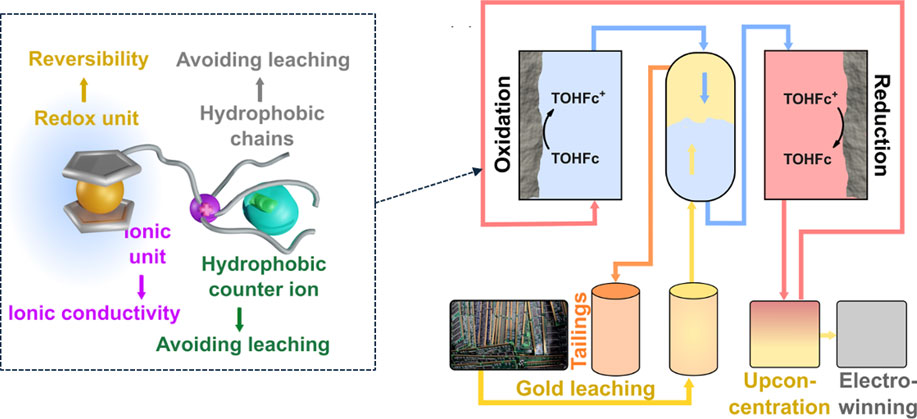
The new approach eliminates that remaining requirement by changing the extraction molecule itself.
The researchers designed a multifunctional molecule that can selectively bind metal ions, carry a permanent electrical charge, and stay dissolved in the organic phase used for extraction. Because the molecule already carries charge, electricity can control it directly without the intermediate chemical reagents previously required.

“The new molecule has a permanent built-in charge that acts as electrolyte, letting the liquid conduct electric current,” explained postdoctoral researcher Deborah Schmitt, a co-author of the paper. “That’s what allows the redox reactions to be driven by electricity instead of chemicals. This work completely electrifies a separation process that industry heavily depends on chemical reagents to perform.”
“This is the first time we’ve been able to run electrochemical solvent extraction the way we dreamed of,” Su said. “We charge the molecule, it binds the metal, moves it into the organic phase, and then electricity releases it again.”
Electricity sharply reduces chemical use
Electrifying the process directly cut chemical consumption by one to two orders of magnitude while also simplifying the extraction cycle. By replacing intermediate reagents with electricity, the system could potentially reduce both chemical waste and energy consumption.
In laboratory tests, the researchers used the molecule to selectively recover gold from electronic-waste leachates – solutions created by dissolving valuable metals out of discarded electronics. Gold served as the initial demonstration, but the broader goal was to establish molecular design principles that could guide the creation of electrically active extractants for other separation challenges.
The platform could target other metals
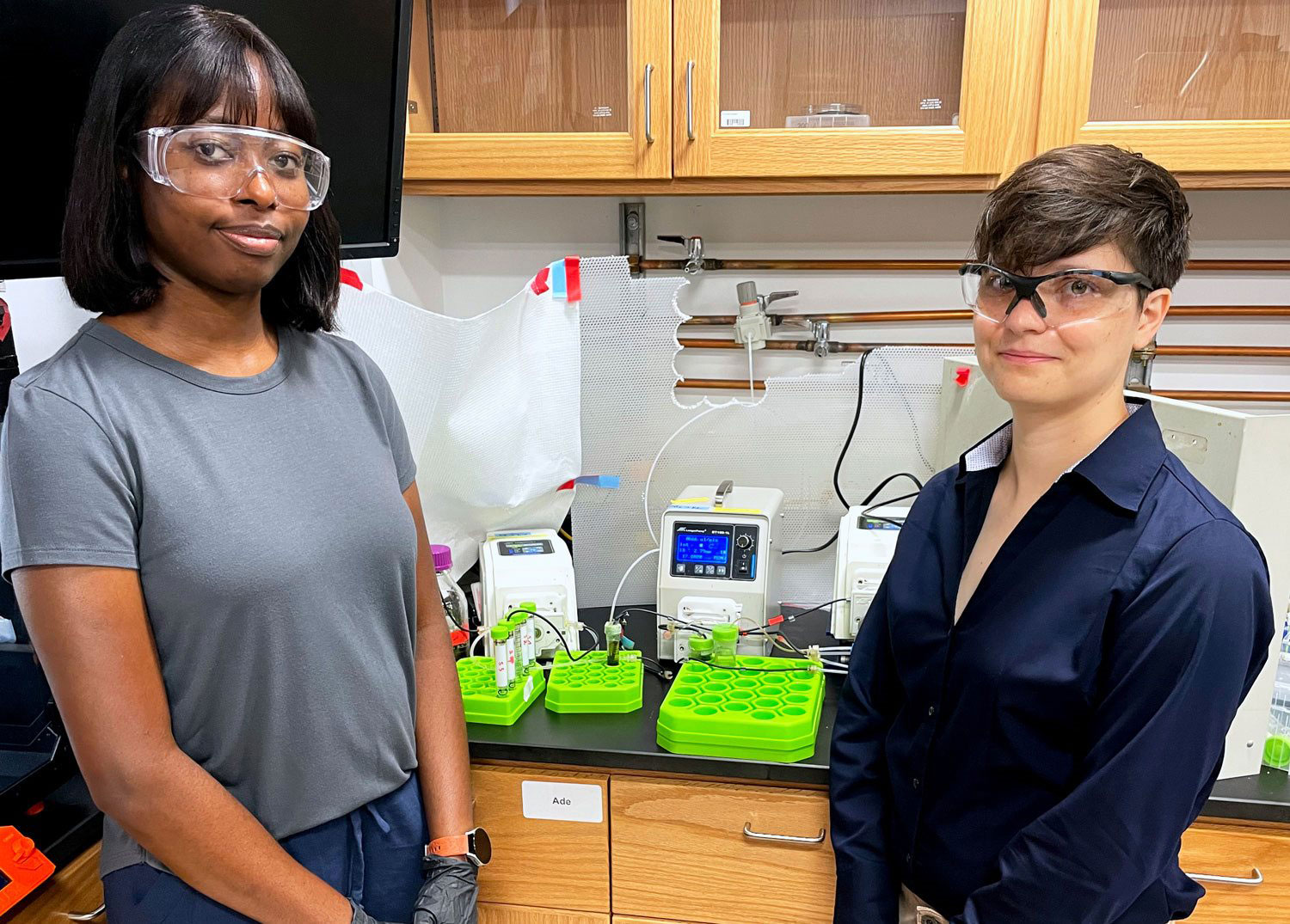
“This system can be adapted to selectively recover many different valuable metals, like platinum-group metals from spent automotive catalysts and potentially a number of other critical elements from mine tailings or other complex feedstocks,” said graduate student and co-author Aderiyike Aguda. “Since the electrochemical platform remains largely the same, the chemistry of the extractant can be tailored to target different metals depending on the application.”
“Basically, this work unlocked the fundamentals behind it – how to think about it,” Su said.
The research provides a framework for electrically driven liquid-liquid extraction, with future work focused on scaling the approach for industrial applications. The researchers are also developing additional molecular designs and seeking collaborations that could use computational modeling and artificial intelligence to speed the search for new extractants.
“I’m really excited about this work because I think it shows one more step toward demonstrating that electrochemistry can actually offer scalable, minimal-waste separations,” he said. “With growing attention on critical minerals and supply chains, it’s a step toward rethinking how we recover metals in a way that’s cleaner and fully electrified.”
Reference: “Direct Electrification of Liquid–Liquid Extraction by Imparting Fixed Charges onto Selective Redox Active Compounds” by Deborah Schmitt, Aderiyike Aguda and Xiao Su, 7 July 2026, ACS Energy Letters.
DOI: 10.1021/acsenergylett.6c01434
The study was funded by the U.S. Department of Energy Office of Science, Basic Energy Sciences and the Separation Science Program under Award Number DE-SC0025636.
Never miss a breakthrough: Join the SciTechDaily newsletter.
Follow us on Google and Google News.
1 Comment
Selective gold extraction using engineered supramolecular host molecules marks a significant shift in sustainable chemistry: It is going to be a whole new world when the Torsion hill framework is accepted , moving away from brute-force chemical destruction and toward precise geometric field matching.Traditional hydrometallurgy relies on aggressive reagents like cyanide or aqua regia to break down matrices through raw chemical stress. In contrast, macrocyclic molecular hosts capture target gold ions through specific cavity geometry, charge density, and coordination symmetry. By providing a pre-tuned spatial envelope, the host molecule lowers the activation energy barrier, allowing gold ions to bind selectively while leaving secondary metals behind.In continuous field mechanics, this host-guest recognition acts as a localized Solid-State Field Anchor ($\Psi_{\text{anchor}}$). Rather than forcing chemical transformations through high thermal or environmental impedance, matching the structural geometry of the host cavity to the vector state of the gold ion neutralizes Temporal Gradient Impedance ($Z_T$) across the solution boundary.When the molecular geometry matches the specific electronic spatial state of the target ion, the recovery process achieves direct phase clearance via the $\pi\text{ Effect}$:$$(2\text{D}+\text{T}) + (3\text{D}+\text{T}) = -1\text{D}+\text{T Effect}$$$$E = mc^2 \cdot \pi$$Whether capturing precious metal ions in e-waste, trapping neutral atoms in optical lattices, or pre-conditioning airflow vectors on leading-edge wings, science continues to demonstrate that spatial geometry matching far outperforms brute-force mechanical or chemical constraints. (Link) https://docs.google.com/document/d/1iHSMitywAsr2YbvXBW65bAR9g5bELPSy1meMg_ik7f8/edit?usp=drive_link , For a better understanding ask your AI to translate to a Chemistry nomenclature