
Close Menu
    Facebook X (Twitter) Instagram
    SciTechDaily
    • Biology
    • Chemistry
    • Earth
    • Health
    • Physics
    • Science
    • Space
    • Technology
    Facebook X (Twitter) Pinterest YouTube RSS
    SciTechDaily
    Home»Space»Hubble Spies Cleopatra’s Eye in the Sky
    Space

    Hubble Spies Cleopatra’s Eye in the Sky

    By NASA's Goddard Space Flight CenterNovember 9, 2021No Comments2 Mins Read
    Facebook Twitter Pinterest Telegram LinkedIn WhatsApp Email Reddit
    Share
    Facebook Twitter LinkedIn Pinterest Telegram Email Reddit
    NGC 1535
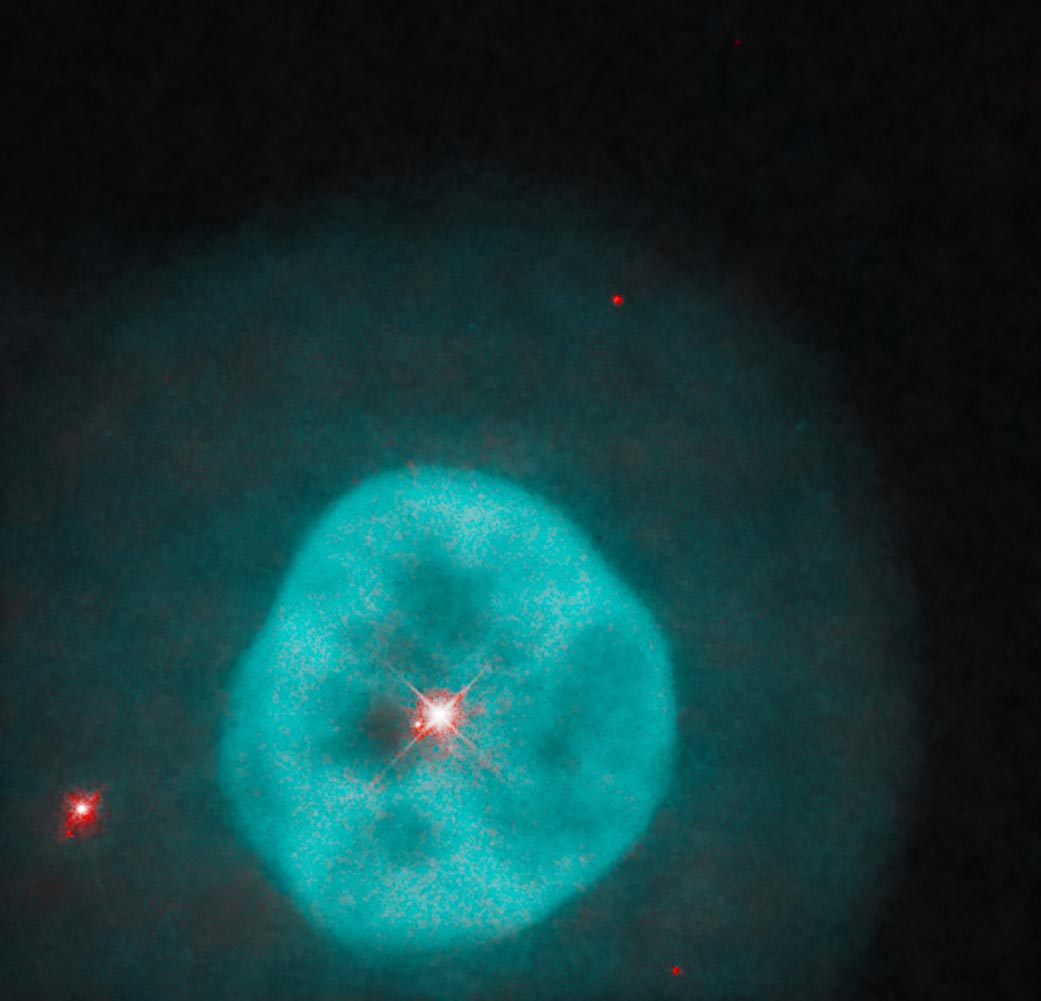
    Hubble Space Telescope image of planetary nebula NGC 1535, which is also known as Cleopatra’s Eye. Credit: NASA, ESA, and H. Bond and R. Ciardullo (Pennsylvania State University), et. al.; Processing: Gladys Kober (NASA/Catholic University of America)

    Hubble data reveal that Cleopatra’s Eye, a planetary nebula in Eridanus, likely hosts a central star bound in a binary system.

    Cleopatra’s Eye, or NGC 1535, is a planetary nebula in the constellation Eridanus. This nebula has an unusual structure that is similar to the better-known NGC 2392, with an outer region and a brighter inner center.

    A planetary nebula forms when a star approximately the size of our Sun dies, exhaling its outer layers into space as the core turns into a white dwarf star. Through early telescopes these objects resembled planets – giving them their name – but planetary nebulae are unrelated to actual planets.

    Hubble observed this nebula as part of a study of over 100 planetary nebulae with nearby stars. The proximity of the stars indicated a possible gravitational connection between the nearby stars and the central stars of the nebulae. Observations of the distance between NGC 1535’s central star and its possible companion suggest that Cleopatra’s Eye is indeed part of a gravitationally bound binary star system.

    Never miss a breakthrough: Join the SciTechDaily newsletter.
    Follow us on Google and Google News.

    Astronomy Hubble Space Telescope NASA NASA Goddard Space Flight Center
    Share. Facebook Twitter Pinterest LinkedIn Email Reddit

    Related Articles

    Astronomers Finally Solve Betelgeuse’s Biggest Mystery

    The Andromeda Mystery: Hubble Discovers Strange Galactic Behavior

    3.7 Billion Miles Away: Hubble Uncovers a Hidden Trio That Could Rewrite Kuiper Belt History

    Historic Discovery: Twin Titans Clash As NASA Unveils Closest Supermassive Black Hole Duo

    The Great Escape: NASA’s Hubble and MAVEN Help Solve Mystery of Mars’ Vanishing Water

    Into the Rosy Depths: Hubble’s Journey Through Andromeda

    Hubble Observes a Lonely Beacon in the Cosmic Dark

    What Lies Within? Hubble’s Deep Dive Into the Structured Chaos of Leo A

    Hubble Spots Billowing Bubbles of Stellar Floss Across 1,000 Light-Year Expanse

    Leave A Reply Cancel Reply

    • Facebook
    • Twitter
    • Pinterest
    • YouTube

    Don't Miss a Discovery

    Subscribe for the Latest in Science & Tech!

    Trending News

    These Toads Are Surviving a Deadly Fungus – Scientists May Finally Know Why

    These Brain Cells May Explain Why We Eventually Have To Sleep

    Tomatoes Contain an Invisible Ingredient With Surprising Effects on Liver Health

    World’s First Heat-Powered Cooling System Turns Waste Heat Into Cold

    Antarctica Gained a Record 695 Billion Tons of Ice in Just Two Years

    Don’t Miss: A Brilliant Venus and Glowing Harvest Moon Light Up the Sky

    New Twist on the Einstein Problem Reveals Unexpected Physics

    JWST Captures Stunning Evidence of How Supermassive Black Holes Feed

    Follow SciTechDaily
    • Facebook
    • Twitter
    • YouTube
    • Pinterest
    • Newsletter
    • RSS
    SciTech News
    • Biology News
    • Chemistry News
    • Earth News
    • Health News
    • Physics News
    • Science News
    • Space News
    • Technology News
    Recent Posts
    • Scientists Bring a Galápagos Plant Back From the Brink of Extinction
    • Scientists Discover a Bacterial Molecule That “Disarms” a Dangerous Fungus
    • Bats May Hold the Secret to Fighting Aging, Cancer, and Infection
    • Scientists Discover a Hidden Defect That Could Explain Why IBD Keeps Coming Back
    • Millions Take Blood Pressure Drugs, but Many May Be Missing Their Heart-Protective Benefits
    Copyright © 1998 - 2026 SciTechDaily. All Rights Reserved.
    • Science News
    • About
    • Contact
    • Editorial Board
    • Privacy Policy
    • Terms of Use

    Type above and press Enter to search. Press Esc to cancel.