
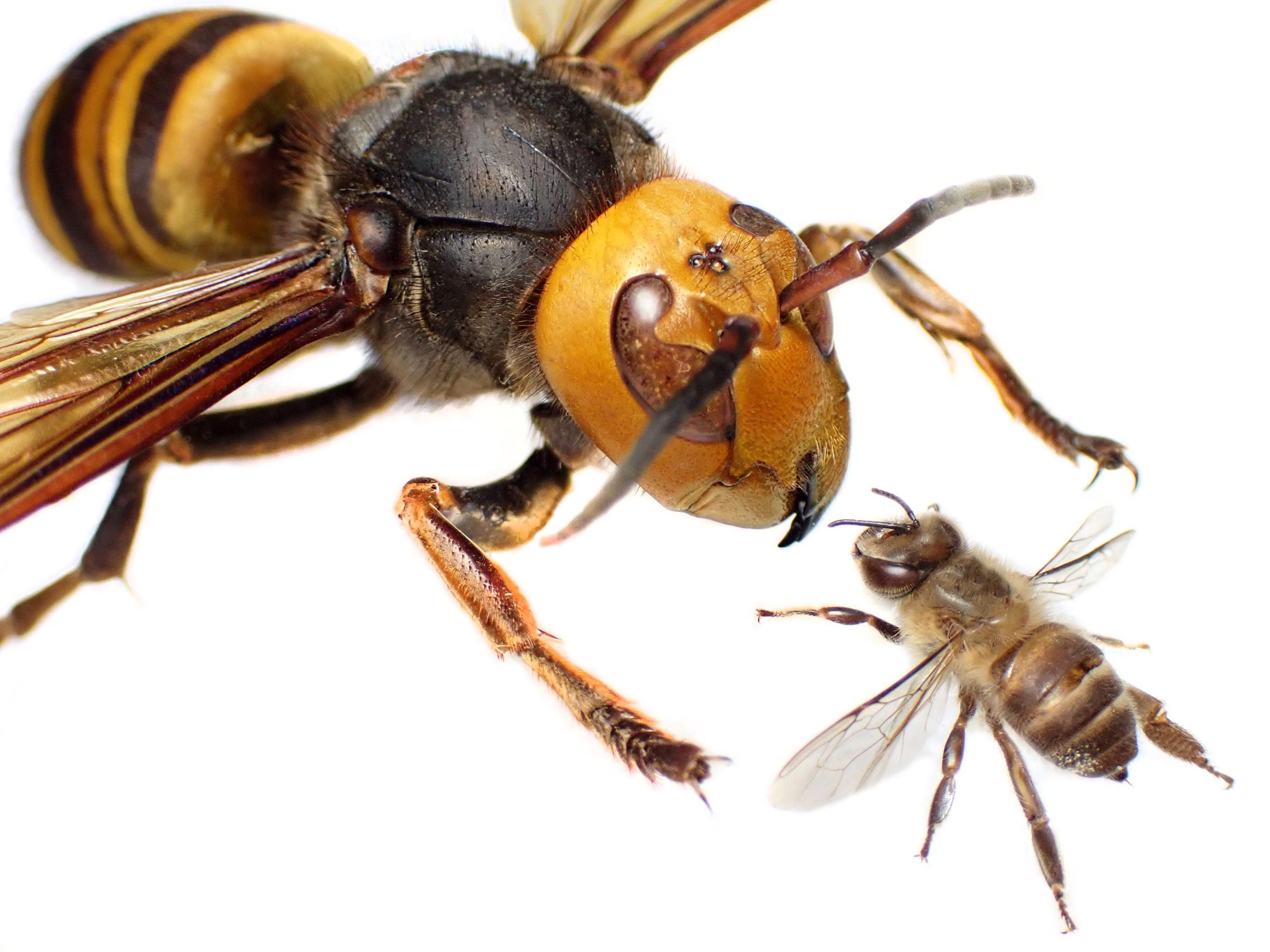
Chemicals used as bait to trap and track so-called ‘murder hornets’ as they expand their footprint in the Western United States.
The world’s largest hornet has been the focus of extensive news coverage of late due to its menacing appearance and expanding footprint in North America.
But while the “murder hornet” label attached to the Asian giant hornet (Vespa mandarinia) may be an overdramatization of its danger, researchers agree that the invasive species is destructive and threatens North American bee populations and millions of dollars in crop production. Because honey bees offer few defenses (other than a “heat ball” defense seen in the video below), giant hornets can rapidly destroy entire bee colonies.
“My usual plea is that people should stop calling them ‘murder hornets’ because they are large and perhaps frightening but not truly murderous,” said James Nieh, a Division of Biological Sciences professor and bee researcher at the University of California San Diego. “They are amazing social insects, but they don’t belong in North America and harm our critical bee populations, so we should remove them.”
But how to eliminate them is not clear. Even knowing where they occur—thus far reported in Canada and the Pacific Northwest—has been difficult to determine.
Pheromone-Based Trapping: A Potential Solution
As one possible solution, Nieh his colleagues in China have developed a method for identifying the Asian giant hornet’s presence and possibly accelerating its removal. In the journal Current Biology, the researchers reveal the identification of three major components of the Asian giant hornet queen’s sex pheromone, an achievement that could be used as bait to trap and track the insects. Using gas chromatography and mass spectrometry, along with experiments spanning two years, Nieh and his colleagues identified the major chemicals in the sex pheromone as hexanoic acid, octanoic acid and decanoic acid, compounds that can be readily purchased and deployed immediately in the field.

In a previous study, Nieh and his colleagues used a comparable approach to identify the female sex pheromone of a related Asian hornet species (Vespa velutina). In their new study, the researchers placed traps near hornet nests, locations where they typically mate, and captured only male hornets, but no females or other species. During their experiments the scientists tested the hornet’s neural activity and found that male antennae are highly sensitive to the pheromone.
“The males are drawn to the odors of the females since they typically mate with them near their nests,” said Nieh. “In two field seasons we were able to rapidly collect thousands of males that were attracted to these odors.”
Expanding and Tracking the Invasion Front
Scientists are not clear how Asian giant hornets first came to North America. In recent years they have been documented in British Columbia and Washington state, while modeling simulations indicate they could rapidly spread throughout Washington, Oregon and possibly the eastern U.S.
Vespa mandarinia virgin queen mating with a male in a cage in Kunming, Yunnan, China. The queen is in the center and is anesthetized (she is not moving much). There is male mating with her on the bottom and another male that is on her back. This was part of a series of experiments that isolated major components of female sex pheromone in this species. Identifying this sex pheromone is a key step in creating traps that could help biologists monitor the invasion of these giant hornets around the world, particularly in North America. Credit: Professor James Nieh
Although the experimental pheromone hornet traps were set close to bee colonies, Nieh hopes they can be deployed in multiple field locations to evaluate whether they can chemically attract the hornets over distances of a kilometer or more.
“Because these pheromone-based traps are fairly inexpensive I think they could be readily deployed for sampling across a large geographic range,” said Nieh. “We know where they have been found, so the big question is whether they are expanding. Where is that invasion front?”
Open-Source Findings for Wider Application
Instead of patenting the identification of the sex pheromone, Nieh and his colleagues decided to publish their findings as quickly as possible in hopes of providing a possible solution to help document the hornet’s spread. As more pheromone bait traps are deployed, a map could emerge along with predictive models to assess where and how rapidly they are spreading.
“We hope that others, especially in invaded areas, will take the protocol we have established and test this method,” said Nieh. “We’ve described the chemical blends needed for these traps, which could reduce the number of males available to mate with females to help depress the population but primarily would help us figure out where they are.”
Reference: “Identification of giant hornet Vespa mandarinia queen sex pheromone components” by Shihao Dong, Aili Sun, Ken Tan and James C. Nieh, 14 March 2022, Current Biology.
DOI: 10.1016/j.cub.2022.01.065
Nieh’s coauthors on the Current Biology study include Shihao Dong and Ken Tan of the Chinese Academy of Sciences and Aili Sun of Yunnan Agricultural University.
Funding: CAS Key Laboratory of Tropical Forest Ecology, Xishuangbanna Tropical Botanical Garden, CAS 135 program, National Natural Science Foundation of China, China Postdoctoral Science Foundation.
Never miss a breakthrough: Join the SciTechDaily newsletter.
Follow us on Google and Google News.