

Research from Wellesley College professor Heather Mattila shows that bees use animal dung to prevent giant hornets from attacking colonies, a behavior documented by scientists for the first time.
For the first time, honey bees (Apis cerana) have been documented using tools, specifically animal dung, to defend their colonies in Asia. This phenomenon is the focus of new research from Wellesley College associate professor of biological sciences Heather Mattila and her colleagues, whose findings were recently published in the journal PLOS ONE.
Mattila and an international team of researchers observed that to defend themselves against giant hornet (Vespa soror) attacks, which can wipe out whole colonies, honey bees forage for animal feces and apply spots of it around their nest entrances. Giant hornets were repelled by feces-covered entrances, limiting their ability to mount deadly group attacks.
Called fecal spotting, this unique use of dung as a defensive tool — a behavior that had not previously been seen from any honey bee species — is a response to the tremendous predatory pressure honey bees face when confronting giant hornets.
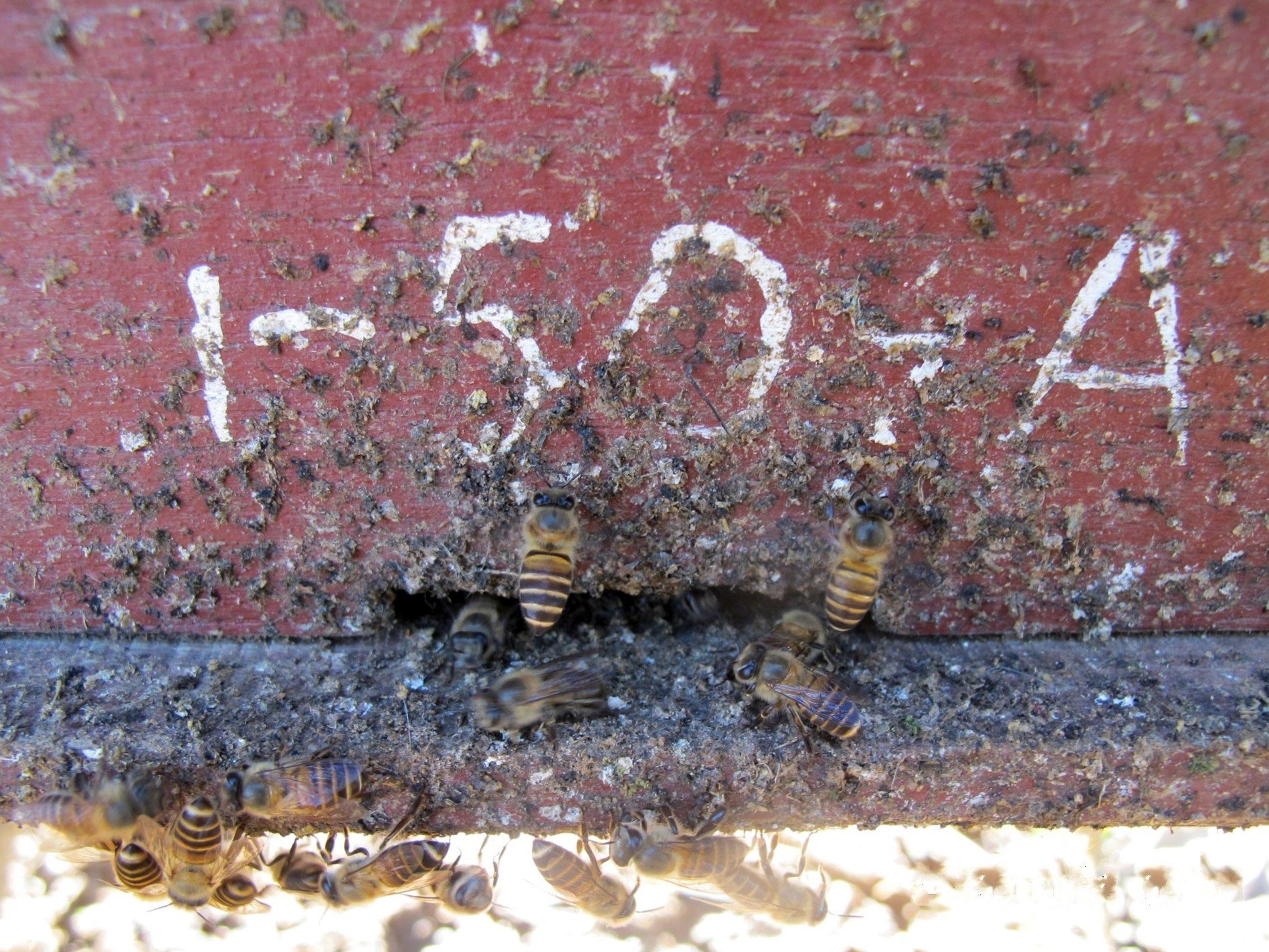
“Not only have we documented the first example of tool use by honey bees in nature,” Mattila said, “but the act of foraging for feces itself is another first for honey bees.” Honey bees routinely forage for materials produced by plants (such as nectar, pollen, and resin), but have not been known previously to collect solid materials from any other source. They occasionally collect fluids from animal waste, which can provide them with needed salts, but this is the first time they have been seen collecting solid pieces of dung, carrying it home with their mouthparts, and applying it to the entrance of their nests.
“Many scientists disagree over whether certain animals, let alone insects, use tools,” said Gard W. Otis, professor of environmental science at the University of Guelph in Ontario, Canada, and one of Mattila’s co-authors. “To qualify as tool users, animals must meet several criteria, including using an object from the environment — in this case, dung. The bees clearly use the material to alter the hive with purpose, in addition to meeting the requirements of holding or manipulating the tool.”
Mattila and her fellow researchers have studied interactions between giant hornets and Asian honey bees in Vietnam for over seven years. They conducted their fieldwork in apiaries with colonies that are managed by local beekeepers and housed in wooden hives. Once they confirmed that Asian honey bees collect animal dung, the team began their experiments by cleaning the front of the hives and then tracking how the bees built up their defenses through fecal spotting in response to attacks by giant hornets. They also showed that Asian honey bees did not use this animal dung defense against smaller, less deadly hornet species.
Mattila found that the bees’ behaviors decreased the severity of attacks by repelling giant hornets from nest entrances, where they focused their attacks. “We documented that hornets were less likely to land on entrances or chew their way into hives when there were more fecal spots around entrances,” Mattila said. “While further research is needed to determine exactly what properties of animal feces repels the hornets, the barrier the bees create is an effective defense against their attacks — a chemical weapon of sorts. What is also interesting is that the bees themselves are not repelled by the animal feces.”
This research has implications beyond Vietnam: Recently, a similar species of giant hornet known as “murder hornets” (Vespa mandarinia) was unintentionally introduced to North America, and has potentially established populations in Washington and British Columbia.
Honey bees in North America already face a range of threats, including poor nutrition, pesticides, pathogens, and habitat loss. Adding a lethal predator to the list could be devastating. Mattila says North American honey bees lack the impressive defensives that Asian honey bees have evolved to fend off giant hornets, making them easy targets. “Our study highlights the extent to which honey bees need to defend themselves against giant hornets. If giant hornets become established in North America, the threats that honey bees face will become further exacerbated,” she said.
For more on this study, read Honey Bees Use Animal Dung to Fend Off Giant “Murder” Hornets.
Reference: “Honey bees (Apis cerana) use animal feces as a tool to defend colonies against group attack by giant hornets (Vespa soror)” by Heather R. Mattila, Gard W. Otis, Lien T. P. Nguyen, Hanh D. Pham, Olivia M. Knight and Ngoc T. Phan, 9 December 2020, PLOS ONE.
DOI: 10.1371/journal.pone.0242668
Funding for this work was provided by the National Geographic Society Committee for Research and Exploration, the Vietnam Academy of Science and Technology, and Wellesley College’s Knafel Chair in the Natural Sciences and the Summer Research Program.
Mattila and her colleagues are currently exploring how the Asian honey bees sound the alarm when giant hornets attack, using recordings they made during this study. While international fieldwork is difficult due to the pandemic, the team is sending hornet samples to collaborators around the world to learn more about how hornets mark colonies for attack.
Never miss a breakthrough: Join the SciTechDaily newsletter.
Follow us on Google and Google News.
6 Comments
I think that we need a more rigorous definition of the term “tool.” As used here, any animal that gathers plant material to construct a nest could be said to be using a ‘tool.’ Similarly, an octopus that uses an empty shell to hide in could be said to be using a ‘tool.’ Do we want to go so far as saying that an animal that stands under a rock overhang to avoid rain or hail is using a ‘tool?’ I think not, because it misses the essence of what most people consider to be a tool.
Using dung as a deterrent for predators is an interesting observation for bees, but really isn’t different from a small mammal defecating in an attempt to make itself unpalatable to a predator.
Mr. Spencer – I don’t think you’re fully acknowledging the difference between tool crafting/use and instinctually using an object for protection per say. Whereas an octopus finding, carrying, and using when necessary empty coconut shells for protection would qualify as tool use, one seeking shelter under a rock to hide under or a shell to hide in would not (or an animal finding shelter from the rain under an overhang for that matter). There also has to be a physical trade off between making an effort to use a tool and whatever normal business the animal might be doing for a higher immediate payoff. In this case, the bees knowing the cause and effect of using the animal dung, using valuable energy and daylight to find it, transport it, and apply it for future use while they could be looking for nectar which is of a normally higher priority. Nest building is mostly instinctual – ‘animal architecture.’ Nests, ant hills, and burrows and such; they don’t have to learn it or figure out any cause/effect. Finally, an animal has to intentionally manipulate something in the environment to qualify as tool use. Seeking shelter from rain in existing environmental construct using your example doesn’t qualify.
Jeremy
You make a distinction between a behavior that is instinctual versus behavior that is learned or inventive. You imply that bees ‘know’ that animal dung can be used as a predator deterrent. However, you don’t provide any evidence to convince me that they have the cognitive ability to understand such abstract behavior. I’d suggest that the use of dung is instinctual, just like building a hexagonal-lattice honey comb, or dancing to inform other bees about a source of food.
Fundamentally, locating and bringing dung to the hive is no more ‘tool like’ than finding and bringing nectar to the hive, from which they make honey.
That is why I suggested a more rigorous definition of tool is necessary to differentiate between behavior that just utilizes natural resources, and behavior that takes a resource and modifies it to achieve some goal, as when chimpanzees select a branch, strip off the leaves, and use it to purposefully fish for termites. I think that the essential quality of a tool is selecting something that is modified, as an intermediate step, in achieving some goal such as when a raven selects a probe to reach something that is beyond its normal grasp, and the size and shape of the probe is dependent on the task.
I’m no bee expert, but given the huge size difference between honey bees and murder hornets could the honey bee farmer not just encapsulate the honey hives in galvanized mesh which would only allow the honeys in? The biggest issues I’ve read about thus far is these murder hornets getting into the hives and performing mass execution.
I agree with you, Ben. I like the idea of hardware cloth…as long as it is exactly the right size.. easy enough to traverse for heavy 2 way traffic, but just too small for the hornets!😏 I wish they could design something whereby the hornets get their head through, it gets stuck and the bees take their revenge by chewing off THEIR heads !!I was a beekeeper and there are many predators and microbial pests that plague them. It’s not easy keeping them well, but, being holistic with an organic garden with a college degree in Biology, I’ve studied them and they are VERY intelligent
Treat them with care and respect and they won’t sting you..after all, they die if they do!
I think that they do what they can to protect themselves, BUT, since we domesticated them, I feel a responsibility to protect them from known and perceived dangers.
With so many threats to their survival, we had better start helping them, rather than poisoning, harassing, exterminating and eliminating their natural habitats if we want them to continue to provide honey, beeswax, propolis, royal jelly …but equally important is our dependence on their amazing pollination abilities, rivaled by no other!
I’m retired and don’t keep them anymore, but planting thyme around the hives helps with microbial infections,and if you’re doing your part in healing the planet, and not spraying chemicals in your yard or burning brush ( let it sit in water during colder months and use it as ” tea” for liquid fertilizer in spring..then compost it…less carbon in air)and using manures as fertilizer,you could ” give them a hint” and put a little manure at the hive entrance if you live in an area known to have these hornets. Save the Bees!!!
I am no expert by any means but I do have to say that if this is not something that is instinctual and was not learned by the bee it should not be considered tool usage but on the other hand if infact learned it should be considered tool usage I do have say that this is more like a defense mechanism that is instinctual so I believe it no to be tool usage and something closer related to marking territory or pheromones