
Close Menu
    Facebook X (Twitter) Instagram
    SciTechDaily
    • Biology
    • Chemistry
    • Earth
    • Health
    • Physics
    • Science
    • Space
    • Technology
    Facebook X (Twitter) Pinterest YouTube RSS
    SciTechDaily
    Home»Space»Unexpected Discovery of Star Cluster With Extreme Composition on Outskirts of the Nearby Andromeda Galaxy
    Space

    Unexpected Discovery of Star Cluster With Extreme Composition on Outskirts of the Nearby Andromeda Galaxy

    By American Association for the Advancement of ScienceDecember 19, 20203 Comments2 Mins Read
    Facebook Twitter Pinterest Telegram LinkedIn WhatsApp Email Reddit
    Share
    Facebook Twitter LinkedIn Pinterest Telegram Email Reddit
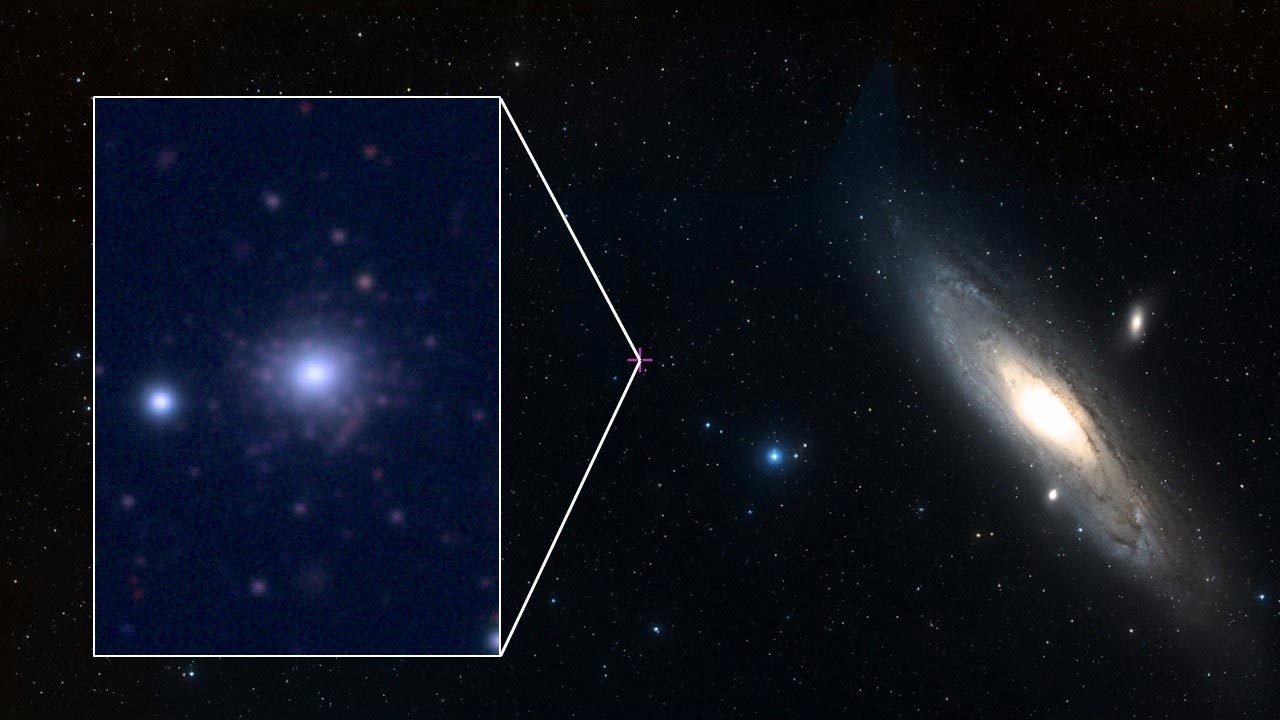
    Metal-poor Globular Star Cluster RBC EXT8
    The RBC EXT8 globular cluster orbits the outskirts of the Andromeda Galaxy, a close companion to our Milky Way Galaxy, located 2.5 million light-years from Earth. Credit: ESASky/CFHT

    Low-Metallicity Globular Star Cluster Challenges Formation Models

    On the outskirts of the nearby Andromeda Galaxy, researchers have unexpectedly discovered a globular cluster (GC) — a massive congregation of relic stars — with a very low abundance of chemical elements heavier than hydrogen and helium (known as its metallicity), according to a new study.

    The GC, designated RBC EXT8, has 800 times lower abundance of these elements than the Sun, below a previously observed limit, challenging the notion that massive GCs could not have formed at such low metallicities.

    GCs are dense, gravitationally bound collections of thousands to millions of ancient stars that orbit in the fringes of large galaxies; many GCs formed early in the history of the Universe. Because they contain some of the oldest stars in a galaxy, GCs provide astronomers with a record of early galaxy formation and evolution.

    The most metal-poor GCs have abundances about 300 times lower than the Sun and no GCs with metallicities below that value were previously known. This was thought to indicate a limit to metal content — a metallicity floor — that was required for GC formation; several mechanisms have been proposed to explain this limit.

    Søren Larsen and colleagues report the discovery of an extremely metal-deficient GC in the Andromeda Galaxy. Spectral analysis of RBC EXT8 shows that its metallicity is nearly three times lower than most metal-poor clusters previously known, challenging the need for a metallicity floor.

    “Our finding shows that massive globular clusters could form in the early Universe out of gas that had only received a small ‘sprinkling’ of elements other than hydrogen and helium. This is surprising because this kind of pristine gas was thought to be associated with proto-galactic building blocks too small to form such massive star clusters,” said Larsen.

    Read Anemic Star Cluster Breaks Metal-Poor Record for more on this discovery.

    Reference: “An extremely metal-deficient globular cluster in the Andromeda Galaxy” by Søren S. Larsen, Aaron J. Romanowsky, Jean P. Brodie and Asher Wasserman, 20 November 2020, Science.
    DOI: 10.1126/science.abb1970

    Never miss a breakthrough: Join the SciTechDaily newsletter.
    Follow us on Google and Google News.

    American Association for the Advancement of Science Astronomy Astrophysics
    Share. Facebook Twitter Pinterest LinkedIn Email Reddit

    Related Articles

    Cosmic Time Travel: Webb Unveils Physical Properties of Compact Galaxy From the Early Universe

    Science’s 2022 Breakthrough of the Year: NASA’s Stellar New James Webb Space Telescope

    Planetary Evolution: Composition of Earth-Like Exoplanet Interiors Linked to Composition of Host Stars

    Patterns of Light Emitted From Accretion Disks Vary Depending on Supermassive Black Hole Mass

    Enhanced X-ray Emissions Coincide With Giant Radio Pulses From Crab Pulsar

    Earth Has a Hot New Neighbor: Discovery of a Nearby Exoplanet Suitable for Atmospheric Investigation

    Black Hole in Cygnus X-1 Is So Massive That It Challenges Current Stellar Evolution Models

    New Measurement of the Hubble Constant – Rate of Expansion of the Universe – From Combined Observations of Neutron Stars

    Dazzling Array of Complex Shapes Found in Planetary Nebulae Generated by Stellar Winds Interaction With Binary Companions

    3 Comments

    1. Kulu Balla on December 19, 2020 11:52 am

      I wonder how many watch the space, but for me lhave been watching the space for many year l have different drawings of moon and stars lhave rain water over ten years and insect army colour over 5year .the space has many wonders beautifully,s lot to learn Happy New year.

      Reply
    2. Goran Štefančić on January 4, 2021 4:40 am

      Please link to a website that shows a 3D model of the solar system in which a computer mouse can rotate the system, zoom in and out on planets, and approach them from different angles.

      Reply
    3. jay on January 13, 2021 8:54 am

      Once again, assumptions wrong. Is the desire to say “I know” driven by careers and fame?

      Reply
    Leave A Reply Cancel Reply

    • Facebook
    • Twitter
    • Pinterest
    • YouTube

    Don't Miss a Discovery

    Subscribe for the Latest in Science & Tech!

    Trending News

    New Study Reveals Why Ozempic Works Better for Some People Than Others

    Climate Change Is Altering a Key Greenhouse Gas in a Way Scientists Didn’t Expect

    New Study Suggests Gravitational Waves May Have Created Dark Matter

    Scientists Discover Why the Brain Gets Stuck in Schizophrenia

    Scientists Engineer “Tumor-Eating” Bacteria That Devour Cancer From Within

    Even “Failed” Diets May Deliver Long-Term Health Gains, Study Finds

    NIH Scientists Discover Powerful New Opioid That Relieves Pain Without Dangerous Side Effects

    Collapsing Plasma May Hold the Key to Cosmic Magnetism

    Follow SciTechDaily
    • Facebook
    • Twitter
    • YouTube
    • Pinterest
    • Newsletter
    • RSS
    SciTech News
    • Biology News
    • Chemistry News
    • Earth News
    • Health News
    • Physics News
    • Science News
    • Space News
    • Technology News
    Recent Posts
    • The Surprising Reason You Might Want To Sleep Without a Pillow
    • Household Cats Could Hold the Secret to Fighting Breast Cancer
    • Scientists Say This Natural Hormone Reverses Obesity by Targeting the Brain
    • This 15,000-Year-Old Discovery Changes What We Know About Early Human Creativity
    • 35-Million-Year-Old Mystery: Strange Arachnid Discovered Preserved in Amber
    Copyright © 1998 - 2026 SciTechDaily. All Rights Reserved.
    • Science News
    • About
    • Contact
    • Editorial Board
    • Privacy Policy
    • Terms of Use

    Type above and press Enter to search. Press Esc to cancel.