

Using data from nearly 15 million galaxies and quasars, the Dark Energy Spectroscopic Instrument (DESI) has created the most detailed 3D map of the universe ever made. A new analysis combining DESI’s observations with other major cosmic datasets suggests that dark energy, the mysterious force behind the universe’s accelerating expansion, may not be constant. Instead, its influence could be changing over time, challenging the standard model of cosmology.
- DESI’s latest analysis is based on its first three years of data, covering almost 15 million galaxies and quasars.
- The team combined DESI data with results from other experiments, including studies of the cosmic microwave background (CMB), supernovae, and weak gravitational lensing.
- When viewed together, the full range of data is difficult to reconcile with the standard cosmological model (Lambda CDM).
- A model in which dark energy evolves over time appears to better explain the combined observations.

Dark Energy’s Role in the Universe’s Fate
The future of the universe depends on the balance between matter and dark energy, the mysterious force driving its accelerating expansion. New findings from the Dark Energy Spectroscopic Instrument (DESI), which has created the most detailed 3D map of the cosmos, reveal how dark energy has influenced the universe over the past 11 billion years. Scientists have detected hints that dark energy, long believed to be a fixed “cosmological constant,” may instead be evolving in unexpected ways.
DESI is a global collaboration of over 900 researchers from more than 70 institutions, led by the U.S. Department of Energy’s Lawrence Berkeley National Laboratory (Berkeley Lab). The team has released its latest results in multiple papers on arXiv and presented them at the American Physical Society’s Global Physics Summit in Anaheim, California.
Hints of an Evolving Dark Energy
“What we are seeing is deeply intriguing,” said Alexie Leauthaud-Harnett, co-spokesperson for DESI and a professor at UC Santa Cruz. “It is exciting to think that we may be on the cusp of a major discovery about dark energy and the fundamental nature of our universe.”
Taken alone, DESI’s data are consistent with our standard model of the universe: Lambda CDM (where CDM is cold dark matter and Lambda represents the simplest case of dark energy, where it acts as a cosmological constant). However, when paired with other measurements, there are mounting indications that the impact of dark energy may be weakening over time and that other models may be a better fit. Those other measurements include the light leftover from the dawn of the universe (the cosmic microwave background or CMB), exploding stars (supernovae), and how light from distant galaxies is warped by gravity (weak lensing).
DESI has made the largest 3D map of our universe to date and uses it to study dark energy. Earth is at the center in this animation, and every dot is a galaxy. Credit: DESI collaboration and KPNO/NOIRLab/NSF/AURA/R. Proctor
Shifting the Understanding of Dark Energy
“We’re guided by Occam’s razor, and the simplest explanation for what we see is shifting,” said Will Percival, co-spokesperson for DESI and a professor at the University of Waterloo. “It’s looking more and more like we may need to modify our standard model of cosmology to make these different datasets make sense together — and evolving dark energy seems promising.”
So far, the preference for an evolving dark energy has not risen to “5 sigma,” the gold standard in physics that represents the threshold for a discovery. However, different combinations of DESI data with the CMB, weak lensing, and supernovae datasets range from 2.8 to 4.2 sigma. (A 3-sigma event has a 0.3% chance of being a statistical fluke, but many 3-sigma events in physics have faded away with more data.) The analysis used a technique to hide the results from the scientists until the end, mitigating any unconscious bias about the data.
A Universe More Complex Than Expected
“We’re in the business of letting the universe tell us how it works, and maybe the universe is telling us it’s more complicated than we thought it was,” said Andrei Cuceu, a postdoctoral researcher at Berkeley Lab and co-chair of DESI’s Lyman-alpha working group, which uses the distribution of intergalactic hydrogen gas to map the distant universe. “It’s interesting and gives us more confidence to see that many different lines of evidence are pointing in the same direction.”
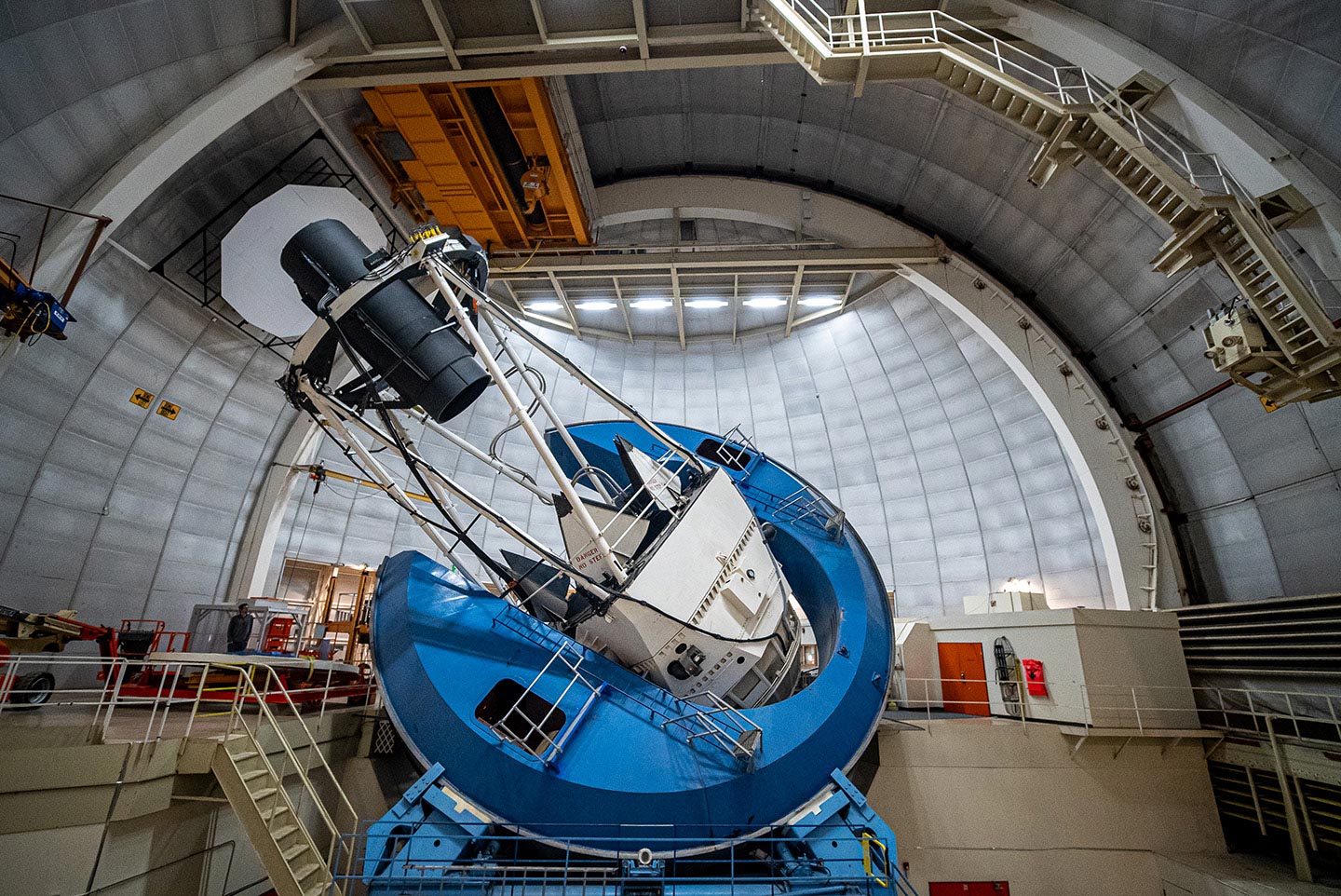
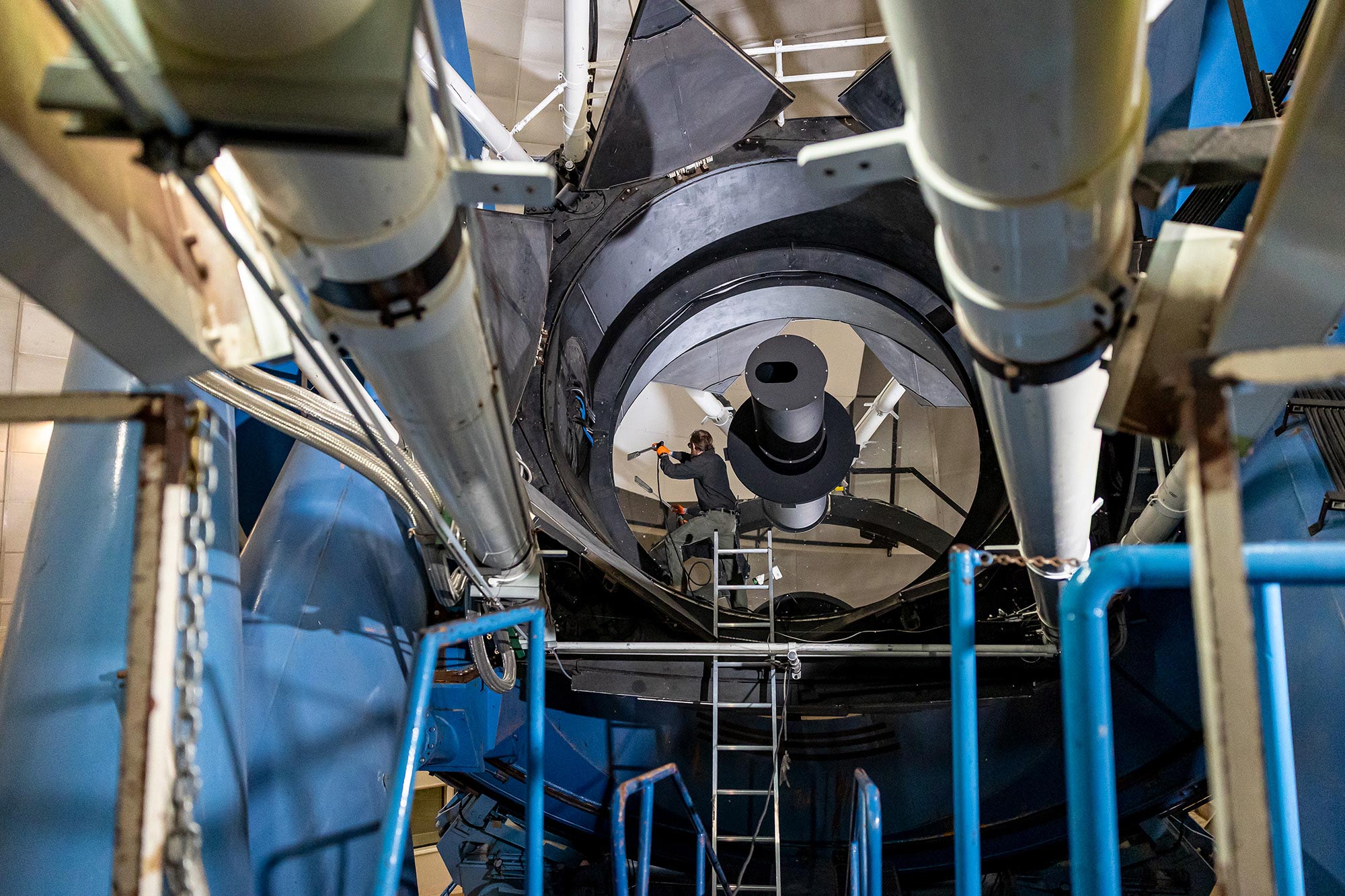
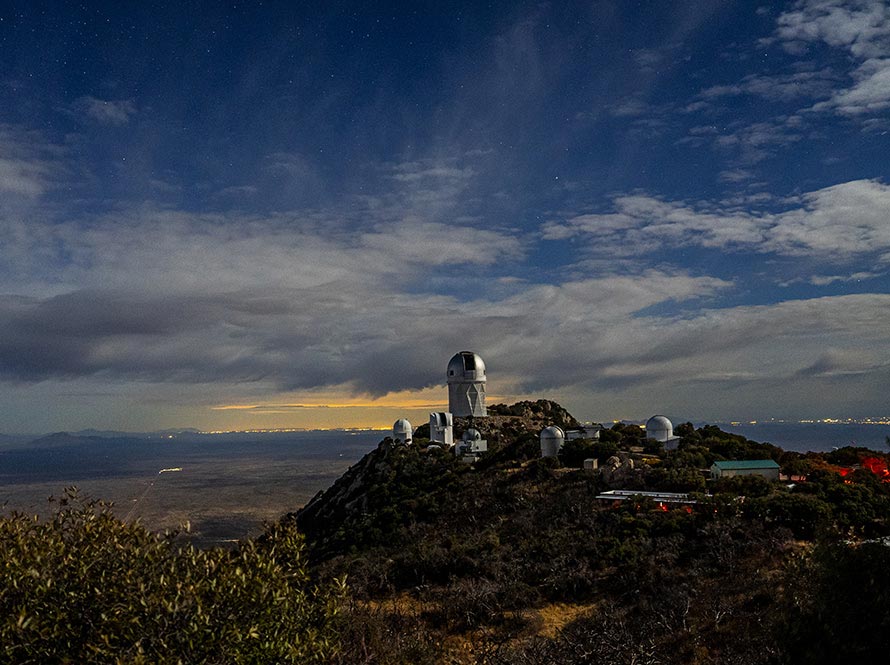
DESI is one of the most extensive surveys of the cosmos ever conducted. The state-of-the-art instrument, which capture light from 5,000 galaxies simultaneously, was constructed and is operated with funding from the DOE Office of Science. DESI is mounted on the U.S. National Science Foundation’s Nicholas U. Mayall 4-meter Telescope at Kitt Peak National Observatory in Arizona. The experiment is now in its fourth of five years surveying the sky, with plans to measure roughly 50 million galaxies and quasars (extremely distant yet bright objects with black holes at their cores) by the time the project ends.
The Dark Energy Spectroscopic Instrument has made the largest 3D map of the universe to date. Fly through millions of galaxies mapped using coordinate data from DESI. Credit: DESI collaboration and Fiske Planetarium, CU Boulder
A Major Leap in Precision and Evidence
The new analysis uses data from the first three years of observations and includes nearly 15 million of the best measured galaxies and quasars. It’s a major leap forward, improving the experiment’s precision with a dataset that is more than double what was used in DESI’s first analysis, which also hinted at an evolving dark energy.
“It’s not just that the data continue to show a preference for evolving dark energy, but that the evidence is stronger now than it was,” said Seshadri Nadathur, professor at the University of Portsmouth and co-chair of DESI’s Galaxy and Quasar Clustering working group. “We’ve also performed many additional tests compared to the first year, and they’re making us confident that the results aren’t driven by some unknown effect in the data that we haven’t accounted for.”
DESI tracks dark energy’s influence by studying how matter is spread across the universe. Events in the very early universe left subtle patterns in how matter is distributed, a feature called baryon acoustic oscillations (BAO). That BAO pattern acts as a standard ruler, with its size at different times directly affected by how the universe was expanding. Measuring the ruler at different distances shows researchers the strength of dark energy throughout history. DESI’s precision with this approach is the best in the world.
Cracks in the Standard Model?
“For a couple of decades, we’ve had this standard model of cosmology that is really impressive,” said Willem Elbers, a postdoctoral researcher at Durham University and co-chair of DESI’s Cosmological Parameter Estimation working group, which works out the numbers that describe our universe. “As our data are getting more and more precise, we’re finding potential cracks in the model and realizing we may need something new to explain all the results together.”
The collaboration will soon begin work on additional analyses to extract even more information from the current dataset, and DESI will continue collecting data. Other experiments coming online over the next several years will also provide complementary datasets for future analyses.
“Our results are fertile ground for our theory colleagues as they look at new and existing models, and we’re excited to see what they come up with,” said Michael Levi, DESI director and a scientist at Berkeley Lab. “Whatever the nature of dark energy is, it will shape the future of our universe. It’s pretty remarkable that we can look up at the sky with our telescopes and try to answer one of the biggest questions that humanity has ever asked.”
Sharing the Data with the World
Videos discussing the experiment’s new analysis are available on the DESI YouTube channel. Alongside unveiling its latest dark energy results at the APS meeting today, the DESI collaboration also announced that its Data Release 1 (DR1), which contains the first 13 months of main survey data, is now available for anyone to explore. With information on millions of celestial objects, the dataset will support a wide range of astrophysical research by others, in addition to DESI’s cosmology goals.
Meeting: Global Physics Summit 2025
DESI is supported by the DOE Office of Science and by the National Energy Research Scientific Computing Center, a DOE Office of Science national user facility. Additional support for DESI is provided by the U.S. National Science Foundation; the Science and Technology Facilities Council of the United Kingdom; the Gordon and Betty Moore Foundation; the Heising-Simons Foundation; the French Alternative Energies and Atomic Energy Commission (CEA); the National Council of Humanities, Sciences, and Technologies of Mexico; the Ministry of Science and Innovation of Spain; and by the DESI member institutions.
The DESI collaboration is honored to be permitted to conduct scientific research on I’oligam Du’ag (Kitt Peak), a mountain with particular significance to the Tohono O’odham Nation.
Never miss a breakthrough: Join the SciTechDaily newsletter.
Follow us on Google and Google News.
6 Comments
Does this result chime with the divergent numbers for the universe expansion.?
Would it not be amusing if whatever constitutes dark energy, which may appear to us to be rather old in some parts of the universe, also affects the speed of light from those older bits?
The simpler solutions are usually better than complex solutions. ‘Evolving’ dark energy adds another layer of complexity. There’s a better way.
They don’t even know what dark energy is yet, or if it exists at all… but they already know it’s evolving?
All theories evolve……………
So the thing that they call dark energy because they don’t understand what they’re seeing is now supposed to be evolving. These aren’t scientists speaking, they’re hypchondriacs.