
Close Menu
    Facebook X (Twitter) Instagram
    SciTechDaily
    • Biology
    • Chemistry
    • Earth
    • Health
    • Physics
    • Science
    • Space
    • Technology
    Facebook X (Twitter) Pinterest YouTube RSS
    SciTechDaily
    Home»Space»Cosmic Leviathan: Hubble Unveils an Exceptionally Massive Galaxy Cluster
    Space

    Cosmic Leviathan: Hubble Unveils an Exceptionally Massive Galaxy Cluster

    By ESA/HubbleMay 7, 20231 Comment2 Mins Read
    Facebook Twitter Pinterest Telegram LinkedIn WhatsApp Email Reddit
    Share
    Facebook Twitter LinkedIn Pinterest Telegram Email Reddit
    Gravitationally Lensed Galaxy Cluster
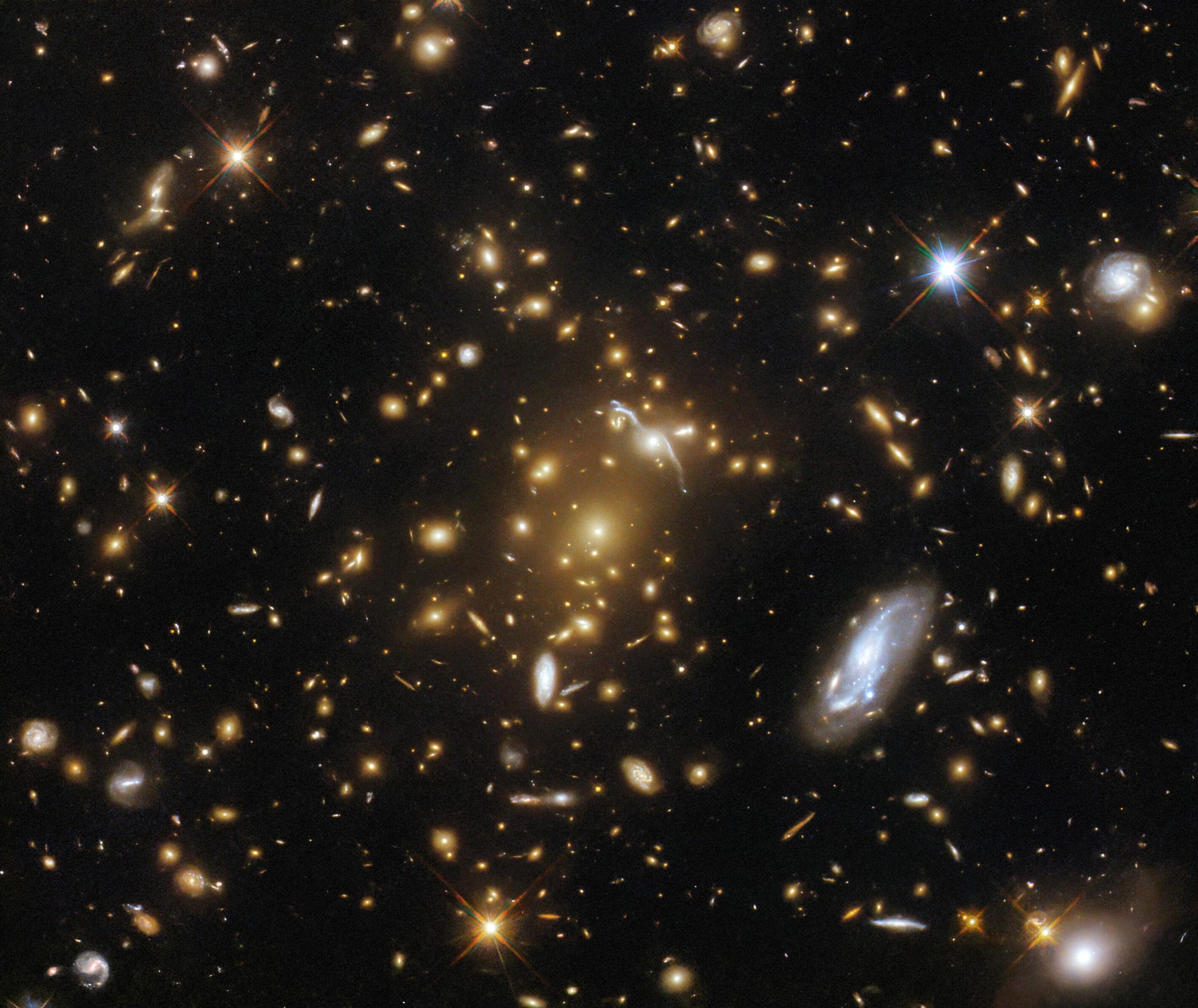
    The Hubble Space Telescope has captured an image of a massive galaxy cluster, eMACS J1823.1+7822, which offers insights into dark matter distribution and acts as a natural telescope to study distant objects. Credit: ESA/Hubble & NASA, H. Ebeling

    This Hubble Space Telescope image reveals a massive galaxy cluster, eMACS J1823.1+7822, located nine billion light-years away in the constellation Draco. Gravitational lensing caused by the cluster’s mass distorts background galaxies into streaks and arcs of light, offering insights into dark matter distribution.

    A vast galaxy cluster lurks in the center of this image from the Hubble Space Telescope. Like a submerged sea monster causing waves on the surface, this cosmic leviathan can be identified by the distortions in spacetime around it. The mass of the cluster has caused the images of background galaxies to be gravitationally lensed; the galaxy cluster has caused a sufficient curvature of spacetime to bend the path of light and cause background galaxies to appear distorted into streaks and arcs of light. A host of other galaxies can be seen surrounding the cluster, and a handful of foreground stars with tell-tale diffraction spikes are scattered throughout the image.

    This particular galaxy cluster is called eMACS J1823.1+7822, and lies almost nine billion light-years away in the constellation Draco. It is one of five exceptionally massive galaxy clusters explored by Hubble in the hopes of measuring the strengths of these gravitational lenses and providing insights into the distribution of dark matter in galaxy clusters. Strong gravitational lenses like eMACS J1823.1+7822 can help astronomers study distant galaxies by acting as vast natural telescopes which magnify objects that would otherwise be too faint or distant to resolve.

    This multiwavelength image layers data from eight different filters and two different instruments: Hubble’s Advanced Camera for Surveys (ACS) and Wide Field Camera 3 (WFC3). Both instruments have the ability to view astronomical objects in just a small slice of the electromagnetic spectrum using filters, which allow astronomers to image objects at precisely selected wavelengths. The combination of observations at different wavelengths lets astronomers develop a more complete picture of the structure, composition, and behavior of an object than visible light alone would reveal.

    Never miss a breakthrough: Join the SciTechDaily newsletter.
    Follow us on Google and Google News.

    Astronomy Astrophysics European Space Agency Gravitational Lensing Hubble Space Telescope
    Share. Facebook Twitter Pinterest LinkedIn Email Reddit

    Related Articles

    Hubble Reveals Some of the Earliest Known Galaxies

    Hubble Discovers the Farthest Lensing Galaxy to Date

    Astronomers Map Galaxy Cluster More Precisely Than Ever Before

    Astronomers Discover Water-Building Molecule in Planetary Nebulas

    New Herschel Data Reveal Insight into the Internal Dynamics of Two Young Galaxies

    Hubble Survey Helps Solve “Quenched” Galaxy Mystery

    Hubble Gazes on Ring Galaxy Zw II 28

    Hubble Views Abell 2261, An Elliptical Galaxy With an Unusually Large Core

    Hubble Captures Image of Compact Blue Dwarf Galaxy UGC 5497

    1 Comment

    1. dale on December 18, 2023 4:54 pm

      On a monthly or weekely sent out. Thank you for your time…

      Reply
    Leave A Reply Cancel Reply

    • Facebook
    • Twitter
    • Pinterest
    • YouTube

    Don't Miss a Discovery

    Subscribe for the Latest in Science & Tech!

    Trending News

    The Universe Is Expanding Too Fast and Scientists Can’t Explain Why

    “Like Liquid Metal”: Scientists Create Strange Shape-Shifting Material

    Early Warning Signals of Esophageal Cancer May Be Hiding in Plain Sight

    Common Blood Pressure Drug Shows Surprising Power Against Deadly Antibiotic-Resistant Superbug

    Scientists Uncover Dangerous Connection Between Serotonin and Heart Valve Disease

    Scientists Discover a “Protector” Protein That Could Help Reverse Hair Loss

    Bone-Strengthening Discovery Could Reverse Osteoporosis

    Scientists Uncover Hidden Trigger Behind Stem Cell Aging

    Follow SciTechDaily
    • Facebook
    • Twitter
    • YouTube
    • Pinterest
    • Newsletter
    • RSS
    SciTech News
    • Biology News
    • Chemistry News
    • Earth News
    • Health News
    • Physics News
    • Science News
    • Space News
    • Technology News
    Recent Posts
    • Forgotten Medicinal Plant Shows Promise in Fighting Dangerous Superbugs
    • Millions Take These IBS Drugs, But a New Study Finds Serious Risks
    • 5 Common Myths About Learning a New Language, Debunked
    • The Neanderthal “Love Story” Isn’t What It Seems
    • Scientists Unlock Hidden Secrets of 2,300-Year-Old Mummies Using Cutting-Edge CT Scanner
    Copyright © 1998 - 2026 SciTechDaily. All Rights Reserved.
    • Science News
    • About
    • Contact
    • Editorial Board
    • Privacy Policy
    • Terms of Use

    Type above and press Enter to search. Press Esc to cancel.