
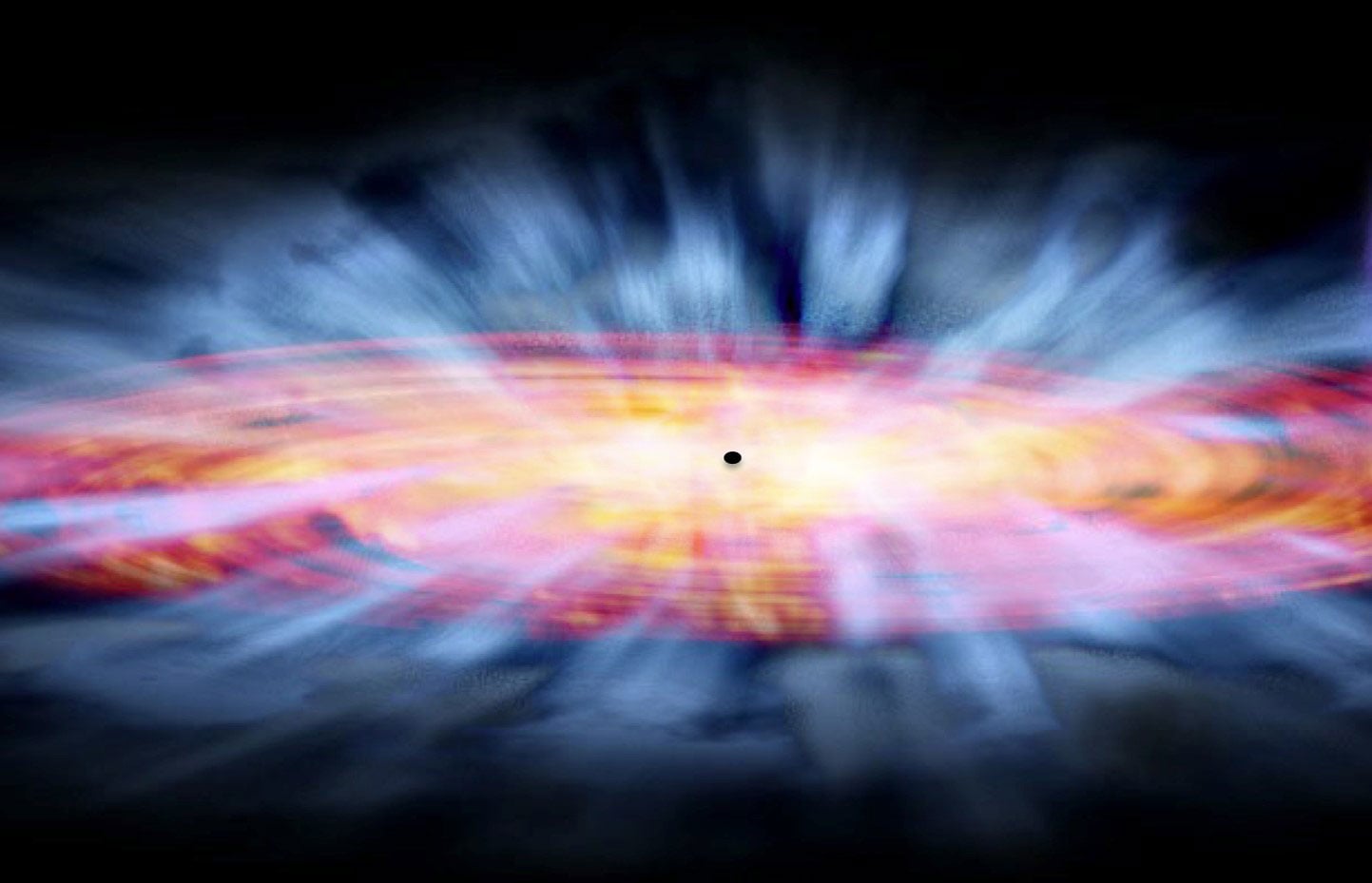
A distant quasar has revealed one of the most extreme ultraviolet outflows ever observed, providing new clues about the powerful interactions between supermassive black holes and their host galaxies.
A supermassive black hole more than a billion times the mass of the Sun is blasting gas through space at such extraordinary speeds that astronomers are struggling to explain how the outflow survives.
Researchers led by York University have discovered the fastest ultraviolet wind ever detected near a supermassive black hole. The outflow, originating from a distant quasar known as J2318, reaches speeds of up to 30 percent of the speed of light, making it the most extreme ultraviolet quasar wind ever observed.
The discovery offers a rare glimpse into one of the universe’s most powerful engines and could help scientists better understand how black holes influence the growth and evolution of entire galaxies.
“This quasar has a black hole of 1.7 billion times the mass of the Sun. That’s typical. What’s not typical is that it has gas moving towards us at 30 per cent of the speed of light,” says York University professor Patrick Hall.
The findings were published in The Astrophysical Journal.
A Cosmic Wind Unlike Anything on Earth
The newly studied object, J2318 (Jay Twenty-Three Eighteen), lies in the constellation Pegasus and belongs to a class of objects known as quasars.
Quasars are among the brightest objects in the universe. They form when enormous amounts of gas spiral toward a supermassive black hole, creating a blazing disk of material that can outshine entire galaxies. As matter falls inward, some of it is also launched outward in powerful winds that carry vast amounts of energy into surrounding space.
“This quasar, known as J2318 (Jay Twenty-Three Eighteen), can be found in the Great Square in the constellation of Pegasus,” says lead author Lucas Seaton. “In terms of its speed, this quasar’s wind could be called a category 79 hurricane. Every category of hurricane is about 20 per cent faster than the category below it. Calling it category 79 gives an idea of just how fast it is, but of course this wind is unlike anything on Earth.”
Although even faster outflows have been detected in X-rays, J2318 now holds the record for ultraviolet observations.
“In quasars, we often see winds of gas pushed away from the black hole by the light of the quasar,” says Seaton. “The wind in J2318 can be seen at ultraviolet wavelengths at velocities up to 30 per cent the speed of light. Even faster winds can be seen at x-ray wavelengths, but J2318 is the fastest ever discovered at ultraviolet wavelengths.”
The Mystery of How the Wind Stays Visible
What makes the discovery particularly intriguing is that the wind should, in theory, be difficult to observe.
The same intense radiation that accelerates the gas can also strip electrons from atoms, erasing the chemical signatures astronomers rely on to detect the outflow. Yet in J2318, researchers can still see evidence of carbon and silicon ions moving at tremendous speeds.
That creates a puzzle for theorists trying to understand how these extreme winds work.
“Quasars put out so many photons that those tiny pushes add up to extreme velocities,” says Seaton. “The problem is, the photons can also remove all the electrons from the atoms, making them invisible. How to push the gas to the speeds we see while keeping the carbon and silicon ions we see intact… it’s quite a puzzle.”
A Discovery Hidden in Decades of Data
The record-breaking outflow was uncovered using observations from the Sloan Digital Sky Survey (SDSS), one of the most ambitious astronomical mapping projects ever undertaken.
The crucial clue came from graduate student Marianna Veltri, who identified J2318 as a potentially unusual object while still an undergraduate student at York University. After Hall examined the quasar using software developed by undergraduate researcher Zezhou Zhu, the team realized they were looking at something extraordinary.
To verify the finding, astronomers turned to the Frederick C. Gillett Gemini Telescope in Hawai’i, whose observations confirmed the unprecedented wind speed.
“Canada has a share of the eight-meter-diameter Frederick C. Gillett Gemini Telescope (also known as Gemini North) in Hawai’i (26.2 feet), and we immediately proposed observations with it. They succeeded in confirming its record-breaking wind velocity,” Hall says.
Hall explains that “just as a rainbow spreads the Sun’s light into different wavelengths (colors), the SDSS spreads out the light from certain stars, galaxies, and quasars into what we call their ‘spectra’. From those spectra, with practice, students learn to spot unusual quasars. In the past, only PhD astronomers or graduate students studying for a PhD would have made a discovery like this, but the SDSS enables undergraduates to do so.”
Why These Winds Matter
For astronomers, the significance of quasar winds extends far beyond the black hole itself.
Researchers increasingly believe that powerful outflows can regulate how galaxies evolve by heating gas, disrupting star formation, and redistributing material across enormous distances. In some cases, black holes may shape the future of their host galaxies despite occupying only a tiny region at their centers.
Study co-author Paola Rodríguez Hidalgo of the University of Washington Bothell says these extreme outflows may help explain one of the most important processes in modern astrophysics.
“These extreme outflows carry incredible amounts of energy that can affect the galaxies around them. They serve as a sort of missing link: the elusive feedback between the active central region of a galaxy and the rest of the galaxy. While this process has been included in simulations of galaxy formation for decades, a lot more work needs to be done to understand it from observations and make sure the simulations handle it correctly.”
Searching for Even Faster Outflows
Researchers are now looking for additional examples of these extreme winds across the universe.
The challenge is that objects like J2318 appear to be exceptionally rare. Even after examining decades of observations, astronomers have found few systems that approach its velocity.
Still, each new discovery helps scientists probe the limits of what supermassive black holes can do and reveals how these cosmic giants shape their surroundings across billions of years.
“It won’t be easy to find a faster ultraviolet outflow than that of J2318, but we are continuing this search from the nearby universe to the most distant reaches of the universe that we can see,” says Liliana Flores.
Reference: “A New Member of the Fast and Furious Family: A Relativistic and Time-variable UV Outflow in a Luminous Quasar” by Lucas M. Seaton, Patrick B. Hall, Liliana Flores, Paola Rodríguez Hidalgo, Marianna Veltri, Zezhou Zhu, Javier Serna, W. Niel Brandt, Scott Anderson, Roberto J. Assef, Eduardo Bañados, Catherine J. Grier, Yasaman Homayouni, Sean Morrison, C. Alenka Negrete, Amy L. Rankine, Jessie Runnoe, Donald P. Schneider, Yue Shen, Matthew Temple, Benny Trakhtenbrot, Jonathan R. Trump and Erik Weiss, 4 June 2026, The Astrophysical Journal.
DOI: 10.3847/1538-4357/ae5f94
Never miss a breakthrough: Join the SciTechDaily newsletter.
Follow us on Google and Google News.
1 Comment
Уважаемые коллеги!
В дополнение к вашим наблюдениям хотел бы обратить внимание на важный аспект процесса взаимодействия джета с межзвёздной средой.
На основании анализа процессов торможения релятивистской струи в межзвёздной среде можно выделить следующий механизм конденсации вещества:
1. При снижении скорости джета происходит:
* Формирование ударной волны на границе контакта
* Синхронизация движения частиц
* Снижение турбулентности потока
* Выравнивание температурных параметров
2. Данный процесс приводит к:
* Образованию условий для конденсации атомов
* Формированию плотных газовых скоплений
* Возможному последующему звездообразованию
Примечательно, что наблюдаемая синхронизация частиц выступает необходимым условием для перехода от плазменного состояния к конденсированным формам материи. Этот процесс можно рассматривать как естественный механизм преобразования космической плазмы в более упорядоченные структуры.
Данные выводы могут быть полезны для:
* Уточнения моделей взаимодействия джетов с межзвёздной средой
* Прогнозирования областей звездообразования
* Понимания механизмов формирования молекулярных облаков
Готов предоставить дополнительные материалы и обсудить данный вопрос более детально при личной встрече или в рамках научной дискуссии.
С уважением,
Юрис Гилманшин.