
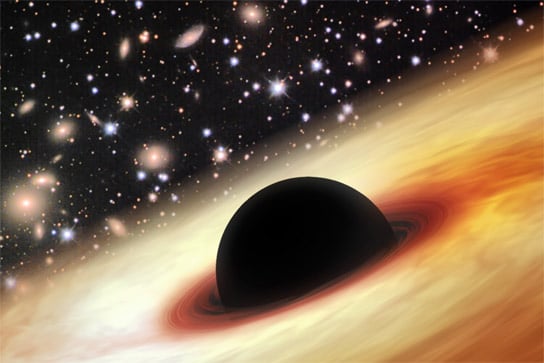
A newly published study details the discovery of the brightest quasar in the early universe, powered by the most massive black hole yet known at that time.
The international team led by astronomers from Peking University in China and from the University of Arizona announce their findings in the scientific journal Nature on Thursday.
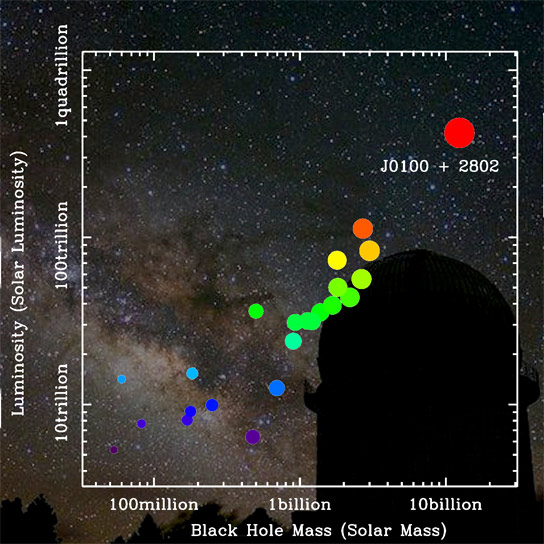
The discovery of this quasar, named SDSS J0100+2802, marks an important step in understanding how quasars, the most powerful objects in the universe, have evolved from the earliest epoch, only 900 million years after the Big Bang, which is thought to have happened 13.7 billion years ago. The quasar, with its central black hole mass of 12 billion solar masses and the luminosity of 420 trillion suns, is at a distance of 12.8 billion light-years from Earth.
The discovery of this ultraluminous quasar also presents a major puzzle to the theory of black hole growth in the early universe, according to Xiaohui Fan, Regents’ Professor of Astronomy at the UA’s Steward Observatory, who co-authored the study.
“How can a quasar so luminous, and a black hole so massive, form so early in the history of the universe, at an era soon after the earliest stars and galaxies have just emerged?” Fan said. “And what is the relationship between this monster black hole and its surrounding environment, including its host galaxy?
“This ultraluminous quasar with its supermassive black hole provides a unique laboratory to the study of the mass assembly and galaxy formation around the most massive black holes in the early universe.”
The quasar dates from a time close to the end of an important cosmic event that astronomers referred to as the “epoch of reionization”: the cosmic dawn when light from the earliest generations of galaxies and quasars is thought to have ended the “cosmic dark ages” and transformed the universe into how we see it today.
Discovered in 1963, quasars are the most powerful objects beyond our Milky Way galaxy, beaming vast amounts of energy across space as the supermassive black hole in their center sucks in matter from its surroundings. Thanks to the new generation of digital sky surveys, astronomers have discovered more than 200,000 quasars, with ages ranging from 0.7 billion years after the Big Bang to today.
Shining with the equivalent of 420 trillion suns, the new quasar is seven times brighter than the most distant quasar known (which is 13 billion years away). It harbors a black hole with mass of 12 billion solar masses, proving it to be the most luminous quasar with the most massive black hole among all the known high redshift (very distant) quasars.
“By comparison, our own Milky Way galaxy has a black hole with a mass of only 4 million solar masses at its center; the black hole that powers this new quasar is 3,000 time heavier,” Fan said.
Feige Wang, a doctoral student from Peking University who is supervised jointly by Fan and Xue-Bing Wu at Peking University, the study’s lead author, initially spotted this quasar for further study.
“This quasar was first discovered by our 2.4-meter Lijiang Telescope in Yunnan, China, making it the only quasar ever discovered by a 2-meter telescope at such distance, and we’re very proud of it,” Wang said. “The ultraluminous nature of this quasar will allow us to make unprecedented measurements of the temperature, ionization state and metal content of the intergalactic medium at the epoch of reionization.”
Following the initial discovery, two telescopes in southern Arizona did the heavy lifting in determining the distance and mass of the black hole: the 8.4-meter Large Binocular Telescope, or LBT, on Mount Graham and the 6.5-meter Multiple Mirror Telescope, or MMT, on Mount Hopkins. Additional observations with the 6.5-meter Magellan Telescope in Las Campanas Observatory, Chile, and the 8.2-meter Gemini North Telescope in Mauna Kea, Hawaii, confirmed the results.
“This quasar is very unique,” said Xue-Bing Wu, a professor of the Department of Astronomy, School of Physics at Peking University and the associate director of the Kavli Institute of Astronomy and Astrophysics. “Just like the brightest lighthouse in the distant universe, its glowing light will help us to probe more about the early universe.”
Wu leads a team that has developed a method to effectively select quasars in the distant universe based on optical and near-infrared photometric data, in particular using data from the Sloan Digital Sky Survey and NASA’s Wide-Field Infrared Explorer, or WISE, satellite.
“This is a great accomplishment for the LBT,” said Fan, who chairs the LBT Scientific Advisory Committee and also discovered the previous record holders for the most massive black hole in the early universe, about a fourth of the size of the newly discovered object. “The especially sensitive optical and infrared spectrographs of the LBT provided the early assessment of both the distance of the quasars and the mass of the black hole at the quasar’s center.”
For Christian Veillet, director of the Large Binocular Telescope Observatory, or LBTO, this discovery demonstrates both the power of international collaborations and the benefit of using a variety of facilities spread throughout the world.
“This result is particularly gratifying for LBTO, which is well on its way to full nighttime operations,” Veillet said. “While in this case the authors used two different instruments in series, one for visible light spectroscopy and one for near-infrared imaging, LBTO will soon offer a pair of instruments that can be used simultaneously, effectively doubling the number of observations possible in clear skies and ultimately creating even more exciting science.”
To further unveil the nature of this remarkable quasar, and to shed light on the physical processes that led to the formation of the earliest supermassive black holes, the research team will carry out further investigations on this quasar with more international telescopes, including the Hubble Space Telescope and the Chandra X-ray Telescope.
Reference: “An ultraluminous quasar with a twelve-billion-solar-mass black hole at redshift 6.30” by Xue-Bing Wu, Feige Wang, Xiaohui Fan, Weimin Yi, Wenwen Zuo, Fuyan Bian, Linhua Jiang, Ian D. McGreer, Ran Wang, Jinyi Yang, Qian Yang, David Thompson and Yuri Beletsky, 25 February 2015, Nature.
DOI: 10.1038/nature14241
Never miss a breakthrough: Join the SciTechDaily newsletter.
Follow us on Google and Google News.