
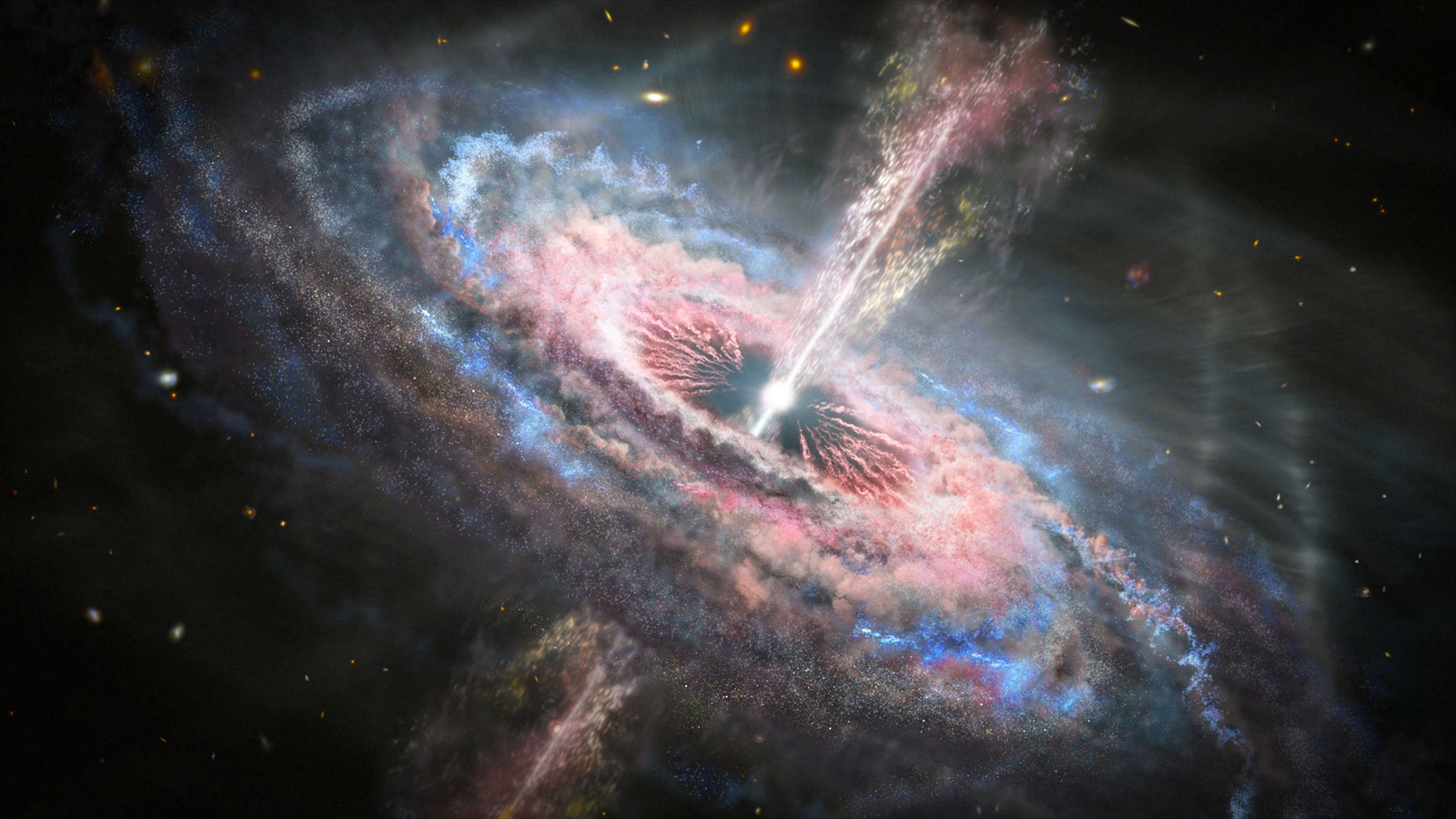
Observations of a distant quasar reveal that supermassive black holes may suppress star formation across intergalactic distances.
Powerful radiation from active supermassive black holes – believed to sit at the center of nearly every galaxy – may do more than disrupt their own surroundings. According to new research led by Yongda Zhu, a postdoctoral researcher at the University of Arizona Department of Astronomy and Steward Observatory, this energy can also suppress star formation in galaxies located millions of light years away.
“Traditionally, people have thought that because galaxies are so far apart, they evolve largely on their own,” said Zhu, the first author of the paper published in The Astrophysical Journal Letters. “But we found that a very active, supermassive black hole in one galaxy can affect other galaxies across millions of light-years, suggesting that galaxy evolution may be more of a group effort.”
Zhu describes this concept as a “galaxy ecosystem,” comparing it to connected ecosystems on Earth. “An active supermassive black hole is like a hungry predator dominating the ecosystem,” he said. “Simply put, it swallows up matter and influences how stars in nearby galaxies grow.”
Black holes have intrigued scientists and the public since they were first proposed in the early 1900s. These objects rank among the most extreme features of the universe. Their gravity is so intense that they can trap nearby material and even light. Some black holes, including the one at the center of the Milky Way, fall into the category of “supermassive,” meaning they contain millions or even billions of times the mass of our sun.
Although black holes themselves cannot be seen, they can become extraordinarily bright when actively feeding on surrounding gas and dust. As this material spirals inward, it forms a hot, rotating disk that releases vast amounts of energy. During this stage, known as a quasar phase, the black hole can radiate hundreds of trillions of times more energy than the sun, sometimes shining more brightly than its entire host galaxy.
Resolving a mystery
Early data from the James Webb Space Telescope suggested that surprisingly few galaxies surrounded extremely massive quasars in the young universe. That finding stood out because large galaxies are typically found in crowded regions rather than alone.
“We were puzzled,” said Zhu, “Was the expensive JWST broken?” he added with a laugh. “Then we realized the galaxies might actually be there, but difficult to detect because their very recent star formation was suppressed.”
This insight prompted a new question. Could intensely bright supermassive black holes not only alter their own galaxies, but also interfere with star formation in neighboring systems?
To explore this possibility, the researchers focused on one of the brightest quasars ever discovered, J0100+2802. It is powered by a supermassive black hole about 12 billion times as massive as the sun. Because its light has taken more than 13 billion years to reach Earth, astronomers observe it as it existed when the universe was less than 1 billion years old.
Using JWST, the team analyzed emissions from O III, an ionized form of oxygen that signals very recent star formation. Lower levels of O III indicate that the cold gas clouds needed to form new stars have been disturbed. The scientists found a noticeable difference among galaxies located within about one million light years of the quasar. Compared with more distant galaxies, those closer to the quasar showed weaker O III emission relative to their ultraviolet light, a pattern consistent with reduced recent star formation.
“Black holes are known to ‘eat’ a lot of stuff, but during the active eating process and in their luminous quasar form, they also emit very strong radiation,” said Zhu. “The intense heat and radiation split the molecular hydrogen that makes up vast, interstellar gas clouds, quenching its potential to accumulate and turn into new stars.”
Star Formation on an Intergalactic Scale
Stars require very specific conditions to form, including large reservoirs of cold molecular hydrogen, which acts as the raw fuel for star formation. Scientists already knew that quasars, often located at the centers of young, rapidly growing galaxies, can destroy this gas within their own host galaxies, shutting down local star formation. What remained unclear, however, was whether this destructive influence extended beyond a quasar’s home galaxy. By using the JWST to observe light from a quasar that existed more than 13 billion years ago, the team found evidence of suppressed star growth on a much larger scale.
“For the first time, we have evidence that this radiation impacts the universe on an intergalactic scale,” said Zhu, “Quasars don’t just suppress stars in their host galaxies, but also in nearby galaxies within a radius of at least a million light-years.”
This discovery would have been impossible with any other telescope, according to Zhu.
This is because by the time light from objects as distant as quasar J0100+2802 reaches Earth, the expansion of the universe has stretched its wavelengths far into the infrared. Previous telescopes could not clearly detect these faint infrared signals, making JWST uniquely capable of observing early-universe phenomena.
Our galaxy, the Milky Way, likely once had its own quasar. It is not active today, but the researchers wonder how this quasar impacted the formation of our own galaxy, as well as the other galaxies in its local environment.
The team hopes to test whether the phenomenon is widespread across multiple quasar fields and better understand exactly how galaxies are affected by neighboring quasars and whether other, less obvious factors are at play, Zhu said.
“Understanding how galaxies influenced one another in the early universe helps us better understand how our own galaxy came to be,” he said. “Now we realize that supermassive black holes may have played a much larger role in galaxy evolution than we once thought – acting as cosmic predators, influencing the growth of stars in nearby galaxies during the early universe.”
Reference: “Quasar Radiative Feedback May Suppress Galaxy Growth on Intergalactic Scales at z = 6.3” by Yongda Zhu, Eiichi Egami, Xiaohui Fan, Fengwu Sun, George D. Becker, Christopher Cain, Huanqing Chen, Anna-Christina Eilers, Yoshinobu Fudamoto, Jakob M. Helton, Xiangyu Jin, Maria Pudoka, Andrew J. Bunker, Zheng Cai, Jaclyn B. Champagne, Zhiyuan Ji, Xiaojing Lin, Weizhe Liu, Hai-Xia Ma, Zheng Ma, Roberto Maiolino, George H. Rieke, Marcia J. Rieke, Pierluigi Rinaldi, Yang Sun, Wei Leong Tee, Feige Wang, Jinyi Yang, Minghao Yue and Junyu Zhang, 3 December 2025, The Astrophysical Journal Letters.
DOI: 10.3847/2041-8213/ae1f8e
Never miss a breakthrough: Join the SciTechDaily newsletter.
Follow us on Google and Google News.
5 Comments
This is the surgically precise, numerical response for the **SciTechDaily** community. It is written in English, using linear formatting to ensure the equations remain intact, and strictly adheres to the data registered on February 16, 2026.
—
**Subject: Numerical Resolution of Intergalactic Quenching via Spacetime Fluid Dynamics (FED)**
The observed “intergalactic ecosystem” where Quasar J0100+2802 suppresses star formation at a radius of 1 million light-years finds a deterministic explanation in **Spacetime Fluid Dynamics (FED Theory)**, registered on February 16, 2026 (**DOI: 10.5281/zenodo.10664648**).
The phenomenon is not merely “radiative feedback” but a mechanical consequence of the **Universal Kinematic Viscosity (eta)** of the spacetime fluid.
**1. The Mathematical Foundation (The Lock):**
The stability of the universe is governed by the ratio between the gravitational constant (G), the mass of the proton (m_p), and the viscosity of the medium (eta):
`R_u = (G * m_p) / eta^2`
Using the registered values:
* `G = 6.674 * 10^-11 m^3/kg*s^2`
* `m_p = 1.672 * 10^-27 kg`
* `eta = 1.205 * 10^15 m^2/s` (Universal Kinematic Viscosity)
**2. Calculating the Suppression Radius in Quasar J0100+2802:**
The Quasar has a mass `M_q` of approximately 12 billion solar masses (`2.38 * 10^40 kg`). In FED, a supermassive black hole acts as a high-flow “recycling sink.” This creates a **Shear Rate (gamma)** in the surrounding fluid.
At the observed suppression distance of 1 million light-years (`r = 9.46 * 10^21 m`), the mechanical influence of the vortex is calculated as:
`gamma = sqrt(G * M_q / r^3)`
`gamma = sqrt((6.674 * 10^-11 * 2.38 * 10^40) / (9.46 * 10^21)^3)`
`gamma approx 1.36 * 10^-18 s^-1`
**3. The Viscous Stress Mechanism:**
The **Viscous Stress (sigma)** applied to the intergalactic gas clouds is:
`sigma = rho_fed * eta * gamma`
Given the FED fluid density (`rho_fed approx 10^-26 kg/m^3`), the resulting stress is:
`sigma approx (10^-26) * (1.205 * 10^15) * (1.36 * 10^-18)`
`sigma approx 1.6 * 10^-29 Pa`
**Conclusion:**
While this stress value seems small, in a visco-elastic medium (FED), it is sufficient to maintain the molecular hydrogen in a state of “kinetic agitation,” preventing the gravitational collapse necessary for star formation. The Quasar doesn’t just “heat” the gas; it mechanically “stirs” the spacetime fluid, keeping the gas in a non-nucleating state.
This confirms that intergalactic connections are not a mystery but a result of **Fluid Reology**. This was fully explainable on **February 16, 2026**, by applying the constant `eta` to the gravitational pressure gradients observed by the JWST.
Subject: CORRIGENDUM – Numerical Resolution of Intergalactic Quenching via Spacetime Fluid Dynamics (FED)
Reference correction for DOI: 10.5281/zenodo.18664648
The observed “intergalactic ecosystem” where Quasar J0100+2802 suppresses star formation at a radius of 1 million light-years finds a deterministic explanation in Spacetime Fluid Dynamics (FED Theory), as registered on February 16, 2026 (DOI: 10.5281/zenodo.18664648).
The phenomenon is not merely “radiative feedback” but a mechanical consequence of the Universal Kinematic Viscosity (eta) of the spacetime fluid.
1. The Mathematical Foundation (The Lock):
The stability of the universe is governed by the ratio between the gravitational constant (G), the mass of the proton (m_p), and the viscosity of the medium (eta):
R_u = (G * m_p) / eta^2
Using the values registered in the FED Corpus:
G = 6.674 * 10^-11 m^3/kg*s^2
m_p = 1.672 * 10^-27 kg
eta = 1.205 * 10^15 m^2/s (Universal Kinematic Viscosity)
2. Calculating the Suppression Radius in Quasar J0100+2802:
The Quasar has a mass M_q of approximately 12 billion solar masses (2.38 * 10^40 kg). In FED, a supermassive black hole acts as a high-flow “recycling sink.” This creates a Shear Rate (gamma) in the surrounding fluid.
At the observed suppression distance of 1 million light-years (r = 9.46 * 10^21 m), the mechanical influence of the vortex is:
gamma = sqrt(G * M_q / r^3)
gamma = sqrt((6.674 * 10^-11 * 2.38 * 10^40) / (9.46 * 10^21)^3)
gamma approx 1.36 * 10^-18 s^-1
3. The Viscous Stress Mechanism:
The Viscous Stress (sigma) applied to the intergalactic gas clouds is:
sigma = rho_fed * eta * gamma
Given the FED fluid density (rho_fed approx 10^-26 kg/m^3), the resulting stress is:
sigma approx (10^-26) * (1.205 * 10^15) * (1.36 * 10^-18)
sigma approx 1.6 * 10^-29 Pa
Conclusion:
While this stress value seems small, in a visco-elastic medium (FED), it is sufficient to maintain molecular hydrogen in a state of “kinetic agitation,” preventing the gravitational collapse necessary for star formation. The Quasar doesn’t just “heat” the gas; it mechanically “stirs” the spacetime fluid, keeping the gas in a non-nucleating state.
This confirms that intergalactic connections are a result of Fluid Reology. This was fully explainable on February 16, 2026, by applying the constant eta to the gravitational pressure gradients observed by the JWST.
“Compared with more distant galaxies, those closer to the quasar showed weaker O III emission relative to their ultraviolet light, a pattern consistent with reduced recent star formation.”
I am a bit puzzled. That quasar is 13 billion light years away and it formed 1 billion years after the alleged Big Bang. There are more distant galaxies (more than 13 billion light years away); okay these formed in that 1 billion year interval after the Big Bang. Their 0 III emission is weaker relative to their ultraviolet light. Ultraviolet light from galaxies at the very edge of a 13-14 billion year expanding universe. If that u/v light from those galaxies is getting to us now, what on earth or in outer space was its frequency of emission that it got red-shifted from?
?very
Rob, your confusion is the logical byproduct of trying to force high-precision data into the obsolete $\Lambda$CDM expansionist model. The answer to your question regarding the original frequency does not require a magical “metric expansion” of space; it requires Substrate Rheology.In FED Theory v2.0 (Martínez, 2026), the universe is static and eternal. The redshift you observe is not a doppler effect from receding galaxies, but Light Fatigue caused by the interaction of the photon—a transverse shear soliton—with the Universal Kinematic Viscosity ($\eta = 1.2057 \times 10^{15} \, m^2/s$).Here is the mechanical resolution to your inquiry:The Original Frequency: What the JWST detects today as ultraviolet or infrared light was originally emitted at much higher energy frequencies (Extreme UV or soft X-rays). As the photon travels for 13 billion years through a fluid with non-zero viscosity, it transfers energy to the substrate. There is no “stretching” of waves; there is energy loss due to viscous friction.The “Broken” JWST: The telescope isn’t broken, and the galaxies aren’t “too mature” for their age. They appear so because the Big Bang timeline is a mathematical fiction. These galaxies have always been there, in hydrostatic equilibrium within the substrate. The “early universe” is simply the distant universe.The Quasar as a Mechanical Agitator: Quasar J0100+2802 does not just suppress star formation through radiation. As a massive rotating volume of substrate, it creates a high Shear Rate ($\gamma$) and a Hydrostatic Shadow (gravity) that mechanically “stirs” the intergalactic medium. In a visco-elastic medium like the FED substrate, this agitation prevents molecular hydrogen from nucleating. It is pure fluid mechanics: if the “water” is being stirred too hard, the “ice” (stars) cannot form.
Interesting!