

Using the Keck I Telescope, a team of astronomers viewed part of the network of filaments thought to connect galaxies in a cosmic web.
Astronomers have discovered a distant quasar illuminating a vast nebula of diffuse gas, revealing for the first time part of the network of filaments thought to connect galaxies in a cosmic web. Researchers at the University of California, Santa Cruz, led the study, published January 19 in Nature.
Using the 10-meter Keck I Telescope at the W. M. Keck Observatory in Hawaii, the researchers detected a very large, luminous nebula of gas extending about 2 million light-years across intergalactic space.
“This is a very exceptional object: it’s huge, at least twice as large as any nebula detected before, and it extends well beyond the galactic environment of the quasar,” said first author Sebastiano Cantalupo, a postdoctoral fellow at UC Santa Cruz.
The standard cosmological model of structure formation in the universe predicts that galaxies are embedded in a cosmic web of matter, most of which (about 84 percent) is invisible dark matter. This web is seen in the results from computer simulations of the evolution of structure in the universe, which show the distribution of dark matter on large scales, including the dark matter halos in which galaxies form and the cosmic web of filaments that connect them. Gravity causes ordinary matter to follow the distribution of dark matter, so filaments of diffuse, ionized gas are expected to trace a pattern similar to that seen in dark matter simulations.
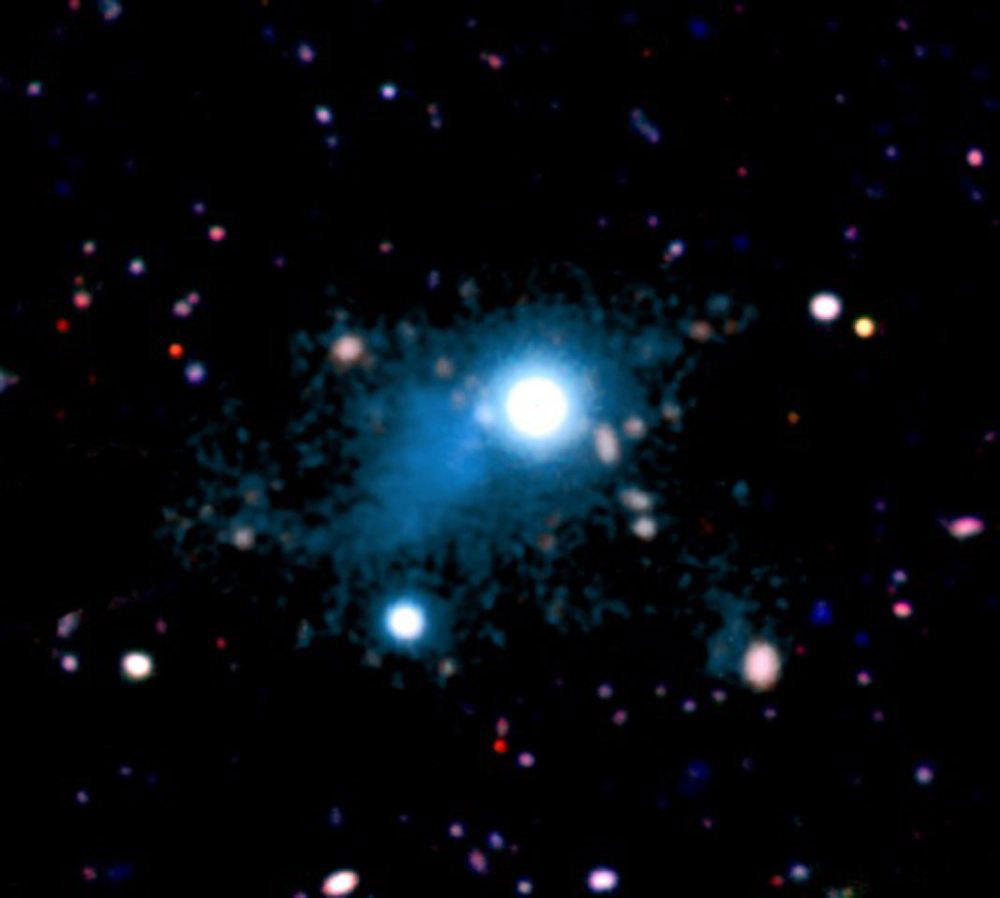
Until now, however, these filaments have never been seen. Intergalactic gas has been detected by its absorption of light from bright background sources, but those results don’t reveal how the gas is distributed. In this study, the researchers detected the fluorescent glow of hydrogen gas resulting from its illumination by intense radiation from the quasar.
“This quasar is illuminating diffuse gas on scales well beyond any we’ve seen before, giving us the first picture of extended gas between galaxies. It provides a terrific insight into the overall structure of our universe,” said coauthor J. Xavier Prochaska, professor of astronomy and astrophysics at UC Santa Cruz.
The hydrogen gas illuminated by the quasar emits ultraviolet light known as Lyman alpha radiation. The distance to the quasar is so great (about 10 billion light-years) that the emitted light is “stretched” by the expansion of the universe from an invisible ultraviolet wavelength to a visible shade of violet by the time it reaches the Keck Telescope. Knowing the distance to the quasar, the researchers calculated the wavelength for Lyman alpha radiation from that distance and built a special filter for the telescope’s LRIS spectrometer to get an image at that wavelength.
“We have studied other quasars this way without detecting such extended gas,” Cantalupo said. “The light from the quasar is like a flashlight beam, and in this case, we were lucky that the flashlight is pointing toward the nebula and making the gas glow. We think this is part of a filament that may be even more extended than this, but we only see the part of the filament that is illuminated by the beamed emission from the quasar.”
A quasar is a type of active galactic nucleus that emits intense radiation powered by a supermassive black hole at the center of the galaxy. In an earlier survey of distant quasars using the same technique to look for glowing gas, Cantalupo and others detected so-called “dark galaxies,” the densest knots of gas in the cosmic web. These dark galaxies are thought to be either too small or too young to have formed stars.
“The dark galaxies are much denser and smaller parts of the cosmic web. In this new image, we also see dark galaxies, in addition to the much more diffuse and extended nebula,” Cantalupo said. “Some of this gas will fall into galaxies, but most of it will remain diffuse and never form stars.”
The researchers estimated the amount of gas in the nebula to be at least ten times more than expected from the results of computer simulations. “We think there may be more gas contained in small dense clumps within the cosmic web than is seen in our models. These observations are challenging our understanding of intergalactic gas and giving us a new laboratory to test and refine our models,” Cantalupo said.
In addition to Cantalupo and Prochaska, the coauthors of the paper include Piero Madau, professor of astronomy and astrophysics at UC Santa Cruz, and Fabrizio Arrigoni-Battaia and Joseph Hennawi at the Max Planck Institute for Astronomy in Heidelberg, Germany. This research was supported by grants from the National Science Foundation (AST-1010004, OIA-1124453) and NASA (NNX12AF87G).
Reference: “A cosmic web filament revealed in Lyman-α emission around a luminous high-redshift quasar” by Sebastiano Cantalupo, Fabrizio Arrigoni-Battaia, J. Xavier Prochaska, Joseph F. Hennawi and Piero Madau, 19 January 2014, Nature.
DOI: 10.1038/nature12898
arXiv:1401.4469
Never miss a breakthrough: Join the SciTechDaily newsletter.
Follow us on Google and Google News.
1 Comment
If lumps of Dark Matter can blow out galaxies into speeding galaxies apart, then some pieces of Dark Matter can also throw some cosmic web on other gases and star clusters. Dark Matter is not uniformly distributed in the cosmos, but lies here and there in a random manner and they can be found inside a galaxy also near the Black hole at their center or even at the center of the stars or sun to keep their spherical shape from collapsing,since they have to blow out to be a red giant in their terminal days. Dark Matter is a machinery like heart beat of the galaxies and universe spinning around the matter-real found everywhere. Until we find the texture of the Dark Matter our probe is not complete and our understanding of Physics is also inconclusive. But, for this matter, we cannot do away with the concept of Dark Matter altogether because gravity alone is a peanut in the Universal forces to describe. Thank You.