
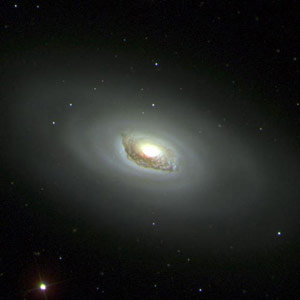
Newly published research reveals that dark matter is being swallowed up by dark energy, offering novel insight into the nature of dark matter and dark energy and what the future of our Universe might be.
Researchers in Portsmouth and Rome have found hints that dark matter, the cosmic scaffolding on which our Universe is built, is being slowly erased, swallowed up by dark energy.
The findings appear in the journal Physical Review Letters, published by the American Physical Society. In the journal cosmologists at the Universities of Portsmouth and Rome, argue that the latest astronomical data favors a dark energy that grows as it interacts with dark matter, and this appears to be slowing the growth of structure in the cosmos.
Professor David Wands, Director of Portsmouth’s Institute of Cosmology and Gravitation, is one of the research team.
He said: “This study is about the fundamental properties of space-time. On a cosmic scale, this is about our Universe and its fate.
“If the dark energy is growing and dark matter is evaporating we will end up with a big, empty, boring Universe with almost nothing in it.
“Dark matter provides a framework for structures to grow in the Universe. The galaxies we see are built on that scaffolding and what we are seeing here, in these findings, suggests that dark matter is evaporating, slowing that growth of structure.”
Cosmology underwent a paradigm shift in 1998 when researchers announced that the rate at which the Universe was expanding was accelerating. The idea of a constant dark energy throughout space-time (the “cosmological constant”) became the standard model of cosmology, but now the Portsmouth and Rome researchers believe they have found a better description, including energy transfer between dark energy and dark matter.
Research students Valentina Salvatelli and Najla Said from the University of Rome worked in Portsmouth with Dr Marco Bruni and Professor Wands, and with Professor Alessandro Melchiorri in Rome. They examined data from a number of astronomical surveys, including the Sloan Digital Sky Survey, and used the growth of structure revealed by these surveys to test different models of dark energy.
Professor Wands said: “Valentina and Najla spent several months here over the summer looking at the consequences of the latest observations. Much more data is available now than was available in 1998 and it appears that the standard model is no longer sufficient to describe all of the data. We think we’ve found a better model of dark energy.
“Since the late 1990s astronomers have been convinced that something is causing the expansion of our Universe to accelerate. The simplest explanation was that empty space – the vacuum – had an energy density that was a cosmological constant. However there is growing evidence that this simple model cannot explain the full range of astronomical data researchers now have access to; in particular the growth of cosmic structure, galaxies and clusters of galaxies, seems to be slower than expected.”
Professor Dragan Huterer, of the University of Michigan, has read the research and said scientists need to take notice of the findings.
He said: “The paper does look very interesting. Any time there is a new development in the dark energy sector we need to take notice since so little is understood about it. I would not say, however, that I am surprised at the results, that they come out different than in the simplest model with no interactions. We’ve known for some months now that there is some problem in all data fitting perfectly to the standard simplest model.”
Reference: “Indications of a Late-Time Interaction in the Dark Sector” by Valentina Salvatelli, Najla Said, Marco Bruni, Alessandro Melchiorri and David Wands, 30 October 2014, Physical Review Letters.
DOI: 10.1103/PhysRevLett.113.181301
Never miss a breakthrough: Join the SciTechDaily newsletter.
Follow us on Google and Google News.
6 Comments
It is known that dark matter particles, whatever they are, self-annihilate. So the total amount of dark matter is decreasing over time, assuming no other process produces dark matter. Would this natural decrease be augmented by dark energy increasing? One consequence is that galaxies would lose some of their cohesion as dark matter is disappearing. Eventually, the only thing keeping large structures together would be whatever matter is left. Most interesting.
Is this a case of a hypothetical battle between a hypothetical irresistible force (dark energy) and a hypothetical immovable object (dark matter)?
[He says, with tongue planted firmly in cheek!]
We are in the dark as to whether it matters, hypothetically speaking.
Atlas replaced Jörmunger, now he’s decaying, rebirth is next
Einstein compromised the special relativity energy calculation in order to preserve the principle of energy conservation. He assumed energy conservation is fundamental and necessary. However, the corrected relativity form proposed by Osiak, that doesn’t conserve energy, conserves something else that’s more fundamental and important, and can account for all phenomena that are constrained by energy conservation considerations in traditional relativistic physics. That leaves unconserved energy in relativistic collisions to fuel cosmic inflation in the very hot early universe and a continuing lesser, decaying expansion to the present.
https://www.youtube.com/watch?v=j1FhR34Awe0&t=46s
Cosmologists can assess viability of the corrected relativity dark energy model by simply modifying the relativistic energy formula in early-universe and other large-scale cosmological computer models. Also, there is a low-cost table-top experiment that determine whether the traditional or proposed corrected relativistic energy expressions is correct.
Dark matter is understandable in the corrected relativity framework as a difference of inertial and gravitational mas. This difference can arise only in the corrected relativity framework and if the Harari and Shupe model of quarks and leptons and bosons as matter-antimatter composite objects (of “preons”) is correct. Validating the corrected relativity version will make the Harari-Shupe theory more plausible and possibly lead to new approaches for detecting preons. Rough calculation of the the amount of dark matter expected according to the Harari-Shupe-Osiak model can be easily done and obtain good agreement with observations. https://www.youtube.com/watch?v=g7I52_VpE9A
Dark Matter appears unecessary. Existing physics can replicate Lambda results. All that is required is a change of perspective.